Snappit logo
Snappit
Get App
Generic illustration, not a photograph of this venueIllustration
ParkKR

Hwadamsup

The best way to enjoy Hwadamsup is to leave room for the smaller gardens between the headline views.

About

The best way to enjoy Hwadamsup is to leave room for the smaller gardens between the headline views. A visit can move from the low textures of the Moss Garden to upright birches, then to the sculpted forms of pines and bonsai. The gardens are cultivated collections set within a forest landscape, so their appeal changes well beyond the autumn leaf season. Choose your walking time first, then fit the optional attractions around it. Be ready to snap and learn! Get the Snappit app to identify any nature species you find here.

Hwadamsup opened on June 1, 2013, as an LG Evergreen Foundation arboretum. Its name evokes friendly conversation, an apt idea for a place best enjoyed at walking pace. The foundation describes both public garden visits and ecological restoration research as part of its purpose. Hwadamchae followed on March 29, 2024, introducing the forest through artists’ work.

What to do here

Follow the signed garden circuit, spending longer in the areas that interest you. The [official themed-garden guide](https://www.hwadamsup.com/pc/ko/info/themeone) lets you preview the stops. Hwadamchae adds an art-focused introduction; the monorail offers either a shorter ascent or a full scenic circuit.

Seasonal info

For 2026, the announced autumn peak booking period is October 23–November 15. Check the dated hours below before choosing your entry slot. Winter arrangements need a separate seasonal check; do not assume the full walking circuit or monorail will operate.

Accessibility

The garden routes are designed for wheelchairs and strollers, with some slopes and narrow stretches. Bring your own equipment: rentals are unavailable. If independent travel on gradients is difficult, discuss your route and boarding needs with the operator before booking.

Don't miss

1

Moss and fern gardens for a closer look at forest-floor planting

2

The White Birch Forest and its changing seasonal underplanting

3

Pines and bonsai that reward a slower look at tree form

4

Hwadamchae for a different, art-led view of the forest

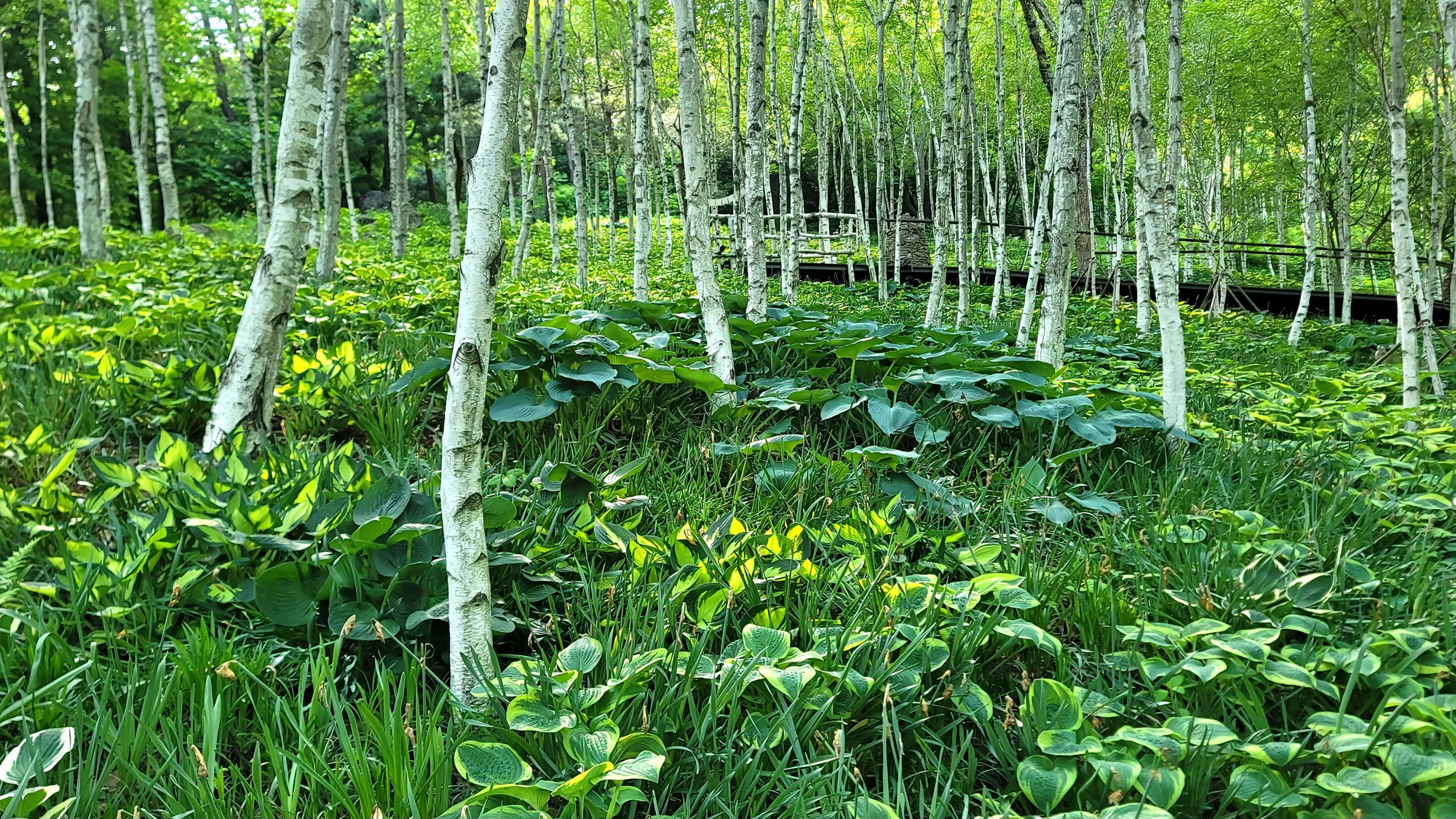
Pale tree trunks rise above dense green groundcover, with a raised wooden walkway behind them.

Green woodland planting at Hwadamsup, photographed on May 13, 2026. The scene records that visit, not current garden conditions.

0014-03-27 (2026-05-13) *Gwangju (Gyeonggi) — Katsujiro Maekawa. Flickr. CC0 1.0. Unchanged original. · Creative Commons 1 · Creative Commons 2

Walks and routes

The garden on foot

For a first visit, make the signed garden circuit your main plan. Use the current visitor map or the garden app for the order of stops, and linger in the Moss Garden, White Birch Forest, Fern Garden, Pine Garden and Bonsai Garden according to your interests. Walking is especially worthwhile if you want close-up plant photographs: you can stop beside the beds without watching the scenery pass from the monorail. The two-hour operator estimate is a starting point; three hours gives you more room to pause.

Follow the signed walking route. Slopes and narrow sections call for care, and the full circuit can still be tiring for someone who finds long walks difficult.


The garden on foot

Platform 1 to 2, then walk

This is the useful compromise if you want a short ride and still intend to explore on foot. The operator gives about five minutes for the ride from platform 1 to 2, then about an hour on foot from the platform 2 exit. Add your own time for garden stops and reaching the platform. Buy the correct sector ticket and be ready at the booked departure; this is not a hop-on, hop-off service.

Check that the remaining walk suits everyone before choosing a one-way ride. A lift uphill does not remove all gradients, and priority seating is limited.

Platform 1 to 2, then walk

A full monorail circuit

The full ride returns to platform 1 in about 20 minutes on a 1.213 km loop. Choose it for a moving overview of the garden when a longer walk is unsuitable, then decide separately how much walking to add. The circuit ticket does not permit getting off midway and reboarding. Keep the distinction clear: 20 minutes is the ride time, not a complete garden visit.

The service is primarily standing, with priority seats. Ask about your wheelchair and boarding needs before purchase; do not assume a seat or a particular mobility-device fit.

A full monorail circuit

A relaxed first visit

Choose a morning garden slot with enough time to arrive unhurried. If you have added Hwadamchae, see it at its booked time, then devote the next part of the visit to the garden walk. Save your longest stops for two or three collections rather than trying to photograph everything. Finish with a drink or meal near the entrance before returning to your transport. This is a suggested order; your ticket times and the day’s route signs come first.

Things to try

Add Hwadamchae before the forest

Hwadamchae is an optional cultural stop that introduces the garden through art. Its published sequence leads through the Object Staircase, Annex, Courtyard, Main Building and rooftop garden before continuing into Hwadamsup. Choose it if you enjoy the relationship between art and landscape, and leave time rather than squeezing it between tight reservations. The media hall and Gallery 1 may close for emergency inspection. Follow exhibit signs on photography; flash is not allowed, and some works may not be photographed.

Make the walk your activity

The garden offers a walking stamp tour, with a souvenir for visitors who complete the required route without riding the monorail. Check the current instructions before starting if the reward matters to you. It can give children a reason to keep exploring, but there is no need to hurry past a garden just to collect the next mark.

Keep a wet-weather version simple

Ordinary rain does not automatically close the garden, but thunder and lightning stop the monorail. Shorten your walk and take breaks if conditions become uncomfortable. If you have a Hwadamchae ticket and its galleries are open, the indoor art visit can be part of a shorter day; its courtyard and rooftop elements are not a wholly indoor substitute. Follow staff instructions if weather worsens.

Wildlife and habitats

Birches

Spring daffodils and later-season lilyturf give the pale-trunked birch planting a changing foreground. The grove is a cultivated collection, with individual labels providing the more precise tree names.

Pines

The Pine Garden brings together trees gathered from around Korea. It is a good stop for the shapes of trunks and branches, especially when you want something other than flowers to be the focus of your visit.

Rhododendrons and azaleas

The spring planting includes jin-dallae and cheoljjuk azaleas. The garden guide points out a useful distinction: jin-dallae flowers before its leaves develop, while cheoljjuk flowers after the leaves appear. Their flowering periods vary with the weather.

Ostrich fern

Ostrich fern is one of the named plants in the woodland Fern Garden. Its feather-like green fronds form clusters, while separate spore-bearing fronds develop later in the year. It makes an appealing summer stop when foliage is the main attraction.

Rose of Sharon

Mugunghwa, Korea’s national flower, has its own collection here, including several named varieties. An individual flower is short-lived, but new flowers open in succession. Weather and variety affect how much is flowering on any particular visit.

Yews

Yews appear among the operator’s listed bonsai subjects. This garden is worth including if you are curious about how the character of a large tree can be suggested in a pot; bonsai is a cultivation art rather than a separate kind of tree.

Stories and discoveries

A garden with a research purpose

The foundation reports about 4,000 native and introduced plant species across 16 themed gardens. Its restoration work gives the place a role beyond seasonal sightseeing; it does not mean rare animals are on guaranteed display.

Trees at very different scales

The operator describes roughly 2,000 birches, 1,300 planted pines and about 550 bonsai displays. Together they make a useful comparison: the broad effect of a grove, the character of individual trees, and the deliberately reduced scale of bonsai. Collection totals can change.

A welcoming house for the forest

Hwadamchae takes its cue from the sarangchae, the part of a traditional house used to receive visitors. That idea helps explain why the art space works as an introduction to the garden rather than a separate destination.

When to visit

Spring and summer choices

In spring, prioritise the azalea planting and the birches with their daffodil underplanting. In summer, give the Hydrangea Garden and Fern Garden more of your time. The hydrangea collection was one of the first gardens created here. Plan around the plants you most want to see, while allowing for weather-driven changes in flowering.

Autumn 2026 hours

Autumn opening hours change mid-season. Through October 22, the notice gives 09:00–18:00 with last entry at 17:00; October 19 is closed. October 23–November 1 opens daily 08:00–18:00, with last entry at 17:00. November 2–15 opens daily 08:00–17:00, with last entry at 16:00. These peak-period Mondays are open. For visits after November 15, confirm the date-specific arrangements directly. Recheck the current monthly notice before travel.

Tickets and prices

The autumn 2026 notice lists garden admission at ₩11,000 for adults, ₩9,000 for seniors and teenagers, and ₩7,000 for children. Hwadamchae is an additional ₩5,000. Monorail fares depend on sector; the full loop is ₩9,000 for adults/seniors/teenagers or ₩7,000 for children. Confirm the age category and final price when booking, and do not assume a seasonal discount applies.

Booking without surprises

Use the official booking link to NOL, where membership and login are required. Select garden admission, then any Hwadamchae or monorail options. Hwadamchae kiosks sell only the day’s remaining quantity; monorail platforms 2 and 3 have their own kiosks. A sold-out add-on does not prevent a garden-only visit if you have garden admission. Review the cancellation terms: garden and Hwadamchae same-day cancellations incur a 30% fee, and a monorail cancellation within two hours of departure or a missed ride is nonrefundable.

Getting there and practical advice

Water, food and breaks

Bring water and use the entrance-area cafés or food outlets for a longer break. The Hwadam Café & Shop is inside, to the right of the main entrance; seed green café and bakery is beside the ticket office. Lockers are available near the ticket office. Benches and rest areas are distributed through the garden.

Family practicalities

Toilets are listed beside the ticket office and Eco Center, as well as at several points inside, including platform 2 and the Pine Garden. A small nursing room is beside the Eco Center. Plan a toilet stop before beginning a long section, especially if you are balancing a timed ride with younger children.

Train and the last leg

Take the Gyeonggang Line to Gonjiam Station, then continue by taxi or the operator-listed Gwangju bus 9. Check the current bus service and return connection before you leave; the station is not the garden gate. The destination is 278-1 Docheokwit-ro, Docheok-myeon, Gwangju, Gyeonggi-do. This is Gwangju in Gyeonggi Province.

Driving and reaching the entrance

Follow parking staff to the designated resort parking areas serving the garden. The free approach lift is separate from the paid monorail inside Hwadamsup. If the lift queue is long, the operator suggests the approximately 400 m approach walk, about 5–10 minutes for an adult. Add congestion and ticket-check time rather than arriving at the car park at your exact reservation time.

Arrange the arrival that works for you

The operator allows wheelchair or stroller passengers to be dropped at the turning area beside the ticket office; the driver then moves the vehicle to parking. Accessible parking below that area requires a disability parking permit. Accessible toilets are listed by the ticket office, beside the Eco Center and at the outdoor learning area. For Hwadamchae, ask staff about an appropriate step-free route before following the published stair-based visitor sequence. Call +82-31-8026-6666 for specific access questions.

Plan beyond the word accessible

A route designed for wheels can still involve sustained effort. Allow extra time, make use of rests and consider assistance if slopes are difficult. Wet surfaces add another reason to slow down. Bring your own wheelchair or stroller, and check monorail arrangements for your particular equipment rather than treating the ride as an automatic solution.

Sources and useful links

Wildlife you might spot

6

Each card links to a full Explore page with photos, traits, and fun facts.

Snap map for this place

Start with the big picture, then zoom in to explore individual wildlife observations around this place.

Loading map…

Good to know before you go

Book through the official website’s NOL link, and keep the live mobile ticket accessible. Do not rely on a screenshot or a resale ticket.

Give parking, the approach to the gate and any lift queue their own time allowance. Your garden entry and monorail departure are separate appointments.

Carry drinking water. There are no drinking fountains inside the garden.

Bring a handheld camera rather than a tripod, and leave drones and collecting equipment at home.

Stay on the paths and let planted beds remain undisturbed. A photograph is a better souvenir than a picked flower.

Frequently asked questions

No. Choose it because the ride or reduced walking suits you. Walking lets you stop at the collections, and the operator says wheelchair and stroller users can tour without taking it.
Plan on advance reservation for garden entry. Limited remaining-ticket sales specifically described by the operator apply to Hwadamchae and monorail services; they are not a dependable garden walk-in option.
No. Hwadamsup admission is required, and Hwadamchae is an optional additional ticket. Include its visit time when arranging a later monorail departure.
Pets are not admitted. The garden etiquette page allows drinks and snacks, but restricts other outside food and picnic mats. Use the designated eating area before entry for a packed meal.
The garden has its own ticketing arrangements. A stay at neighbouring Gonjiam Resort does not replace a Hwadamsup booking.

Recent snaps at this place

Recent snaps will appear here as new observations are added.

View all ›

Take the discovery with you

Exploring Hwadamsup?

Identify the wildlife you spot, learn as you go, and keep a collection of the adventure.

  1. 1Spot it
  2. 2Snap it
  3. 3Keep the discovery