Snappit logo
Snappit
Get App
Generic illustration, not a photograph of this venueIllustration
ParkKR

Korea National Arboretum

The pleasure here is the change of scale: small flowers close to the path, labelled trees worth a second look, then a canopy that makes the gardens feel part of a much larger forest.

About

The pleasure here is the change of scale: small flowers close to the path, labelled trees worth a second look, then a canopy that makes the gardens feel part of a much larger forest. You can spend a whole morning following a botanical interest, or choose one woodland walk and leave plenty of time to sit. Start with the visitor map and decide what matters most to your group. A shorter visit with time to read labels is often more satisfying than trying to tick off every collection. Explore the grounds like a pro—download the Snappit app to instantly identify animals and plants.

The forest’s protection reaches back to 1468, when the royal tomb of King Sejo was established at Gwangneung. The public arboretum opened in 1987 and became Korea National Arboretum in 1999. In 2010, the wider Gwangneung Forest landscape received UNESCO biosphere-reserve designation. That long history helps explain the emphasis on conservation alongside public enjoyment. [Institutional chronology](https://www.forest.go.kr/newkfsweb/cmm/fms/BoardFileDown.do?atchFileId=FILE_000000000684654&bbsId=&dwldHistYn=&fileSn=0&fn=2015+%EA%B5%AD%EB%A6%BD%EC%88%98%EB%AA%A9%EC%9B%90+%EC%97%B0%EB%B3%B4.pdf)

What to do here

Make one of the arboretum’s themed walks the backbone of your day, then add the Aquatic Plant Garden or a pause by Yukrim Lake. The fir-forest walk suits a quieter outing; the rare-and-medicinal-plant theme rewards visitors curious about botany. Families can choose the plant-evolution theme and leave room for hands-on activities when offered.

Seasonal info

Look low for early spring flowers, favour shaded walks in summer, and save time for foliage beside the lake in autumn. Winter brings clearer views of trunks and conifers, alongside shorter opening hours and additional Sunday closures.

Accessibility

The Conifer Garden has a purpose-built barrier-free observation deck, but that does not establish a step-free route through the whole arboretum. Ask for the best current approach, accessible toilets and any construction diversions before setting out. Wheelchair loans are limited; bring your own if essential.

Don't miss

1

A quiet woodland focus on the official Healing Fir Forest Walk.

2

Plant collections that turn an ordinary stroll into a botany lesson.

3

Yukrim Lake and the nearby Conifer Garden observation deck.

4

Seasonal discoveries, from small spring flowers to autumn leaves.

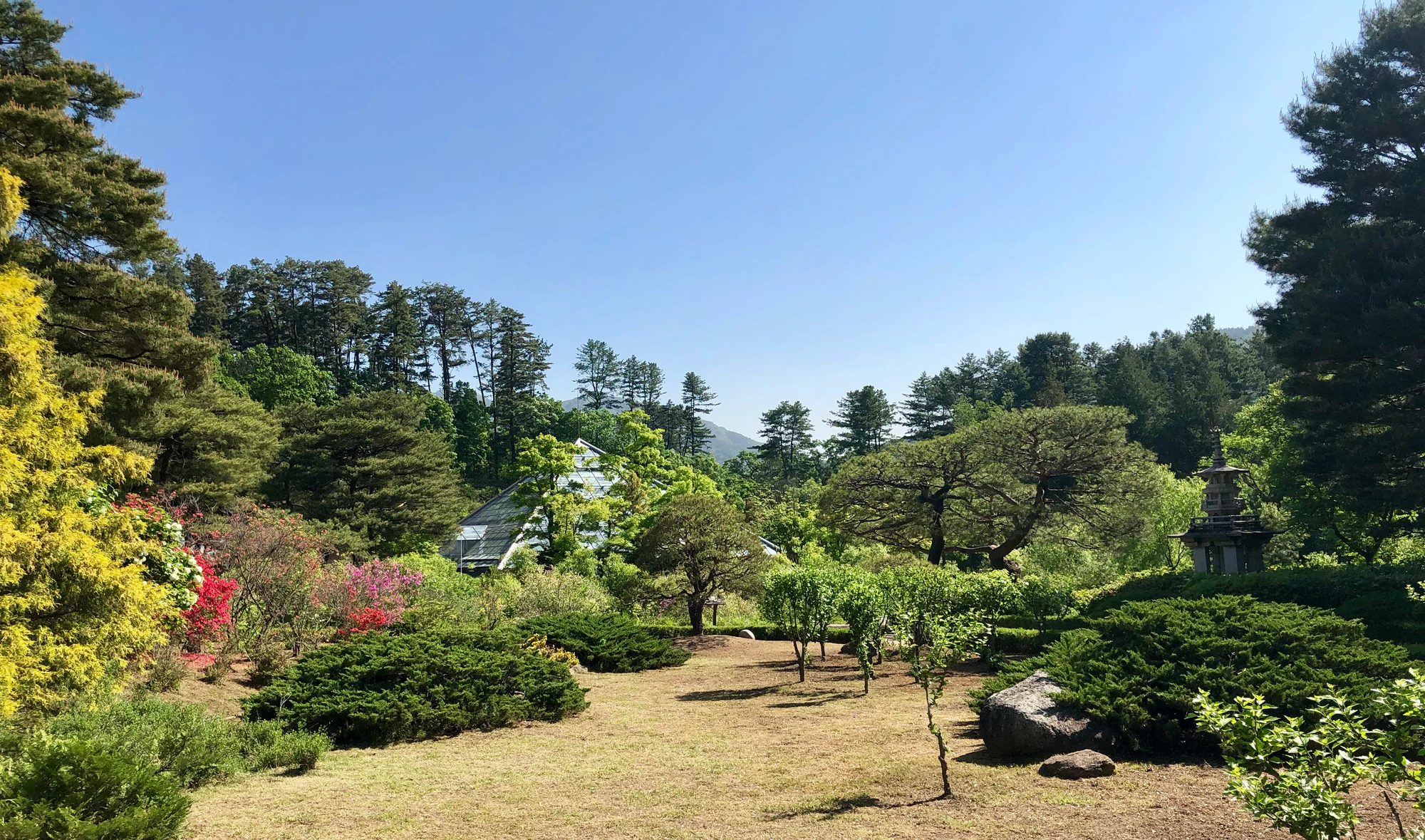
Cultivated trees, colourful flowering shrubs and lawn beneath a blue sky, with tall woodland behind, a partly visible glass roof and a stone garden structure.

Trees, flowering shrubs and open lawn at Korea National Arboretum, photographed on 21 May 2019.

[Korea National Arboretum](https://www.flickr.com/photos/col_and_tasha/47938295986/) by [Natasha de Vere (Disgwylfa)](https://www.flickr.com/photos/col_and_tasha/), [CC BY 2.0](https://creativecommons.org/licenses/by/2.0/deed.en). Unmodified. · Creative Commons 1 · Creative Commons 2

Walks and routes

Healing Fir Forest Walk

Choose this official theme when the trees themselves are the main attraction. Give yourself permission to walk slowly through the tall fir setting and spend less time moving between collections. Start by locating the route on the current visitor map, then follow signed public paths and any diversions. A quiet woodland pause works well before returning to the more detailed garden displays. Official fir-forest walk


Healing Fir Forest Walk

Rare and Medicinal Plant Walk

This is the official themed choice for a closer look at plants and their uses. Read the labels, compare plants that look similar and take photographs to follow up at home. A medicinal label is a starting point for learning, never an invitation to taste or collect. You do not need to identify everything: choosing a few memorable plants is enough to make the walk rewarding. Official rare-and-medicinal walk

Rare and Medicinal Plant Walk

Conifer Garden observation deck

Opposite Yukrim Lake, this short deck lets you concentrate on the conifer collection. The rebuilt observation path is 172 metres long and 1.5 metres wide, designed for barrier-free use including wheelchairs and pushchairs. Treat that measurement as the deck length, not the distance from the entrance. Ask about the current approach if steps, gradients or walking distance affect your plans, and allow others room to pass when you stop.

Conifer Garden observation deck

About 90 minutes: keep it compact

Choose a small set of display gardens after looking at the entrance map. Spend time with the labels and seasonal plants instead of aiming for the farthest woodland section. With children or limited energy, make one good stop and one rest the plan. Allow for the return to the gate within your own pace and parking period.

About three hours: gardens and woodland

Give the first part of the visit to the collections that catch your eye, then make the fir-forest theme or the lake and Conifer Garden your main focus. Take a proper break before heading back. Use the map to choose connecting public paths; this is a flexible selection of places, not a prescribed circuit with turn-by-turn directions.

Half a day: follow your curiosity

If you like reading labels or photographing plants, leave time to revisit one collection after a guided session. Bring a packed meal for the designated area and add another garden only if you still feel fresh. Choose a visit and transport arrangement that genuinely allows this much time, rather than overrunning a reserved parking slot.

Things to try

Join an interpretation session

Ask at the interpretation centre about the day’s garden walks and available places. A guide can make familiar-looking trees much more interesting and help you choose what to revisit afterwards. Check the language and meeting point before signing up; do not build your whole visit around an unconfirmed departure time.

Make plant evolution a family theme

The arboretum offers an official plant-evolution walk for families. Use it as a way to compare very different plant forms rather than turn the day into a test of names. Let children choose a favourite leaf shape or tree, then leave time for a break. Stay on the paths and keep hands off planted beds.

A small-plant exhibition for autumn 2026

The Children’s Garden hosts “Small but Great Beings, Weeds” from 30 September to 29 November 2026. Botanical drawings, woodblock rubbings and layered stamping encourage a closer look at easily overlooked plants. It is a useful extra for families visiting during those dates; check activity availability on arrival. Exhibition announcement

When the weather turns

In light rain, a shorter garden visit may still work with waterproof footwear and a jacket. During the museum closure, do not count on it as an indoor refuge. Ask about any greenhouse or indoor session you particularly want before travelling. Strong wind or heavy rain can restrict access or close the arboretum; in severe weather, postponing is the better plan.

Wildlife and habitats

Dawn redwood: a deciduous conifer

Dawn redwood, Metasequoia glyptostroboides, was recorded in the cultivated display gardens during an interpreted visit in 2024. Its soft, feather-like foliage is a useful reminder that not every conifer stays green all year. Look for a labelled specimen and compare the paired leaves along a small branch without handling it. The foliage turns colour in autumn before the tree loses its leaves.

Baldcypresses in the Aquatic Plant Garden

A 2010 arboretum account describes a large cultivated baldcypress in the Aquatic Plant Garden. The relationship between trees and wet ground is part of the interest here. Look for plant labels and enjoy the view from the path; staff can help you locate the garden’s current labelled trees.

Stories and discoveries

Why the surrounding forest matters

A biosphere reserve has different zones, balancing protection with research and human activity. Gwangneung’s protected forest gives the arboretum a setting with much more ecological history than a newly made garden. The best way to appreciate that relationship is to enjoy the authorised woodland paths while leaving the undisturbed areas undisturbed.

When to visit

Spring: start with the small flowers

Early spring can be rewarding well before the trees are fully in leaf. The arboretum reported its Korean endemic Eranthis byunsanensis flowering in the display gardens in March 2026. Treat that as an example of the season, not a fixed annual flowering date. Keep to the path even when the best flowers are tiny and tempting to photograph up close.

Summer: shade, water and a slower pace

Make shaded woodland your main outing and use the Aquatic Plant Garden as a contrasting stop. Carry water, take breaks and keep the plan short enough to change if heavy rain arrives. Bright, open garden sections and humid woodland can feel very different on the same day.

Autumn: leave time beside Yukrim Lake

Foliage is part of the attraction around the lake, with the mixture of trees giving you more than one colour or leaf shape to enjoy. Use recent arboretum updates to choose a date if peak colour matters. Fallen leaves can hide wet patches on paths and decks, so a slower walk is sensible after rain.

Winter: trunks, branches and conifers

Choose a clear day for tree shapes and evergreen foliage, and dress for a largely outdoor visit. Check the shorter seasonal hours and winter Sunday closures before travelling. Where ice or snow affects footing, use staff advice to choose a smaller outing rather than insisting on a particular woodland path.

Getting there and practical advice

Important for visits in 2026

The Forest Museum is closed for remodelling from 18 May through December 2026. The closure includes its library, special exhibition room, nursing room and other internal amenities; nearby visitor circulation is also restricted. Plan an outdoor garden visit and check the museum notice for any change or reopening announcement.

Opening hours and admission

Practical information checked on 18 October 2026. Opening is 09:00–18:00 from April to October, with last admission at 17:00; from November to March it is 09:00–17:00, with last admission at 16:00. Regular closures are Mondays, 1 January, the Seollal and Chuseok holiday periods, and Sundays in December, January and February. Additional closures can be announced. Standard admission is KRW 1,000 for adults, KRW 700 for the youth category and KRW 500 for children. Check category eligibility and bring evidence for any concession. Visitor information and fees

An easy start and a proper break

Use the visitor information point to check diversions and ask what is looking good that day. A packed meal at the Rest Plaza makes it easier to stay unhurried. There is also a café by Yukrim Lake, but bring water and a snack rather than relying on its opening hours. If you need a nursing room or a particular toilet facility, ask at the entrance before choosing your walk.

Arriving by car

Reserve every vehicle through the official booking service; only reserved vehicles may enter the car park. The site states that booking opens at midnight, Korean time, 30 days before the visit. Follow the entry and exit period shown on your confirmation. Parking is paid separately on the day; the listed ordinary small-car charge is KRW 3,000. Use the visitor entrance at 415 Gwangneungsumogwon-ro, Sohol-eup, Pocheon-si, unless your reservation directs you to another car park.

Extra weekend parking in autumn 2026

From 3 October through the end of November 2026, 88 spaces at the research-building car park are available by reservation on Saturdays and Sundays. Allow about 15 minutes to walk along the deck path to the main gate. The research building itself remains closed to visitors. Check which car park your booking names before driving there. Autumn parking arrangements

Coming without a car

Visitors arriving on foot or by public transport can buy tickets on arrival without a reservation, subject to the daily 4,500-person limit. Bus 21 is a public-transport option from the Uijeongbu Station area and serves the arboretum. Check the current boarding stop, direction, timetable and return journey in a live transit service before leaving; allow room for waiting rather than planning around a tight connection.

Plan the whole journey, including the car park

For a wheelchair or pushchair visit, ask staff to connect suitable sections into a manageable outing. The accessible design of one deck does not describe every connecting path. The temporary research-building parking option adds a walk before admission, so confirm whether it meets your needs. Check seating and toilet locations at the start, and shorten the visit if rain, wet leaves or fatigue make moving around harder.

Sources and useful links

Wildlife you might spot

2

Each card links to a full Explore page with photos, traits, and fun facts.

Snap map for this place

Start with the big picture, then zoom in to explore individual wildlife observations around this place.

Loading map…

Good to know before you go

Choose your main walk before setting off, and keep the visitor map handy at junctions.

Bring comfortable walking shoes, drinking water and a layer for shaded areas.

Photograph plant labels as well as the plants so you can check names later.

Keep paths clear when stopping for photographs, especially on narrow decks.

Leave time to return to your parking area or bus stop before the end of your visit.

Frequently asked questions

The reservation system uses mobile-phone verification. If you cannot use it, call 031-540-2000 before travelling for help with your circumstances. Do not assume that arriving by car without a reservation will secure a parking space.
Stay within the signed public visitor area. Research grounds, specimen facilities and protected forest beyond authorised routes are not an extension of the garden ticket. An open-looking side track is not permission to enter.
Bring ready-to-eat food for a designated eating area such as the Rest Plaza, and take your rubbish away. Eating elsewhere, cooking, alcohol and smoking are prohibited. Keep a meal separate from time spent browsing the collections.
No. Specialist or group programmes may have their own applications, dates and eligibility. Check the [education booking portal](https://www.kna.go.kr/knaf/main.do) for the programme you want, as well as arranging ordinary entry and parking.

Recent snaps at this place

Recent snaps will appear here as new observations are added.

View all ›

Take the discovery with you

Exploring Korea National Arboretum?

Identify the wildlife you spot, learn as you go, and keep a collection of the adventure.

  1. 1Spot it
  2. 2Snap it
  3. 3Keep the discovery