
Snappit logo
Snappit
Get App
Generic illustration, not a photograph of this venueIllustration
ParkNouvelle-Aquitaine, FR

Millevaches en Limousin Regional Nature Park

Millevaches en Limousin is a whole inhabited upland landscape across Corrèze, Creuse and Haute-Vienne, within Nouvelle-Aquitaine.

About

Millevaches en Limousin is a whole inhabited upland landscape across Corrèze, Creuse and Haute-Vienne, within Nouvelle-Aquitaine. Its rounded granite hills and water-holding hollows give rise to rivers including the Vézère, Vienne and Creuse. Forest, pasture and heath sit alongside these wet beginnings. Looking across the plateau, it is worth asking where the water goes next: a modest stream here belongs to a much bigger landscape downstream.

For a first family visit, focus on the Sentier des Linaigrettes at Longeyroux. The discovery trail makes the peatland understandable without a long hike. Interpretation panels introduce the formation of peat and the plants adapted to this unusual environment. The interest changes as you descend from the overview into the wetland: the distant basin becomes a close-up world of moss, stems and small pools. You do not need to identify everything for the visit to make sense.

This open landscape also needs care. The Conservatoire d’espaces naturels has worked at Longeyroux since 1995, responding to changes in farming and land use. Grazing helps maintain the habitat, and the park describes shepherded summer flocks as part of that work. A fence or flock therefore belongs to the story as much as a patch of wild vegetation. The surrounding fields are working land, and the visitor path is the place from which to explore. Turn your visit into a safari! Use the Snappit app to scan and log wildlife sightings here.

The park was created on 18 May 2004 with 113 communes. Its renewed charter expanded that membership to 124 communes. Regional nature park status supports a shared project for conservation and local life; it does not turn every field, wood or watercourse into unrestricted public space. At Longeyroux, the history of rural depopulation and changing agriculture helps explain why keeping suitable grazing is now a conservation task.

What to do here

Go to the Aire d’accueil du Longeyroux in Saint-Merd-les-Oussines. Start with the view over the basin, then follow the short Linaigrettes discovery loop and its interpretation panels. If the Maison du Parc in Millevaches is open, add it as a separate stop for a broader introduction to the region; it is not the trailhead for this short walk.

Seasonal info

There is little shade on the peatland. Carry sun protection and water in summer, and a windproof waterproof layer whenever you visit. Cold, mist and wet ground can change the feel of a short plateau walk very quickly. Snow, ice, storms or flooding are reasons to postpone rather than improvise a detour.

Accessibility

The discovery loop descends into the basin, crosses a small wooden bridge and uses a plank walkway. Its easy walking grade is not an accessibility certification. Wheelchair users and families with pushchairs should ask Haute-Corrèze tourism about current surface condition, slopes, widths and the parking connection before committing to the visit.

Don't miss

1

A short, interpreted introduction to the headwaters of the Vézère

2

The contrast between a broad peatland panorama and tiny water-loving plants

3

A working upland landscape shaped by conservation grazing

4

The wider park's dark skies and three-department landscape

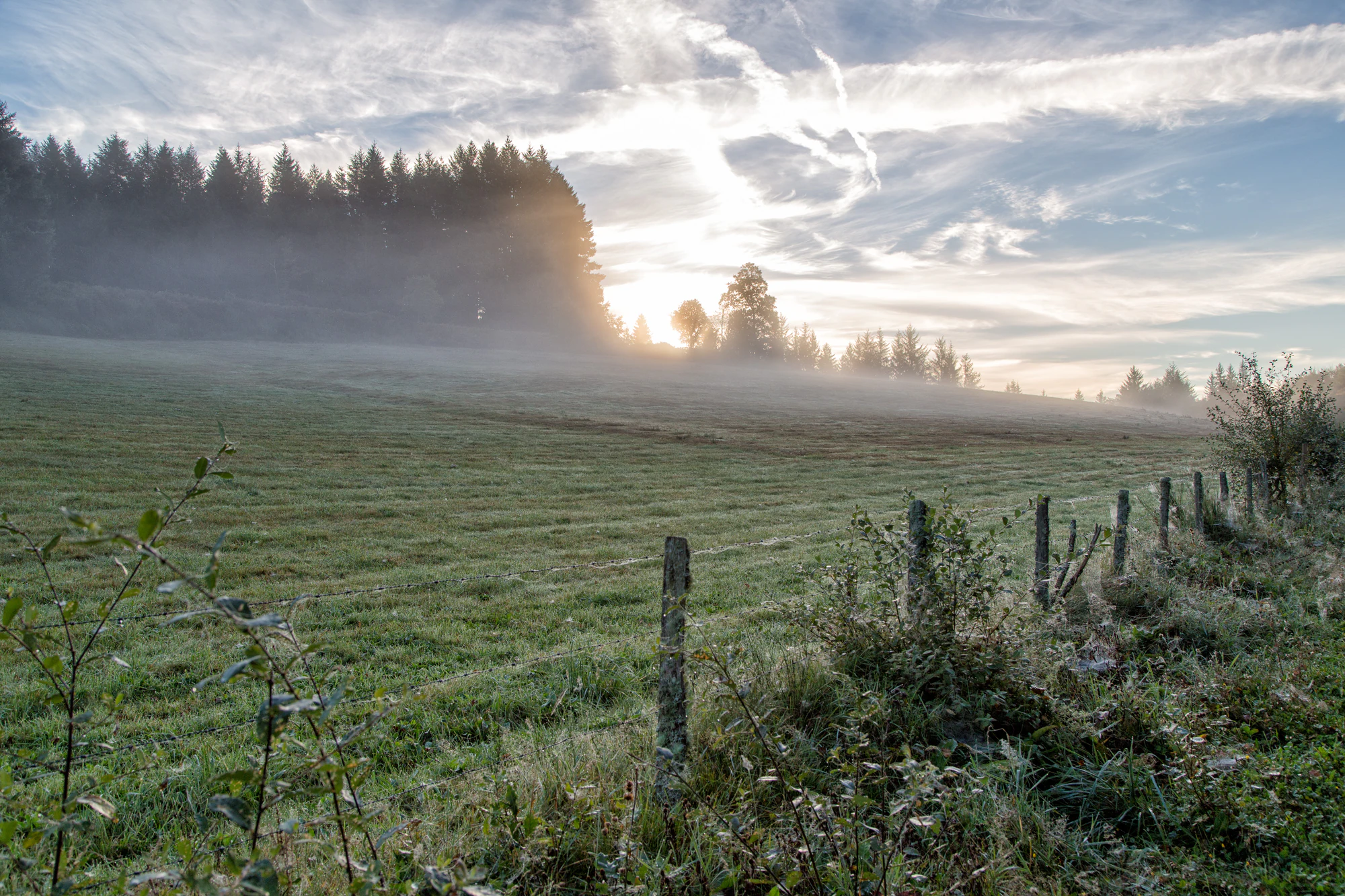
Pale morning light shines through mist above a green meadow and dark tree line, with wooden posts and wire fencing across the foreground.

Morning mist above a fenced meadow at Peyrelevade on the Millevaches plateau, photographed on 27 September 2017. This is a wider landscape view, not the Longeyroux walking route.

“Plateau de Millevaches : Peyrelevade” — Bruno Jargot, CC BY 2.0. Source: https://www.flickr.com/photos/bjargot/46536958204/. License: https://creativecommons.org/licenses/by/2.0/. Original unchanged. · Creative Commons

Walks and routes

Sentier des Linaigrettes: the short discovery loop

The official route is a 905 m loop with 24 m of ascent, graded easy and timed at 30 minutes. Start and finish at the Aire d’accueil du Longeyroux, Saint-Merd-les-Oussines. Look for the granite marker depicting a white cottongrass flower. From the interpretation area, the route descends past the landscape-reading point, crosses a small wooden bridge and follows the plank walkway. Use the on-site signs and official route for navigation.

The boards make a sensitive habitat visit possible; they do not make it an all-weather level promenade. Walk rather than run, supervise young children and leave space for other visitors to pass without stepping into vegetation. Wet or frosty timber needs particular care.


Sentier des Linaigrettes: the short discovery loop

An unhurried first half-day

Begin with the short discovery walk while everyone is fresh and the weather suits it. Give the first viewpoint a few minutes: trace the rim of the basin with your eyes, then compare that broad view with what the panels show closer to the water. After the loop, take a proper break rather than automatically adding kilometres. During the Maison du Parc's opening season, drive there as a separate stop and use its displays to place the morning's wetland in the wider park. Outside that season, finish with a village meal or your own picnic at a suitable public spot. The walk itself is a complete outing.

Things to try

Read a landscape that gathers water

At the overview, look for the higher ground surrounding the peatland and imagine rain moving down towards the lowest areas. The park's granite basins help explain why this is a headwaters landscape. On the trail, compare open water, saturated vegetation and drier ground without leaving the visitor surfaces. Children can sketch the basin and add arrows for the water they think will move downhill, then check their ideas against the interpretation panels.

Watch from one place

Choose a spot where you are not blocking the walkway and spend several quiet minutes looking over the vegetation. Binoculars are useful for birds and for details you cannot reach. Let the wildlife choose the distance: a bird perched beyond the path is a good observation without being a close photograph. Avoid playback calls, bait or attempts to flush an animal into view.

Make a separate evening of the dark sky

The wider park received International Dark Sky Reserve recognition in 2021. If you are staying nearby, ask about an organised astronomy evening or use a permitted, familiar viewing place at your accommodation. Cloud cover matters more than enthusiasm, and warm clothes help even after a mild afternoon. Leave the peatland walk as a daylight outing; the dark-sky label does not provide night access to every natural site.

When the plateau weather wins

If conditions are merely showery and the route is sound, waterproofs may be enough for a short visit. If visibility, wind, thunder or slippery boards make it uncomfortable, save the loop for another day. During its reception season, the Maison du Parc is a useful indoor introduction; outside it, choose a confirmed open indoor stop before leaving your accommodation. A closed visitor centre is not a dependable rain plan.

Wildlife and habitats

Sundews

Sundews add an unexpected twist to the bog: these small plants catch insects on sticky leaves. The shiny droplets are part of the trap, so look without touching. At Longeyroux, use the interpretation images to get your eye in, then see what can be observed from the walkway. Identifying a particular sundew species takes more than spotting a few glistening leaves.

Sphagnum mosses

Sphagnum is part of the bog's living surface and its long memory. At Longeyroux, incompletely decomposed sphagnum makes up much of the peat beneath. Look for the contrast between low mossy growth and taller stems, and imagine the layers accumulating over time. There is no need to pull up or squeeze a handful to understand its role.

Meadow pipit

A meadow pipit can blend almost completely into open vegetation: look for a small brown bird with a strongly streaked appearance. Its high, thin calls and fluttering breeding display can attract attention before its plumage does. This is one of Longeyroux's characteristic birds, but similar-looking pipits make a field guide useful. Watch from the path rather than following a bird into the grass.

Whinchat

The whinchat's pale stripe above the eye is a useful first clue, alongside its warm orange-toned breast and brown, streaked upperparts. It often uses tall stems as lookout posts, making a slow binocular scan worthwhile. At Longeyroux, compare shape and markings carefully if you find one; a perch is a good place to observe from a distance, not an invitation to approach.

Viviparous lizard

Viviparous lizards link the peatland's insects and spiders to larger predators. They are commonly brown with spots or stripes, though colour varies. A sunny edge with cover nearby is the sort of place where a lizard may pause to warm up. If you spot one beside the route, stand still and enjoy the detail; sudden movement can end the encounter very quickly.

Stories and discoveries

The open ground is managed

Longeyroux's broad views can look entirely self-sustaining, but grazing is part of keeping the habitat open. The park's Natura 2000 newsletter describes summer flocks guided by a shepherd to balance feeding with environmental needs. Seeing livestock here can therefore be a useful lesson in conservation, rather than an interruption to a wildlife visit.

Peat is a slow archive

The Linaigrettes interpretation describes peat building where water remains abundant and plant material decomposes slowly. Its published explanation gives an order of magnitude of only one or two centimetres in a century. That makes a small patch of damaged ground much less trivial than it first appears. Use the panels to understand the timescale; leave the peat itself undisturbed.

When to visit

Spring and summer

Use plant interest as a reason to stop, not as a promise that every species will be visible. Early summer suits the cottongrass theme; later summer changes the colours of the heath. On hot days, choose a cooler part of the day. Check livestock and guardian-dog signs before entering the route.

Autumn and winter

Autumn offers a different palette and shorter daylight. Corrèze's general 2026–2027 hunting season is published as 13 September 2026 to 28 February 2027, but species-specific exceptions extend beyond those dates. Ask about local hunts and obey on-site notices; there is no guaranteed hunt-free day implied here. Creuse and Haute-Vienne have their own regulations. In winter, ice on the wooden path can make this a poor family choice.

Getting there and practical advice

Maison du Parc: a seasonal extra

The Maison du Parc is at 7 route d’Aubusson, Millevaches. Its published 2026 reception season ran from 15 May to 15 September, and reception is now seasonally closed. The schedule was Tuesday–Saturday, 09:30–12:30 and 13:30–17:30 in May–June and early September; Monday–Saturday, 09:30–12:30 and 13:30–18:00 in July–August. Recheck the next season before travelling. Admission is free; information is available on 05 55 96 97 00.

At the peatland

The official route identifies a reception/parking area and interpretation panels. Treat this as a countryside trailhead. Bring what you need for the walk, and arrange essential facilities before arrival rather than relying on unconfirmed toilets, drinking water, food sales or shelter. Keep parking access clear for other visitors and land managers.

Arriving at the right place

For the short walk, use the Longeyroux reception area in Saint-Merd-les-Oussines as your destination. The official approach from Meymac uses the D36, then the D979 towards Bugeat, before following signs for Celle and the reception parking. Check the current route page for the final approach. Do not navigate only to the village of Millevaches and expect a short walk from there.

Without a car

Use the park's mobility information to plan the regional part of your journey, then arrange the last leg and return before departure. There is no confirmed direct public-transport connection to this trailhead in the route information used here. A station-based walk elsewhere in the park may suit a rail-only day better than an uncertain roadside connection to Longeyroux.

Match the outing to the person

Ask specifically about the entire route from parking to boardwalk and back, including any uneven approach, bridge thresholds and opportunities to turn around. The Maison du Parc offers accessible interpretation, including an easy-read French guide and audio-description support, but its facilities do not establish accessibility at Longeyroux. For a mixed-ability group, choose the outing around the least adaptable part of the journey.

Sources and useful links

Wildlife you might spot

5

Each card links to a full Explore page with photos, traits, and fun facts.

Snap map for this place

Start with the big picture, then zoom in to explore individual wildlife observations around this place.

Loading map…

Good to know before you go

Download the official Linaigrettes route before leaving; choose the short loop, not the longer Bruyère circuit.

Wear waterproof walking shoes with grip. Bring spare socks for children and keep hands free on the wooden sections.

Stay on the marked trail and boardwalk. Do not step onto the bog for a plant, photograph or shortcut, even where it looks firm.

Plan food, drinking water and toilet stops in advance. The discovery walk should not depend on finding a café or staffed reception at the trailhead.

Leave gates and fences as directed, give livestock room and never approach a flock to photograph its guardian dogs.

Check the weather, trailhead notices and local hunting arrangements shortly before setting out. Follow any closure or diversion posted on site.

Frequently asked questions

It is a large living territory with villages, farms, forests, lakes and many separate visitor sites. This guide uses Longeyroux as a manageable introduction and the Maison du Parc as an optional orientation stop. Allow time to travel between places rather than treating the whole park as a single walkable estate.
Choose the Sentier des Linaigrettes from the Longeyroux reception area. The longer Sentier de la Bruyère is advertised at 9 km and needs its own time, equipment and route planning. It is not a necessary extension of the short discovery walk.
Plan a summer peatland visit without your dog. Haute-Corrèze tourism says dogs, including dogs on leads, are not allowed when summer flocks and their guardian dogs are present, with prevention signs displayed. Check the current Longeyroux signs or ask the tourist office about your date; do not interpret a general park welcome for dogs as permission here.
The official route is presented as a self-guided outdoor walk, with no booking step or admission tariff shown. The Maison du Parc is free to enter during reception hours. Organised walks and other activities have their own schedules and conditions, so check the specific event before travelling.
The wet basin and its streamlets explain the river's beginnings; the outing is not a licence to find a single source by leaving the path. Follow the interpretation route, and let the landscape show how many small flows come together.

Recent snaps at this place

Recent snaps will appear here as new observations are added.

View all ›

Take the discovery with you

Exploring Millevaches en Limousin Regional Nature Park?

Identify the wildlife you spot, learn as you go, and keep a collection of the adventure.

  1. 1Spot it
  2. 2Snap it
  3. 3Keep the discovery




