
Snappit logo
Snappit
Get App
Generic illustration, not a photograph of this venueIllustration
ParkKR

Olympic Park

The most rewarding visit goes beyond the big entrance monument.

About

The most rewarding visit goes beyond the big entrance monument. Mongchontoseong rises in grassy folds above the water, while tree-lined paths connect quieter corners with lawns, seasonal gardens and public art. It is a park for choosing a few interests and following them slowly: archaeology on the earthworks, birds by the water, or sculpture with room to step back and look. Concerts and sports facilities add a different rhythm around the edges, so check the event and construction notices before choosing your entrance. Unlock an interactive field guide for this spot: get the Snappit app to identify nature on the go.

Mongchontoseong belongs to the Hanseong period of Baekje. Its builders used the natural landform and added earthen walls; investigations also identified a moat and timber defenses. Excavations in 1983–1988 informed the restoration seen today. The later Olympic landscape brings another layer: the sculpture park grew out of the cultural program associated with the 1988 Seoul Games. Walking here places an archaeological site and a modern international sporting legacy in the same afternoon.

What to do here

Make Mongchontoseong and Mongchon Moat the heart of your walk, then add either the sculpture landscape or the 88 Lake and flower-garden side. A museum can deepen the visit, but its opening arrangements are separate from the park. There is no need to complete every named sight to have a satisfying afternoon.

Seasonal info

Seasonal flower displays and autumn foliage can make a familiar path feel different, but planting and weather determine what is actually on show. In summer, shorten the exposed hill-and-lawn sections and bring drinking water. Winter can suit a brisk landscape walk if surfaces are dry and ice-free.

Accessibility

Separate the lower park paths from the hilltop earthwork walk when planning mobility access. The official nine-sights directions include wooden stairs, and the rampart circuit has a steep section. Construction can interrupt otherwise straightforward approaches. Ask an information centre for a currently open, step-free outing suited to your needs.

Don't miss

1

Mongchontoseong

grassy Baekje earthworks with a different view at each rise.

2

Mongchon Moat

water, planting and a slower pace beside the historic landscape.

3

Outdoor sculpture

Olympic-era art encountered along paths and across open space.

4

One Tree Hill and the seasonal gardens

distinctive photographic stops when their approaches are open.

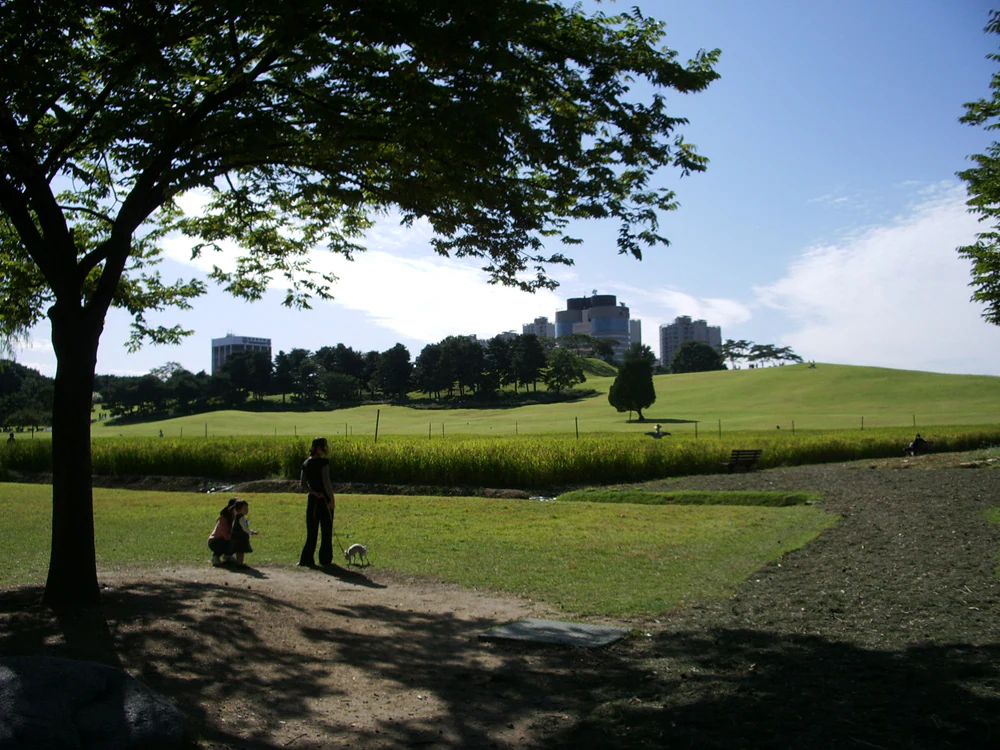
A tree shades two people and a dog in the foreground, with grassy Mongchontoseong slopes, a solitary tree and distant buildings beyond.

Mongchontoseong’s green contours in September 2008. This historical photograph does not indicate today’s lawn access or visitor rules.

Photo: Scarlet Sappho / Flickr, CC BY-SA 2.0. Unchanged original. · Creative Commons 1 · Creative Commons 2

Walks and routes

Toseong-gil: the earthwork circuit

The operator publishes a 2,210 m Mongchontoseong circuit. Choose it for the raised landscape and views across the lawns, rather than for a completely level stroll. Allow roughly 60–90 minutes with pauses, plus time to reach the circuit from your entrance. Use the official walking-route page for the alignment.

There are climbs, including the steep section highlighted by the operator. Choose the lower park paths instead if stairs, slopes or slippery ground would be a problem.


Toseong-gil: the earthwork circuit

Hoban-gil: the published short waterside loop

The published 1,302 m loop links Peace Square, Gommal Bridge and SOMA Museum, returning to the square. It is a useful reference for a shorter water-and-art outing, with about 35–60 minutes suggested for an unhurried visit when the full route is available.

For a mobility-conscious visit, ask which lower-path sections are step-free and unobstructed now.

Hoban-gil: the published short waterside loop

A relaxed first visit: two to three hours

Start at the entrance best suited to your train journey and ask about current diversions. Put the earthwork circuit first if you want to do it, while your legs are fresh, then take a slower waterside section and a few sculptures. Finish near your chosen exit rather than adding a last distant sight. If conditions prevent the hill walk, make the outing shorter and spend the saved time on art or a confirmed-open museum. This is a suggested order, not a newly mapped trail.

With children or limited energy

Pick one theme: the moat and birds, a few large sculptures, or the landmark tree with a break. Set a turnaround point before anyone is tired. An out-and-back walk can be easier to manage than a loop with an uncertain diversion. Avoid promising a stamp-tour prize, and keep museum visits optional until you have checked their admission arrangements.

Things to try

Give the quieter green areas a turn

If the entrance plazas are busy, make a path-based outing around the natural-learning areas. The operator identifies habitat work along Seongnae Stream between Cheongnyong Bridge near North Gate 2 and the moat sluice, including an observation deck near Rainbow Bridge. Stay on the visitor paths and let the water margins remain undisturbed. Tree-lined stretches offer a change of scale after the broad lawns.

Photograph the setting, not only the landmark

For One Tree Hill, leave space around the tree in your composition so the open ground remains part of the picture. The operator identifies the landmark as a Chinese arborvitae. Around 88 Lake, use the water and Oryunjeong pavilion as a different subject. Keep your photo session within open areas, and give other visitors a chance at the view.

Choose one garden rather than chasing every bloom

Deulkkotmaru’s published seasonal displays include spring flowers around May–June and cosmos around September–October. Rose Plaza offers a separate formal-garden stop. Treat these as seasonal pointers, not a bloom forecast, and stay out of the beds. During works, an unobstructed path or a different park area is the better choice.

Choose an indoor visit deliberately

Seoul Baekje Museum is a good place to learn about Baekje history, while SOMA suits an art-focused day. Check each museum’s own site before leaving: as of October 18, 2026, Seoul Baekje Museum warns that its first-floor permanent exhibition is restricted during remodeling. Its other offerings have separate hours. A museum is a good planned alternative to a wet walk, but do not assume every gallery is open or that entry arrangements match the park. Seoul Baekje Museum · SOMA Museum.

Wildlife and habitats

Look for life at the water’s edge

Mallard and grey heron are named in the operator’s account of the Seongnae Stream habitat area. They are possibilities to watch for, not guaranteed sightings on your date. Pause on an open visitor path rather than moving into the vegetation. The landmark Chinese arborvitae is a different kind of nature stop: a managed landscape tree, not evidence of a wild woodland population.

Stories and discoveries

Read the shape of the fortress

The low green banks are the attraction: do not expect a stone castle with towers. From the designated path, the raised ground and the water below make the defensive setting easier to understand. For the richest visit, give the earthworks their own stretch of time before turning to modern Olympic monuments.

Art with breathing room

The sculpture collection was assembled through international exhibitions and symposia connected with the Seoul Olympics, with later additions. Browse a handful of works rather than treating every sculpture as a checkpoint. SOMA’s sculpture catalogue helps you look up an artist or work that catches your attention.

When to visit

Plan the picnic around lawn access

The published lawn policy treats the picnic area, family play area and One Tree Hill lawn as year-round areas, subject to conditions. Other named lawns, including 88 Lawn, normally open June 1–October 31 and rest through winter and spring. Restoration, rain, events and the specific 88 Lawn works can override the usual dates; the signs at the lawn are the decision point.

Adapt the walk to the weather

On a hot day, go early, reduce time on exposed earthworks and make a shaded rest part of the plan. After heavy rain, skip muddy or slippery slopes and respect any water-edge restrictions. In winter, choose footwear with grip and turn back if paths are icy. Check weather and air-quality information before setting off; a shorter comfortable visit is better than forcing a full circuit.

Getting there and practical advice

Information centres and wheelchair loans

The current operator table lists the Peace Square and Meeting Plaza information centres at 09:00–19:00, with a 12:00–13:00 break. It lists three wheelchairs at each, loaned free for up to three hours with an ID left as security. Availability is limited: call before relying on a loan. Peace Square: 02-2180-3564–3565; Meeting Plaza: 02-2180-3566.

Breaks, toilets and lawns

Use the official park map and entrance signs to plan your next toilet and exit before heading deeper inside. Carry enough water and a snack for your walk rather than depending on a particular kiosk. For a picnic, use only a currently open lawn and take your rubbish away.

Match the station to the part you want to see

The operator lists Mongchontoseong Station on Line 8, Exit 1; Olympic Park Station on Lines 5 and 9, Exits 3 and 4; and Hanseong Baekje Station on Line 9, Exit 2. Mongchontoseong suits the World Peace Gate side; Olympic Park Station suits the eastern approach. Check official directions and live navigation for your exact destination. If you need an elevator, confirm its current location and service rather than assuming the listed exit is step-free.

Arriving for a concert or by car

Leave extra time on event days and use public transport where practical. The park’s address is 424 Olympic-ro, Songpa-gu, Seoul, but a general park destination can place you far from your intended venue. Select the actual entrance or building; for driving, check the operator’s parking and congestion information before departure.

A useful question to ask before arrival

Describe your needs clearly: a wheelchair or stroller, difficulty with slopes, a maximum walking distance, or a toilet needed close to the route. Ask for the shortest currently open outing from your arrival point. Ask where you can take a break and whether the return journey follows the same open paths.

Visitor information

Peace Square and the waterside stage in front of Mongchon Moat are listed for facility works from July 7, 2025 to October 31, 2026. Follow the barriers and signed diversions; the scheduled finish is not a confirmed reopening. This stage is distinct from the stage at 88 Lake.

Rolling partial restrictions affect the science institute building and Rose Plaza areas from September 14 to November 30, 2026, and the swimming pool, KSPO Dome and SOMA Museum areas from September 29 to December 25. A separate P1/South Gate 2 approach project was scheduled to end October 8; check its actual condition rather than assuming either continued closure or completion.

Work on 88 Lawn is scheduled for November 2026–March 2027, subject to change. Choose another open lawn or a path-based visit if that work affects your date.

Sources and useful links

Wildlife you might spot

3

Each card links to a full Explore page with photos, traits, and fun facts.

Snap map for this place

Start with the big picture, then zoom in to explore individual wildlife observations around this place.

Loading map…

Good to know before you go

Choose your exit station before setting out; the park is large enough that retracing your steps can add an unwanted walk.

Save the official map and check notices on the day, especially if you are combining the park with a concert.

Keep to open paths around the archaeology and respect fences even when a familiar shortcut looks tempting.

Bring water, comfortable shoes and sun protection. A picnic mat is useful only on a lawn that is currently open.

Take binoculars or use your camera zoom for waterbirds; do not feed, chase or approach them.

Leave room for walkers and cyclists when stopping for photographs, and keep children close near water.

Frequently asked questions

General park entry is free. The published pedestrian and bicycle hours are 05:00–22:00, with plaza areas listed until midnight. The interior is off-limits after 22:00; the later plaza time is not permission to keep exploring the earthworks. Museums, exhibitions, sports facilities, parking and ticketed events have their own arrangements.
Do not plan around stamps or a completion gift. A specific operator notice suspends the program from July 1, 2025 until the Peace Square and waterside works finish. The general tour page is still online, but that alone does not confirm a restart. Ask an information centre before making it the purpose of your visit.
The park advertises three- and six-seat four-wheel cycles for a family or group outing. Check the current rental page and the desk on arrival, because weather and busy events can change operations. The driver must be at least 20, and helmets and passenger limits apply. Keep the walking routes in this guide as an easy alternative if rental is unavailable.
The operator prohibits pets on its lawn areas and bans tents and shade shelters there. Keep a pet outing to permitted paths and follow current signs. Do not assume that an open grassy view is an open picnic space; access is managed by area and season.

Recent snaps at this place

Recent snaps will appear here as new observations are added.

View all ›

Take the discovery with you

Exploring Olympic Park?

Identify the wildlife you spot, learn as you go, and keep a collection of the adventure.

  1. 1Spot it
  2. 2Snap it
  3. 3Keep the discovery




