
Snappit logo
Snappit
Get App
Generic illustration, not a photograph of this venueIllustration
ParkAragón, Spain

Parque Grande José Antonio Labordeta

Start at the Puente de los Cantautores and let the long view along Avenida de San Sebastián draw you into the park.

About

Start at the Puente de los Cantautores and let the long view along Avenida de San Sebastián draw you into the park. Formal planting and fountains lead towards the white stairways below Alfonso I el Batallador. It is a satisfying first walk even if you stop at the foot of the steps, especially when you leave time to sit and watch the park go by.

Then choose a different mood. La Rosaleda rewards slow looking when roses are flowering; the Jardín Botánico Francisco Loscos brings plant labels, water and restored ceramic benches into a compact, enclosed garden. Avenida de los Bearneses and the pine-covered Cabezo de Buenavista offer longer outings. You do not need to fit every corner into one afternoon: pair the central avenue with one garden, or make the hill your main destination.

This is a working city park with runners, families, hire cycles, outdoor events and maintenance teams sharing its spaces. Leave room for a changed path or a closed facility. The botanical garden has its own gates and hours, while a performance, a café visit or a train ride needs its own arrangements. Be ready to snap and learn! Get the Snappit app to identify any nature species you find here.

The park took shape in the early twentieth century and opened in the late 1920s under the name Parque Primo de Rivera. In September 2010 the city formally adopted Parque Grande José Antonio Labordeta in memory of the Aragonese singer-songwriter, writer, teacher and politician. Its landscape has continued to change: the monumental cascades were inaugurated in 1991, La Rosaleda was renewed in 2022, and the enclosed botanical garden reopened as Jardín Botánico Francisco Loscos on 9 December 2025. The latter honours the nineteenth-century pharmacist and botanist and draws on Zaragoza’s older botanical tradition.

What to do here

Walk the fountain avenue, choose between the rose garden and the botanical collections, and add the Batallador viewpoint only if the climb suits your group. For children, a few plant labels and a playground break often work better than a long checklist.

Seasonal info

Flowering and autumn colour vary with the weather. Fountains may be off for maintenance, so enjoy the layout as well as the water. In hot spells carry water; in strong wind or thunderstorms postpone a walk beneath trees. Festival dates can bring crowds and temporary layouts.

Accessibility

The main avenues provide a gentler starting point than the stairways and irregular slopes of the Cabezo. La Rosaleda has a circuit designed for universal access, and the renovated botanical garden has compacted-aggregate paths, level boardwalks and tactile guidance. Confirm the full route, toilet availability and current surface conditions for your own mobility needs; these features do not make every park path step-free.

Don't miss

1

The fountain perspective from Puente de los Cantautores along Avenida de San Sebastián

2

La Rosaleda’s colour-grouped rose beds and close-up viewing circuit

3

Jardín Botánico Francisco Loscos, reopened in December 2025

4

The optional climb to the Batallador viewpoint above the cascades

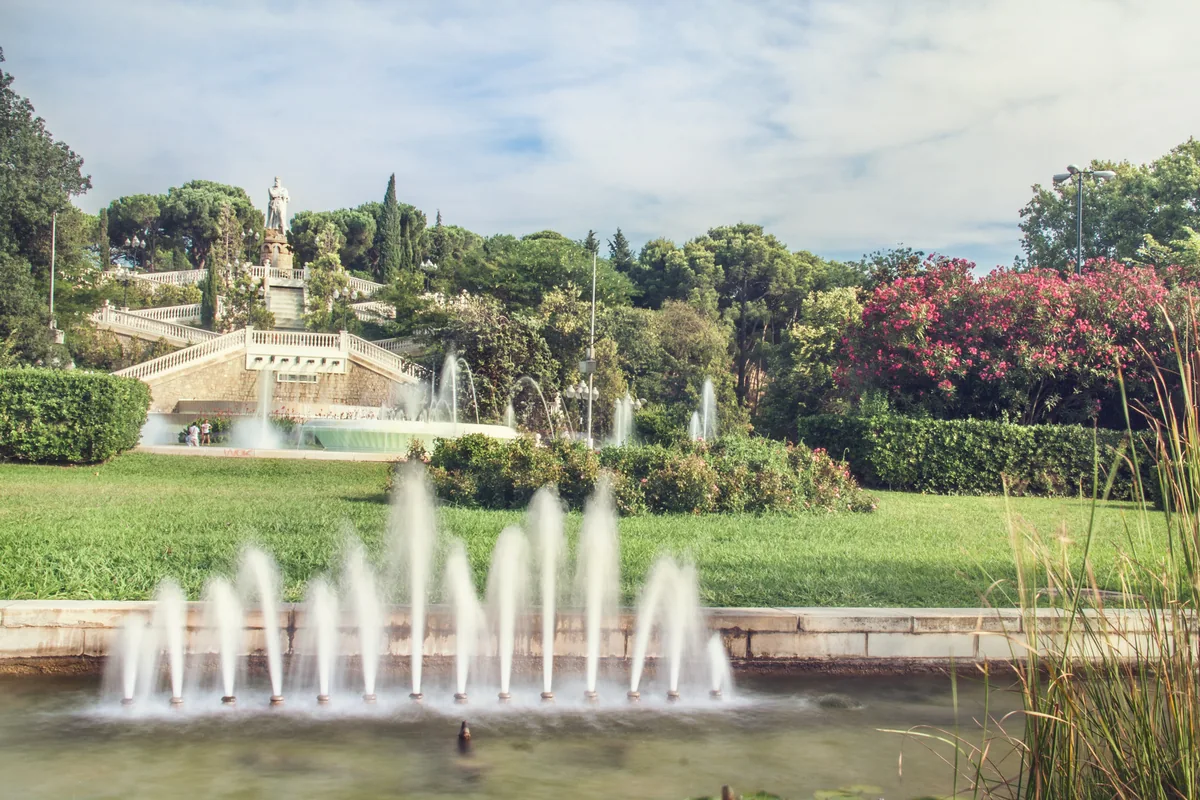
Fountain jets rise in a foreground pool beside lawns and flowering shrubs, with a broad stairway and the distant Alfonso I statue framed by mature trees.

Fountains and formal planting in Parque Grande José Antonio Labordeta, with the Alfonso I monument above the steps, photographed in August 2013.

Parque Grande (9523679117).jpg — Juanedc / Wikimedia Commons / CC BY 2.0 · Creative Commons

Walks and routes

The principal avenue: a straightforward first walk

Enter over Puente de los Cantautores and follow Avenida de San Sebastián towards the cascades. Stop for the changing views of pools, clipped planting and the high monument, then return along the avenue when you are ready. Allow 45–75 minutes with pauses; shorten it by turning back at any point.

Stay on the main paths and stop below the cascades if you need to avoid stairs. The grand stairway is not a step-free continuation of the avenue.


A slow visit inside Jardín Botánico Francisco Loscos

Use the botanical garden entrance on Paseo de San Sebastián and follow the garden’s own paths, choosing a handful of labelled trees before spending time by the water and themed planting. Allow 30–60 minutes. Scan the plant QR labels if you want more detail, rather than trying to identify every specimen from a distance.

The 2025 renovation introduced compacted-aggregate paths, level boardwalks and tactile routes. Check entrance and path conditions, and stay on the intended paths beside water.

A slow visit inside Jardín Botánico Francisco Loscos

Rose beds at an unhurried pace

Follow park signs to La Rosaleda and use its viewing circuit to compare the beds. Choose a flower colour, then look for different petal shapes and scents without touching the plants. Allow 20–40 minutes in the rose garden, with extra time to reach it from your entrance.

The municipality describes a universal-access circuit approaching the rose groups. Check the connection from your arrival point as well as the circuit itself.

Rose beds at an unhurried pace

Avenida de los Bearneses: extend the stroll

For a longer park visit, follow the signs towards Avenida de los Bearneses and the Rincón de Goya surroundings. The avenue and the parallel Acequia de las Abdulas give you a different view of the park’s water and planting. Allow 30–60 minutes for a gentle out-and-back once you reach the avenue; retrace your route rather than improvising a longer circuit when energy is low.

Check each connecting path for steps, surface changes and gradients. Keep children away from the channel edge and leave space for other path users.

Avenida de los Bearneses: extend the stroll

Optional hill walk above the Batallador

If your group is comfortable with steps and slopes, climb to the Batallador viewpoint, then use the city’s itinerary and park signs to explore the pine landscape of Cabezo de Buenavista. Calle José Bueno leads uphill through this area; keep track of your return and leave the further descent towards Paseo de Colón for a longer outing. Allow 45–90 minutes beyond your lower-park walk.

This is the hillier option: the city describes irregular slopes, and the direct approach from the fountain avenue uses stairs. Choose a lower-level visit instead if these barriers do not suit you.

Optional hill walk above the Batallador

About an hour, with plenty of flexibility

Start at Puente de los Cantautores, follow as much of the fountain avenue as feels comfortable, and pause before returning. This is the simplest plan for a short break between city sights. Leave the hill and a full botanical visit for another time.

Two to three hours with children

Combine the central avenue with either the botanical labels or the rose garden, then make room for a playground or refreshment break. Agree a short turnaround point before anyone gets tired. Treat a train ride as an optional extra once you have checked it is running.

A longer garden-and-viewpoint visit

Begin with one planted collection while you have the patience for labels. After a break, choose the Batallador viewpoint and a stretch of the Cabezo if the weather and everyone’s energy suit the climb. Otherwise use Avenida de los Bearneses for a change of scene. Keep the canal and the wider pine woods for a separate outing.

Things to try

Make a three-shape plant challenge

Ask children to find a heart-shaped leaf, a star-shaped leaf and an evergreen leaf using the botanical labels. Photograph or sketch what you find and compare the names afterwards. Keep everything on the plant.

Photograph the park without rushing

Try one wide view along the fountain avenue, one close view of a plant from the path, and one detail of a ceramic bench or sculpture. Wait for a clear view rather than stepping into a flowerbed or blocking a busy path.

Build in a play or movement break

Playgrounds and sports areas are listed in the park’s facilities. Choose a suitable open area for your children’s ages and abilities, or go for a gentle run on the broader paths. Check signs before cycling or skating, slow down around pedestrians and keep the planted garden paths for their intended use.

Take a quiet wildlife pause

Watch from a path near planting or water and let animals approach or leave on their own terms. The botanical garden includes insect and reptile refuges; observe the design without lifting materials or opening cavities. Any animal encounter is a bonus, and the planted-tree suggestions below are the more dependable focus for a short visit.

Shorten the visit rather than relying on a building

If rain is light, choose a short main-avenue walk and a café only once you know it is open. The gardens and Jardín de Invierno are outdoors, and individual park buildings are not guaranteed shelters or visitor attractions. In heavy rain, lightning or strong wind, leave the tree-lined walk for a safer time and choose an indoor city visit with confirmed opening.

Wildlife and habitats

A planted collection, with room for wild visitors

The six trees below are documented in the municipal botanical catalogue. They are cultivated specimens, not evidence of wild populations in the park. Use the labels and current catalogue to find what is on view; individual plants and seasonal features can change. Watch any wild visitors from a respectful distance.

Strawberry tree

Look for evergreen leaves and rough, round fruit, with small bell-shaped flowers in the cooler part of the year. The botanical catalogue explains that autumn flowers and mature fruit can occur together. These are cultivated plants in the garden; observe them without picking or tasting.

Judas tree

Use the label to find the tree with broad, heart-shaped leaves. In spring, flowers can appear on older branches and even the trunk before the leaves fully develop. It is a good tree for returning in another season and comparing the change.

Common ash

The botanical catalogue describes compound leaves and dark winter buds; look carefully at a reachable branch without pulling it down. A separate 2026 city article also highlights a common ash in Parque Grande. Do not assume that every ash you pass is this species: use the label.

Sweetgum

Look for star-like leaves with pointed lobes and, in autumn, red or purple colour when conditions favour it. Compare the leaf shape with the broader evergreen leaves nearby. The catalogue places this ornamental tree in the garden; the exact colour and timing depend on the season.

Southern magnolia

Look for large, glossy evergreen leaves, with a brownish underside where it is naturally visible. The white flowers are another clue when present, but the leaves make this an interesting stop outside flowering season too. Keep to the path and use the label to confirm it.

Holm oak

This evergreen oak provides a contrast with the deciduous trees in the collection. Notice the tough leaves and pale undersides; acorns add another clue in season. Its occurrence here is part of planted garden collections, even though the species also grows naturally in Mediterranean landscapes.

Stories and discoveries

A rose garden organised by colour

La Rosaleda was created in 1940 and renewed in 2022. Its municipal interpretation describes 80 rose varieties grouped into eight colour beds, with a circuit bringing visitors close to the plants. A useful game is to compare two flowers of the same colour rather than simply counting different colours.

A cascade that is younger than it looks

The formal stairways and cascades were inaugurated in 1991. Their designer, Rafael Barnola, used classical garden ideas to extend the visual line of Avenida de San Sebastián up towards the Batallador. Look at the whole composition from below before deciding whether to climb.

A bandstand with a changing setting

The Quiosco de la Música was made for Zaragoza’s 1908–1909 exhibition and moved between city locations before settling in the park. Restoration work is being prepared through municipal contracts in 2026, so check current access before planning a close look.

An outdoor garden called Jardín de Invierno

The city’s longer Cabezo itinerary includes Jardín de Invierno, an outdoor garden and performance space. Its name does not make it a heated winter refuge. Add it only if you have time and a comfortable route back.

When to visit

Spring: flowers and a slower pace

Give the rose garden and botanical planting more time when flowers are out. Choose your stops from what is actually flowering that week, and leave the busiest event dates to a separate visit if you prefer quiet.

Summer: shade first

Keep the outdoor plan short enough to remain comfortable in the heat. Start early or return later, bring water and sun protection, and take breaks before children or less mobile companions tire. Fountain pools are ornamental, so cool off with a shaded pause rather than entering the water.

Autumn: leaves, fruit and events

Compare the botanical garden’s evergreen and deciduous trees, and look for colour in sweetgum leaves. Autumn flowers and fruit can appear together on strawberry trees. Check the Fiestas del Pilar programme if visiting in October and leave fruit for the garden and its wildlife.

Winter: structure and daylight

Use bare branches, evergreen foliage and the formal layout as your focus. Allow for shorter daylight and a cold wind, and confirm the botanical garden’s current hours. Wet steps and paths deserve a slower pace; there is no need to force the climb for a photograph.

Getting there and practical advice

Park access and the botanical timetable

Plan the main outdoor visit in daylight. The municipal park listing does not publish one opening timetable or a general admission tariff; follow local notices and any event controls. The enclosed Jardín Botánico Francisco Loscos separately advertises 08:00–22:00 every day. Its hours were checked on 16 October 2026 and should be checked again before travel.

Toilets and drinking water

The city lists public toilets, adapted toilets and drinking fountains within the park. Ask which toilet is open and suitable for your needs before setting out on a longer route. Bring your own water, since a listed fountain does not guarantee that it is working that day.

Cafés, terraces and a picnic pause

Cafés and terraces offer places to stop when operating. Confirm service and menus before relying on one for a meal. The Cabezo itinerary also describes picnic areas, but these involve a hillier visit; a shorter lower-park break may suit your group better. Use permitted areas and take all rubbish with you.

Hire cycles and the little train

Zaragoza Tourism lists bicycle hire and the Chuchú train at Quiosco-Bar El Botánico near the entrance. Check opening, prices, age or size limits and boarding needs directly. Do not assume that every hire vehicle can enter every garden or path.

Events and temporary changes

The park hosts seasonal events, including family performances during the Fiestas del Pilar. The October 2026 programme confirms activity here, but each event has its own dates and layout. Check the current agenda and notices if you want a performance, an uncrowded walk or reliable access to a particular area.

Arrive by tram at the main entrance

Line 1 connects the city centre with the Parque Grande area. The operator identifies Emperador Carlos V as the stop by the principal entrance. From there, follow the pedestrian signs towards Puente de los Cantautores, taking care at crossings and tram tracks. Check the operator’s current service notices for your journey.

Choose the right entrance before travelling

The municipal park address is Paseo Isabel la Católica, 75, while the botanical garden gives its entrance on Paseo de San Sebastián inside the park. Name the entrance or garden you need when arranging a drop-off. The city lists reserved accessible parking, but confirm its location and availability rather than assuming a space will be waiting.

Be cautious about a riverside approach

Municipal works information in May 2026 described ongoing regeneration of the Huerva between Parque Grande and Gran Vía. Use current street signs and municipal updates for any river-edge approach. Do not treat an older walking map as proof that the riverside route is open from end to end.

Lower park and the grand stairway

Build a shorter visit around the main avenues and check any side-path connection before committing to it. The cascades have several flights of steps; an attractive view from the avenue does not require climbing them. Ask Zaragoza Tourism for current advice if you need a specific step-free journey.

Two gardens with documented improvements

La Rosaleda’s 2022 renewal included a universal-access circuit. The botanical garden’s 2025 reopening announcement specifies compacted-aggregate paths, level boardwalks and tactile guidance. These are useful starting points for planning; confirm your entrance, surface condition and connection to toilets for the whole visit.

Facilities, sensory needs and quieter timing

The park listing records adapted toilets, reserved accessible parking and permission for guide dogs. It does not give enough detail to match every visitor’s needs. Ask about the facility you plan to use and the route to it. For a calmer experience, check event dates and favour a quieter daytime visit away from programmed performances.

Sources and useful links

Wildlife you might spot

6

Each card links to a full Explore page with photos, traits, and fun facts.

Snap map for this place

Start with the big picture, then zoom in to explore individual wildlife observations around this place.

Loading map…

Good to know before you go

Choose one garden to add to the central avenue rather than rushing around the whole park.

The botanical garden advertises daily opening from 08:00 to 22:00; check its gate notices before relying on an evening visit.

Use Emperador Carlos V tram stop for the principal entrance and check travel notices on the day.

Keep a water bottle with you even though drinking fountains are listed; individual fountains may be out of service.

Treat the Cabezo stairways as an optional climb, particularly with a wheelchair, pushchair or tired children.

Read plant labels without picking leaves, flowers or fruit. Medicinal collections are for learning, not self-treatment.

Watch waterbirds and insects quietly; do not feed, handle or disturb them. Keep children close beside pools and channels.

Check event and works notices before making the bandstand or a riverside approach the centre of your plans.

Frequently asked questions

It is an enclosed garden inside Parque Grande and is included in this visit. Use its own entrance and timetable: the municipal page advertises 08:00–22:00 daily, checked on 16 October 2026.
Yes. Base the visit on Avenida de San Sebastián and a garden suited to your group. You can appreciate the cascades from below. Ask for an appropriate step-free connection if you want to reach another area; do not follow an uphill shortcut just because it looks shorter.
The main municipal park pages do not advertise a general timed-entry booking system. Check separate arrangements for organised activities, events and hire services, and follow any temporary entry controls.
City tourism advertises them at Quiosco-Bar El Botánico near the entrance. Confirm that day’s service, prices, boarding arrangements and suitable routes with the operator before promising a ride.
Their operation can change with maintenance, weather and event programming. Plan the walk around the gardens and views too; a historic photograph is not a timetable for the water displays.
No. Buildings, museum spaces, the botanical enclosure and private concessions have their own uses and access arrangements. The Rincón de Goya building is used as a school; enjoy its surroundings without assuming that its interior is open.

Recent snaps at this place

Recent snaps will appear here as new observations are added.

View all ›

Take the discovery with you

Exploring Parque Grande José Antonio Labordeta?

Identify the wildlife you spot, learn as you go, and keep a collection of the adventure.

  1. 1Spot it
  2. 2Snap it
  3. 3Keep the discovery






