Snappit logo
Snappit
Get App
Generic illustration, not a photograph of this venueIllustration
ParkShikoku, Japan

Sanuki Manno National Government Park

Choose the kind of day you want before choosing a path.

About

Choose the kind of day you want before choosing a path. Sanuki Manno National Government Park can be a flower-photography stop, a playground afternoon, a bicycle ride or a patient exploration of satoyama, the traditional landscape of woods, fields and irrigation ponds. Its different zones belong to one park, but they are too varied to treat as a single short circuit.

The central Ryuzu no Sato area is a rewarding introduction: stone walls draw the eye towards the hills, a broad lawn gives children room to pause between activities, and Shoryu Falls adds sound and movement. The northern flower displays offer another focus. For a slower visit, start at the Natural Ecological Garden exhibition building and learn why old fields and ponds are maintained as habitats rather than simply left alone.

Keep a little flexibility in the plan. Flower colour depends on weather and planting, woodland routes can close, and scheduled activities need separate checks. The neighbouring Manno Pond is part of the wider landscape, not an invitation to assume that every lakeside path belongs to an open park circuit. Enhance your adventure: download the Snappit app to identify the local species you encounter.

What to do here

Combine one main area with a rest: central gardens and play, the northern flower displays, or an ecological-garden visit. Add cycling or a woodland outing only after checking access.

Seasonal info

Use the current flower and operating notices, not an old photograph, to choose your destination. Summer heat and winter closing times can substantially shorten an outdoor plan.

Accessibility

Accessible parking, multipurpose toilets and free mobility-equipment loans are documented. Gradients and closures vary by area; request a suitable approach rather than assuming the entire park is step-free.

Don't miss

1

Green and Stone Vista

2

Shoryu Falls and the central lawn

3

Flower Touring Hill

4

Natural Ecological Garden

Walks and routes

A first visit around Ryuzu no Sato

Begin at the entrance information point, look through the visitor centre, follow the stone vista and take a lawn break before choosing one nearby play area. Allow 90–150 minutes with pauses. This editorial plan is not a measured circuit or a certified step-free itinerary. Ask which paths suit your group and whether the waterfall demonstration will fit your visit.
Flowers without a cross-park march

Use the north parking area as the starting point for Flower Touring Hill and a manageable section of the northern gardens. Allow 60–90 minutes for looking and photographs, with more time for a rest or play. This is an editorial area-based outing with no invented distance. Do not extend it through closed Azalea Hill paths simply because they appear on an older map.

Cycle as a separate activity

The official cycling course totals 5.88 km and runs one way. It is not a pedestrian route or unrestricted access to every garden: park the bicycle in a designated rack to visit other features. Standard hire is listed at ¥400 for adults or ¥150 for junior-high-school children and younger for two hours, with additional-time charges. Electric-assist hire is separate. Confirm availability, course conditions and the return deadline; the page still carries a winter exception dated 2024–25, which must not be reused as this winter’s schedule.

Things to try

Give play its own time

Tatsunoko Plaza combines climbing and bouncing equipment; the X Slider has long roller slides in Ryuzu no Mori. The Fuwafuwa Dome is for elementary-school children and younger, with preschoolers prioritised in the covered section. Wet or overheated surfaces can stop use. Let a child choose one main play feature, then add a quiet snack break rather than promising every attraction. Follow the posted age and supervision rules.

Make a small nature notebook

Watch one patch of flowers for a few minutes, compare a sunny edge with a shaded one, and sketch what changes. For birdwatching, the official Sanuki no Mori leaflet lists long-tailed tits among historically recorded year-round birds. Its checklist draws on 2005–06 and 2013–14 surveys, not today’s sightings. Bring binoculars, stay on open paths and keep enough distance that birds can carry on normally.

Plan workshops or camping separately

Woodcraft and other hands-on sessions appear in the park programme, but participation, fees and availability depend on the individual listing. The internal Hot Stay Manno campground requires separate planning and charges; it is not covered by a picnic visit. Its booking guide says on-site reservations are not accepted, and day-camp bookings are by telephone from one month ahead. Check the precise accommodation type, opening calendar and cancellation conditions before reserving.

Stories and discoveries

Start with stone, space and water

At Ryuzu no Sato, the Green and Stone Vista uses narrowing path widths to make its perspective seem deeper. Look along it before walking through: this is a designed landscape, not an ancient ruin. The nearby lawn makes a natural pause, while the visitor centre introduces Manno Pond’s history. Shoryu Falls is an artificial waterfall with a 9 m drop; its stonework is part of the park’s dragon imagery.

Follow the season at Flower Touring Hill

Flower Touring Hill, or Hana Meguri no Oka, spreads planted displays across a sloping landscape in the northern zone. Raised beds offer a closer view at wheelchair-friendly viewing height, although the journey between features still needs checking. Enjoy both the broad pattern and small details from the paths. The Insect Plaza nearby encourages looking into grasses for small creatures, not catching them.

Read a working satoyama landscape

The 15.6-hectare Natural Ecological Garden preserves a landscape of irrigation ponds, grassland, woodland and former farmland. Its exhibition building explains those connections. In the South Valley, part of the former rice-growing area is used for traditional rice cultivation; other former fields have been managed as wetland or grassland. Start with the exhibits, then ask which observation paths are open rather than assuming every valley is accessible.

Treat the woods as another visit

Sanuki no Mori is a 152-hectare landscape with a general area and a guide-only western area. Forest experiences and interpretation walks are part of its programme. The Miharashi-no-Yama viewpoint is listed at 277 m elevation, not 277 m of climbing. Current closures can interrupt connections, so choose an outing with staff rather than following an ambitious improvised loop.

Look towards Manno Pond

Kohan no Mori includes an approximately 400 m wooden viewing promenade described by the operator as barrier-free. That describes the feature, not every approach or onward path. With current lakeside closures, confirm that your intended entrance and turnaround are usable. The park’s July notice explicitly says Kohan no Sato is inaccessible; do not mistake a scenic map for an open route.

The park grew in stages

The first 80.1 hectares opened on 18 April 1998. Later additions brought the ecological garden, lakeside areas and northern recreational zone into use. Sanuki no Mori opened on 21 April 2013, completing the 350-hectare park described in the government chronology. These historical opening figures explain the park’s variety; they are not a claim that all paths are usable today.

A pond with a contrary name

Sakasama Pond in the Natural Ecological Garden is named for its apparently contrary drainage: the operator explains that its water goes towards the Doki River, unlike many nearby ponds associated with the Kanakura River system. It is a small reminder that a pond is part of a wider managed water landscape, not just a scenic surface. Observe from permitted paths and decks.

When to visit

Spring: choose a flower sequence

The official calendar puts daffodils around mid-to-late March, tulips during April and nemophila around mid-to-late April. Cherry displays also vary by variety and location. Make one current flower report your starting point, rather than expecting every spring display at once. Planting quantities and locations can change between years.

Summer: flowers and shade breaks

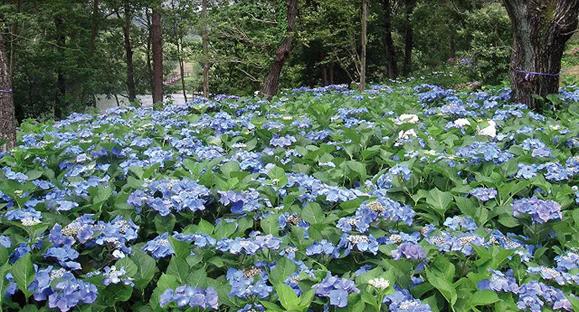
Hydrangeas are generally listed for mid-to-late June in the hydrangea garden. Later summer brings sunflowers, while kochia develops its green foliage before autumn colour. Plan a shorter morning visit in hot weather, carry water and rest in shade. The splash area operates seasonally and can close independently; its 2026 season has already finished.

Autumn: compare leaves and petals

Kochia is grown for rounded foliage that changes from green towards red; cosmos provides a different, flower-led display. October is the usual autumn focus, but current notices matter more than a fixed calendar. The park’s species pages identify cultivated kochia, garden cosmos and yellow cosmos displays. Do not treat them as wildflower records or assume the same bed layout returns every year.

Winter: plan for a different operating pattern

Winter Fantasy is a separate seasonal reason to visit, not evidence that woodland trails remain open after dark. The posted 2026–27 event period is 21 November–11 January. Check the actual event opening days and hours, parking category and return transport before committing to an evening outing; ordinary daytime information is not enough.

Blue and pale-purple hydrangea flowers fill a planted woodland slope beneath tree trunks.

Hydrangeas beneath trees at Manno Park, from the national government park website. The photograph is undated and does not show current flowering or access conditions.

Photo source: MLIT Shikoku Regional Development Bureau, Sanuki Manno National Government Park website. PDL1.0. Published image unchanged; photographer and capture date not identified. · www.digital.go.jp

Getting there and practical advice

Admission and parking

Ordinary admission is ¥450 for adults aged 15 and over, ¥210 for visitors aged 65 and over, and free for junior-high-school pupils and younger. Age evidence is requested for the senior rate. Admission and parking are cash-only. Normal standard-car parking is ¥320, but it rises to ¥2,000 on Winter Fantasy weekends, public holidays and specified peak dates; check the dated tariff. Campground, cycle hire and some activities cost extra.

Opening times and closure days

Normal opening is 09:30–17:00 in March–19 July and September–October; 09:30–18:00 from 20 July–31 August; and 09:30–16:30 in November–February. Tuesdays are normally closed, with holiday adjustments, plus 29 December–1 January and the fourth Wednesday–Friday in January. The published no-weekly-closure periods are 20 March–31 May, 20 July–31 August and 11 September–31 October. Events and severe weather can change arrangements.

Food and family facilities

The entrance visitor centre has a restaurant and shop; the restaurant normally takes last orders one hour before park closing. Ryuno Sato Rest House offers lighter food near the play area. Carry water and a backup snack for a longer outing rather than counting on every menu item. Nursing rooms are documented at the main and north information points; ask staff about their use.

Waterfall demonstrations and water play

From 12 October 2026, water restrictions reduced the Shoryu Falls demonstration to approximately five minutes at 11:00 and 14:00. The system uses recirculated water. Recheck before travelling specifically for it. The splash area closed for the season on 4 October; reopening is planned for late April 2027, not guaranteed. Its rules prohibit nappies, including swim nappies, and pets.

Arriving by car

The official access page gives about 25 minutes from Zentsuji Interchange, 35 minutes from Sakaide Interchange and 40 minutes from Mima Interchange, depending on traffic. It specifically recommends navigating to the North or West toll gate rather than the generic park pin, which may produce a broken route. Choose parking for your main area. The park address is 4243-12 Yoshino, Manno Town, Kagawa.

Arriving without a car

JR Kotohira, Kotoden Kotohira and Kotoden Okada stations are each described as roughly 15 minutes away by taxi. The Miai bus route serves Manno Koenguchi, about a 30-minute walk from the entrance plaza via the north gate. The park asks bus passengers to call before boarding about a possible pickup, which is not guaranteed when busy. Verify the current fare, timetable and return journey: the access page’s fare is explicitly dated 2022.

Use only the shuttle for your date

The autumn 2026 notice lists free Kotohira-station shuttles on weekends and public holidays from 12 September through 25 October. Timetables differ by date, and internal circulating buses have separate exceptions. This is not a year-round service. Read the current notice or ask the management centre on 0877-79-1700 before relying on it.

Match facilities to the actual journey

Accessible parking is provided in several areas, and the park documents multipurpose toilets and baby-changing provision. Wheelchairs, strollers, walking aids and other equipment can be borrowed free at the main or north information point, subject to availability and without reservations. Consult the barrier-free map and ask about gradients, surfaces and closures between the chosen parking space, toilet and destination. A raised flower bed or accessible deck does not certify the whole park.

Check concessions and woodland options

Specified Japanese disability documentation can qualify a visitor and one accompanying person for free entry, with parking concessions also described. Confirm what documents are accepted rather than assuming an overseas card is equivalent. For a nature-focused visit with limited mobility, ask about the ecological exhibition building and a short currently open approach before attempting woodland paths.

Keep to open paths

Observe closure barriers even if the next section looks clear; falling-tree risks cannot be judged from the entrance alone. Supervise children near water and play equipment, wear grippy shoes and shorten plans in heat or heavy rain. The park reported monkeys near the ecological garden in August 2026 and asks visitors not to approach or feed them. That warning is not a promised wildlife encounter.

Protect the landscape and other visitors

Leave flowers, insects and other living things where they are. Keep dogs leashed outside permitted off-leash enclosures and obey restricted-area rules. Bicycles belong on the dedicated cycle course, not pedestrian garden paths. Fires and cooking equipment are restricted to designated arrangements; a picnic lawn is not a barbecue site. Take rubbish away and leave room for others to pass.

Visitor information

Check closures before choosing a woodland route

Checked 20 October 2026: the park continues to display an 8 July notice closing several paths because oak wilt and other damage create falling-branch and falling-tree risks. Affected areas include parts of the campground approaches, the Natural Ecological Garden’s East and North valleys, the charcoal-kiln connection, Azalea Hill, Sanuki no Mori and Kohan no Mori. Kohan no Sato cannot be reached. Follow the current closure map and barriers, not an older walking leaflet.

Sources and useful links

Wildlife you might spot

4

Each card links to a full Explore page with photos, traits, and fun facts.

Snap map for this place

Start with the big picture, then zoom in to explore individual wildlife observations around this place.

Loading map…

Good to know before you go

Bring cash for admission and parking, even if you plan to use a card elsewhere.

Check your return transport before entering, then pick an area that leaves enough time to get back.

Give children a simple observation challenge: find three leaf shapes, hear two different sounds and sketch one flower without picking it.

Frequently asked questions

Not comfortably. Choose the central gardens or one flower area for a brief visit; leave woodland and cycling for another outing. The different zones are not one compact garden.
Not always. The 2026–27 Winter Fantasy has substantially higher parking charges on weekends, public holidays and specified peak dates. Check the dated fee notice before driving.
No. The designated splash area is seasonal and has its own rules. Its 2026 season ended on 4 October. Ponds and the waterfall are not substitutes for the closed play area.
No. Look, draw or photograph instead: the park prohibits collecting plants and catching animals. Guided activities do not create general permission to collect elsewhere.
No. Its western application-controlled area requires an accompanying guide. Even the general area is subject to current path closures; ask the ecological-garden office before setting out.
Leashed pets are allowed subject to area restrictions. The dog run has a separate reception procedure requiring registration identification, current rabies-vaccination documentation and agreement to its rules. Check before bringing a dog from overseas.

Recent snaps at this place

Recent snaps will appear here as new observations are added.

View all ›

Take the discovery with you

Exploring Sanuki Manno National Government Park?

Identify the wildlife you spot, learn as you go, and keep a collection of the adventure.

  1. 1Spot it
  2. 2Snap it
  3. 3Keep the discovery