Snappit logo
Snappit
Get App
Generic illustration, not a photograph of this venueIllustration
ParkIT

Terra delle Gravine Regional Nature Park

The surprise is how abruptly the land changes.

About

The surprise is how abruptly the land changes. An apparently open plateau breaks into deep, branching ravines, with sunlit rock above and greener, more sheltered vegetation below. These are the gravine that give the park its name. For a first encounter, Laterza offers the clearest practical starting point through its managed LIPU oasis. Monte Sant’Elia adds woodland and traditional farm buildings; Massafra brings the relationship between ravines and human settlement into focus. They are different outings, best chosen around your interests and the access available on your dates. Wondering what that bird or insect is? Find out on your visit using the Snappit nature app.

The park was established by Regional Law 18 of 2005. Its cultural landscape is much older: the park’s historical account describes the renewed importance of rock-cut homes, churches and rural religious communities in the early Middle Ages. These remains make more sense when seen alongside the farmland and water-management features that supported daily life. A cave opening is not automatically a visitable monument, and a story attached to a place may be local tradition rather than established history.

What to do here

Start with Laterza for canyon views, Monte Sant’Elia for woodland and rural heritage, or Massafra for rock-cut settlement history. Riggio near Grottaglie is a possible extra once permission and a guided visit are confirmed. Choose one main outing rather than collecting distant viewpoints.

Seasonal info

Access checked on 19 October 2026: LIPU currently requires Laterza visits to be booked with the oasis manager while its regulations are revised. Monte Sant’Elia also requires booking. Confirm your date, meeting point, route and price directly.

Accessibility

For a shorter outing, ask LIPU about the first lookout near the Laterza visitor centre. Discuss your walking or wheelchair needs before booking; suitability varies between the short approach, the rim trail and any descent.

Don't miss

1

The close contrast between exposed cliffs and sheltered ravine woodland

2

Laterza’s managed nature trails and wide canyon views

3

Monte Sant’Elia’s oak woodland, pasture and historic masseria

4

Rock-cut settlement history around Massafra and Grottaglie

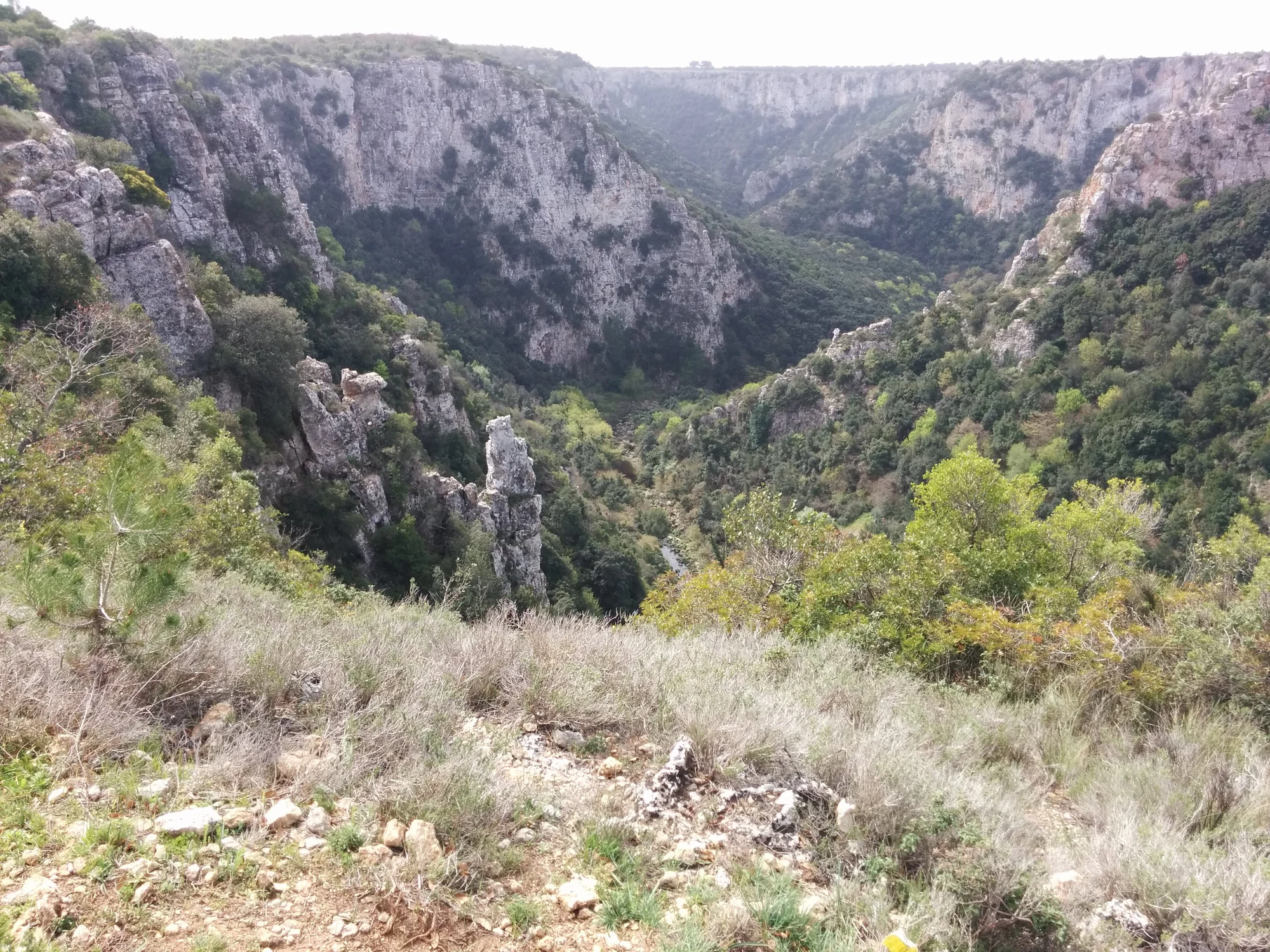
Pale, layered cliffs curve around a deep ravine filled with green vegetation, with scrub and rough rock in the foreground.

The cliffs and wooded slopes of Gravina di Laterza, photographed on 31 March 2018. This historical view shows the landscape, not the present state of a particular walking route.

“Parco naturale regionale Terra delle Gravine a Laterza.jpg” by GiovanniCzz, via Wikimedia Commons, CC BY-SA 4.0. Unmodified original. · Creative Commons

Walks and routes

Laterza: visitor centre to the first lookout

The municipal route account places the first lookout about 100 metres from the LIPU visitor centre. This is the approximate outward approach. Take time over the view, then return the same way.

The undated municipal description says this approach was designed for wheelchair users. Ask LIPU about its current surface, gradient, edge protection and assistance.


Laterza: visitor centre to the first lookout

Laterza: trail 3 along the ravine rim

Beyond the first lookout, the described junction separates trail 2 towards Grotta Croce from trail 3, which continues south along the rim. The published allowance is approximately four hours, with high difficulty. No dependable total distance or cumulative ascent is supplied. Agree the actual extent and return plan with LIPU.

Treat this as a hiking choice, not an extension of the wheelchair-designed approach. Ask about footing, exposure and any shortened guided option.

Laterza: trail 3 along the ravine rim

Two days without rushing

Give the first day to a booked Laterza outing and time in town. On a second day, choose Monte Sant’Elia or an arranged Massafra heritage visit. Let opening times and driving distance shape the order. Keeping the afternoons flexible leaves room for a longer conversation, a meal or a weather change.

A separate heritage outing in Massafra

The Madonna della Scala ravine and sanctuary show how natural rock and settlement history intertwine. The municipality describes a tour lasting about three hours, booked at least two days ahead, with a minimum of ten participants, a variable fee and transfers in your own vehicle from the Piazza Garibaldi information point. Confirm the current offer rather than arriving expecting a departure. The sanctuary approach has 127 steps, and the municipality warns that access is difficult for people with reduced mobility. These cultural stops are companions to a park trip, not a mapped continuous park trail. Read the municipal visit information.

Things to try

Monte Sant’Elia: woodland and a masseria

The WWF oasis near Massafra combines 93 hectares of woodland, pasture and fields around a masseria with late-seventeenth-century trulli. It offers a quieter look at the relationship between wooded slopes and traditional farming. WWF currently lists visits Monday to Friday, 09:00–13:00, by reservation. Ask the guide to choose a suitable walk and confirm any access needs. Plan a Monte Sant’Elia visit.

Riggio: arrange access before making plans

Near Grottaglie, Riggio combines a deep ravine with rock-cut remains, including churches and a medieval monastic complex. The regional description highlights the Caggione, a rounded hollow with caves on several levels. Water features are part of the setting, but do not expect a guaranteed flowing waterfall. Contact the tourism office through the regional Riggio listing to establish lawful access and an appropriate guide. Until that is confirmed, keep Riggio as a possible extra rather than a self-guided walking plan.

Make room for patient birdwatching

Stop safely on the authorised route and scan the sky and opposite slopes. A guide can help identify a distant falcon and explain why some areas must stay quiet. Bring binoculars and let birds come into view; never approach a cliff or nest for a closer look.

Give a wet day to town

Ask whether the booked visitor-centre activities can still take place indoors, or move the outdoor visit to another day. Grottaglie’s ceramics quarter offers a different way to understand local craft and settlement, subject to the individual workshops’ opening hours. Do not substitute an unaccompanied cave visit for a cancelled walk: cave openings, wet steps and ravine access bring their own risks. The town outing is outside the scope of a park-trail recommendation.

Wildlife and habitats

Lanner falcon

One of the ravines’ important birds of prey. Watch distant flights from permitted paths, giving breeding birds the quiet space they need.

Egyptian vulture

A special possibility rather than an expected encounter. Enjoy any bird passing overhead from a distance, without trying to follow it to a nesting site.

Common raven

A bird of the rocky landscape. Listen and watch from a safe stopping point, letting it cross the ravine without approaching occupied ledges.

Crested porcupine

Part of the ravines’ mammal life, though an encounter is never assured. Give any animal room to move and leave dens undisturbed.

Holm oak

An evergreen oak of the park’s woodland and scrub, particularly in warmer, drier settings. Look for the contrast between wooded slopes and open rock.

Mastic

A characteristic shrub in the park’s Mediterranean vegetation, also recorded beneath Aleppo pine. Observe the plants from the established path.

Aleppo pine

Included in the park’s vegetation account. Some pine stands at Monte Sant’Elia are described by WWF as replantings, so pine cover should not automatically be called ancient natural forest.

Stories and discoveries

These ravines are not all shaped in the same way

The pale rock began as marine carbonate deposits. Later land movements, changing sea levels, flowing water and weathering helped create the landscape. The park’s geological account distinguishes deeply incised valleys from others where water working along rock layers weakened the material and encouraged collapse. Look across the cliffs for differences in shape rather than expecting every gravina to be a miniature version of Laterza. Water may be scarce for long periods and still run through with considerable force after rain.

A few metres can change the habitat

Exposed upper slopes and cooler, damper ravine bottoms offer different growing conditions. The vegetation account describes holm oak in warmer, drier settings, Macedonian oak, locally called fragno, in other woodland, and moisture-loving communities lower down. Dry grassland, scrub, cultivated fields and wooded slopes all contribute to the mosaic. What can look like “empty” open ground may be valuable habitat; stay on the path even when a shortcut seems harmless.

When to visit

Spring: flowers and bird activity

Spring brings flowers and bird migration through the ravine country, with timing varying by year. Take time to notice the change from grassland to scrub and oak woodland. A local naturalist can help you see more; photograph plants without trampling the surrounding ground.

Summer: heat and fire change the plan

Prefer short, early outings that the operator has confirmed. Puglia’s 2026 decree set the high fire-danger period at 15 June–15 September, with possible extension. It restricted fires, smoking and parking on dry vegetation in at-risk areas. Those dates are not a permanent annual calendar: check the latest decree and local orders for your visit. Keep vehicles in authorised places and never light a fire or stove on a nature outing.

Autumn and winter: respect water and shorter days

Build a generous daylight margin into the return, wear layers and reconsider exposed walking in strong wind. In heavy rain or thunderstorms, avoid ravine floors and drainage channels. The regional civil-protection guidance stresses that small-watercourse floods and storm impacts can be difficult to forecast precisely. Check the official alert links before setting out, then follow local instructions even if the sky above you looks clear.

Getting there and practical advice

Use the managed starting points

LIPU lists parking, a visitor centre with a teaching room and ravine diorama, and interpreted nature trails. Ask which services are available for your booking, including toilets and drinking water. The park also lists WWF Monte Sant’Elia as a visitor contact.

Booking contacts

For Laterza, contact LIPU on +39 339 3311947 or [email protected]. For Monte Sant’Elia, WWF lists +39 320 6067922 and [email protected]. Describe the size of your group, preferred date and walking or access needs, and ask for the current total cost and cancellation arrangements. Keep the confirmed meeting instructions available offline.

Choose a destination before you drive

For Laterza, use the LIPU visitor centre on Via Selva S. Vito at the southern edge of town as the booking destination. Its operator describes access via the SS7 and Laterza town. Monte Sant’Elia is a separate rural destination off the Mottola–Martina Franca road; ask WWF which approach and final access road to use. A car can make a multi-area trip easier, but do not follow an app onto farm tracks simply because they appear to shorten the journey.

Check the Laterza bus notice, then the last connection

CTP operates links between the Laterza, Ginosa and Taranto areas. Its notice changes several departure times from 21 September 2026. Use the current CTP notice together with the timetable for your travel day, checking weekday, school-day and holiday operation. A bus to town is not a confirmed shuttle to an oasis: arrange the last section and your return before committing to a timed visit. No departure time is fixed in this guide.

Plan around the specific route

Ask about the complete journey from parking or drop-off to the viewpoint, including toilets and whether a companion is needed. With children, choose a supervised visit matched to their stamina. Do not assume woodland means step-free access; confirm the particular route. Massafra’s sanctuary stairs are a substantial separate barrier.

Sources and useful links

Wildlife you might spot

7

Each card links to a full Explore page with photos, traits, and fun facts.

Snap map for this place

Start with the big picture, then zoom in to explore individual wildlife observations around this place.

Loading map…

Good to know before you go

Wear footwear with good grip and carry water, a hat and sun protection. Do not count on drinking-water points along a walk.

Agree a turn-around point before starting. The return from a descent still has to be climbed, and an impressive viewpoint does not require reaching the ravine floor.

Keep children beside you near drops. Put the camera away while moving over uneven ground, and never step closer to an edge for a better angle.

Watch birds from established paths with binoculars. Do not approach nests, enter caves to find bats, or publish precise locations of sensitive wildlife.

Leave flowers, rocks and archaeological material where they are. Close any authorised access gate as instructed and respect working farmland.

Ask about dogs, toilets, parking arrangements and cancellations when booking; rules and facilities belong to the particular site, not to one park-wide promise.

Frequently asked questions

Choose Laterza and contact LIPU first. Ask for a visit matching your walking ability and keep the rest of the morning flexible. If a suitable visit is unavailable, change the plan rather than entering through an unverified track.
Visits are organised through individual sites and providers. Ask your oasis or guide what is included and whether group minimums or separate monument admission apply. Do not rely on the old price shown on Laterza’s trail page.
Only consider a descent after the responsible local operator confirms the exact route, access permission and conditions. A dry streambed can receive fast-moving water, and apparent paths may lead onto private land or exposed ground. For a first visit, the rim or a properly arranged guided outing is the more sensible choice.
There is no guarantee. Egyptian vulture and lanner falcon are among the birds recorded by the park authority, but that list is not a live sightings report. Enjoy any distant observation without searching for nests.
No. Town centres, museums and neighbouring landscapes can enrich a trip without lying inside the legal boundary. Check the park cartography when the location of a particular attraction matters.

Recent snaps at this place

Recent snaps will appear here as new observations are added.

View all ›

Take the discovery with you

Exploring Terra delle Gravine Regional Nature Park?

Identify the wildlife you spot, learn as you go, and keep a collection of the adventure.

  1. 1Spot it
  2. 2Snap it
  3. 3Keep the discovery