Snappit logo
Snappit
Get App
Generic illustration, not a photograph of this venueIllustration
ParkComunitat Valenciana, Spain

University of Valencia Botanical Garden

A short botanical visit here can change the way you look at the rest of Valencia.

About

A short botanical visit here can change the way you look at the rest of Valencia. Step into the Universitat de València’s garden on Carrer de Quart and start with something simple: the outline of a leaf, the shape of a tree crown or two plants sharing a family name. The university’s roughly four-hectare living collection gives those small discoveries a much bigger context.

The Escuela Botánica, or Escola Botànica in Valencian, is the best starting point. Its beds bring related flowering plants together, so the labels help you make comparisons rather than simply collect names. Choose a few beds and look carefully. You will get more from spotting one shared feature than from trying to read every label.

Then change the question. In the dry-climate and aquatic collections, consider how plants deal with very different supplies of water. Around the palms, compare the silhouettes above you. The garden also has useful plants and geographical collections, including Valencian flora, Mediterranean endemics and plants of Macaronesia. Most of the collection is outdoors, which makes a satisfying visit possible without entering every greenhouse.

Architecture is part of the pleasure too. The arched tropical greenhouse and the metal-and-brick Umbracle give the planting distinctive settings. They were built to create conditions that plants needed, so they belong to the story of the collection. Leave room to pause here, and treat any open greenhouse as an optional extra after checking its entrance and visiting arrangements. Enhance your adventure: download the Snappit app to identify the local species you encounter.

The university founded its botanical garden in 1567 to support the teaching of medicine through medicinal plants. It moved between several sites before settling in the Huerto de Tramoyeres in 1802, outside the old city walls near the Torres de Quart. During the nineteenth century it developed as a place for botanical teaching and experiments with useful crops and plant acclimatisation. Later decline was followed by a university-led restoration begun in 1987 and completed in 2000. The public garden remains connected to research, education and the conservation of Mediterranean plants.

What to do here

Begin with a few Escuela Botánica beds, add the outdoor palms, then choose one contrast: desert and aquatic plants, or the useful-plant collections. Finish by looking at the Umbracle and tropical greenhouse. Use the official plan to connect the stops; you do not need to cover all 27 collections.

Seasonal info

The useful-plant beds change with the growing season, while flowering, fruit and leaf cover give repeat visits a different emphasis. A greenhouse does not make this an all-weather destination: the garden’s published rules allow closure on windy or rainy days. Check before setting out in unsettled weather.

Accessibility

Visit València describes level access and mainly flat, compacted-earth outdoor paths, with benches and an adapted toilet near the entrance. Ask staff to connect your chosen collections using the best surfaces that day. Historic greenhouse entrances can present difficulties; confirm each interior separately if you use a wheelchair or pushchair.

Don't miss

1

The Escuela Botánica, where plant families become easier to recognise

2

Outdoor palms and contrasting desert, aquatic and shade-loving collections

3

The arched tropical greenhouse and the historic Umbracle

4

Useful plants that connect botany with crops, food and everyday life

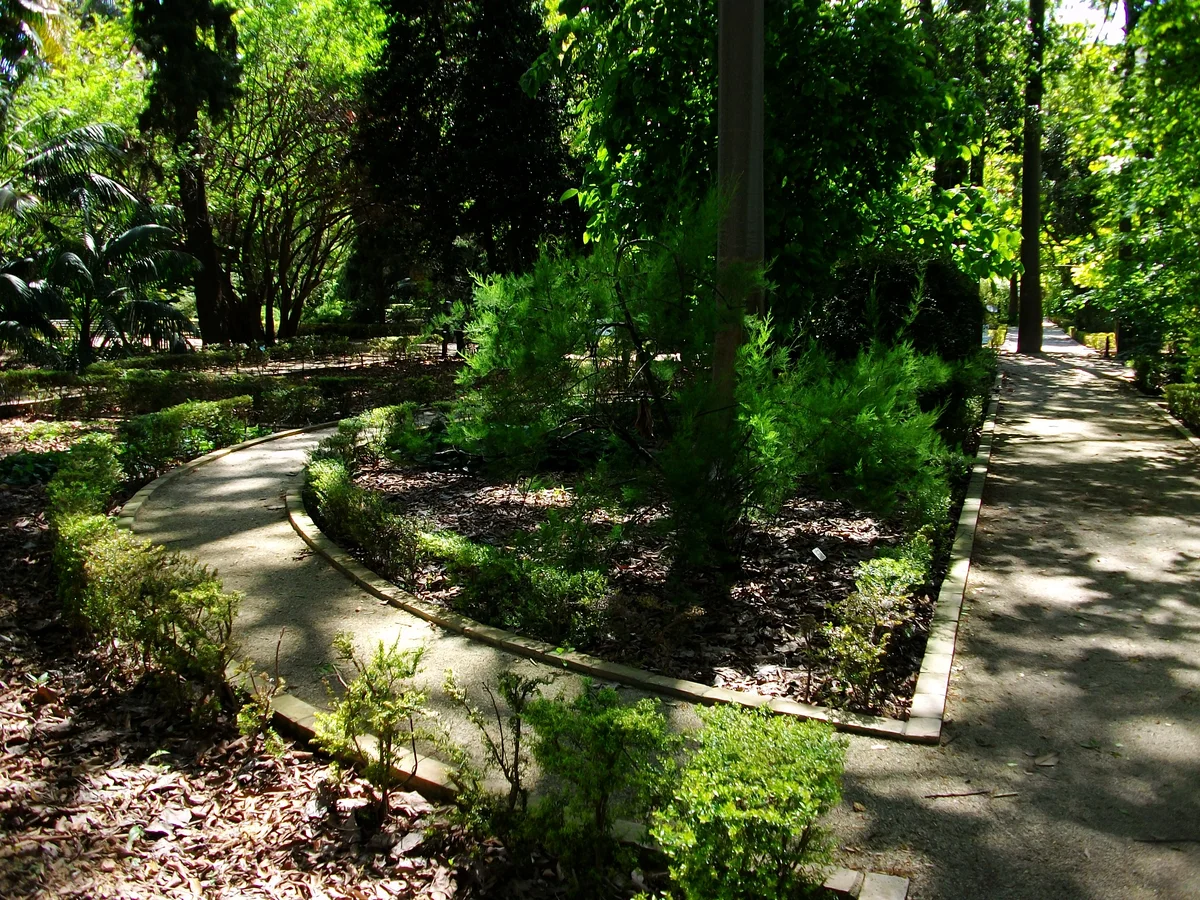
Intersecting garden paths around planted beds beneath mature trees in Valencia’s botanic garden.

Paths and planted beds in the Jardí Botànic de la Universitat de València, photographed in May 2010.

Jardí Botànic de València, escola botànica.JPG — Joanbanjo / Wikimedia Commons / CC BY-SA 3.0 · Creative Commons

Walks and routes

First visit: families of plants and palms

Allow 45–60 minutes to choose several Escuela Botánica beds and an outdoor palm stop. Read a family name, compare two labelled plants, then look up at the different crowns. Use the garden plan for the connections and return. This is a selection of stops, not an official marked circuit.

For a short, level outing, ask staff to connect the selected beds on the firmest outdoor paths. You can keep this visit entirely outside.


Add a contrast: water, dry conditions and shade

Give yourself another 30–45 minutes for selected desert and aquatic displays and the Umbracle surroundings. Compare the plants’ overall shapes before looking at the labels. Ask which nearby greenhouse is open if you would like one indoor stop; there is no need to enter them all.

Check the specific approaches to water features and historic structures. Stay behind planting edges and choose an outdoor alternative if an entrance is awkward.

A food-and-plants detour

Allow an extra 20–30 minutes to pick a useful-plant theme from the plan: crops, fruit trees, citrus or medicinal plants. The planting varies with the season. Ask everyone to name something they use at home that starts with a plant, then see whether a label helps make the connection.

Keep to the paths between beds; do not step into planting to read a label. Ask staff for a closer explanation if a sign cannot be read comfortably.

A relaxed two-hour plan

Spend the first hour with the Escuela Botánica and palms, take a bench break, then choose either the water-and-shade comparison or useful plants. Keep the final minutes for a favourite stop and the return to the gate. Shorten the plan whenever interest or energy fades.

Things to try

Try a plant-family detective game

Choose two plants in the same Escuela Botánica bed. Before reading more, describe one feature they share and one that differs. Leaves, stems and flowers give different clues, so an answer does not need to be right first time. Finish by checking the labels together.

Sketch a plant’s problem and solution

At one dry-climate display and one aquatic display, sketch the outline of a plant without collecting anything. Ask what its surroundings supply easily and what might be difficult. Use the interpretation to test your ideas about water, light and growth.

Choose a dated guided visit

The 2026–2027 programme offers selected Saturday visits for general visitors and Sunday family visits with a workshop. Languages alternate between Valencian and Spanish. Autumn–winter visits are advertised at 11:00, with limited places. Use the dated calendar and booking link; the programme does not run on every weekend.

Use a few audio stops well

The free audio guide covers trees, greenhouses and historic buildings in Valencian, Spanish and English. Ask at the ticket office, then choose a handful of stops rather than trying to finish every recording. Leave room for the things that catch your eye between them.

Explore a greenhouse from indoors

If weather prevents a visit, open the university’s virtual greenhouse tours. They include the tropical, orchid, fern, bromeliad and carnivorous-plant houses. Use them as a preview for a later visit, or to explore an interior that is difficult for you to enter.

Wildlife and habitats

Bear’s breeches

Look for its broad, deeply cut leaves in the Escuela Botánica or Valencian-flora collection, using the label to confirm the plant. When flower spikes are present, compare their shape with the leaves below. A simple outline sketch is a good way to slow down.

Swan-neck agave

The succulent collection includes this agave. Find the name on a label, then compare the outline and arrangement of its leaves with another nearby succulent. Keep hands clear of neighbouring spines even when the plant you are studying looks inviting.

Black maidenhair fern

The catalogue places this fern in the endemic rockery and Valencian-flora collections. Look at the divisions of a frond from the path and compare its overall pattern with a flowering plant nearby. Ask for help locating the label rather than entering a rockery.

Common fig

The fruit-tree collection includes the common fig. Look for its broad crown and large leaves in the growing season, then read the label. If figs are present, leave them on the tree: this is a collection to study rather than fruit to pick.

Canary Island palm

The garden catalogue includes the Canary Island palm in its palm and teaching collections, among others. Compare its dense crown of feather-like leaves with other labelled palms. Keep clear of the lower leaf bases, where leaflets become spines.

These are cultivated plants documented in the garden’s catalogue. Displays and labels can change, so ask staff if you cannot find a particular plant. Use the label to distinguish similar species and enjoy whatever is in good view that day.

Stories and discoveries

A teaching collection that has changed with science

The Escuela Botánica has been present since 1802. Its arrangement has evolved with botanical classification, while the basic idea of bringing related plants together remains a useful way to learn from living examples.

A building designed to filter light

Arturo Mélida designed the Umbracle’s broad curved metal canopy on brick supports. Its historical purpose was to provide shade; looking at the structure makes the needs of shade-loving plants part of the architecture story.

More than the outdoor beds

The garden’s scientific work also involves a herbarium and a germplasm bank, alongside the living plants. These are research and conservation collections, rather than extra rooms to assume are open with ordinary admission.

When to visit

Spring: choose what is happening now

Use a mild morning for the outdoor collections and ask which beds are currently flowering. Make a flower-focused stop a bonus rather than the only reason for the trip.

Summer: a shorter first circuit

Begin at 10:00, bring water and alternate open displays with shaded pauses. Save energy for one well-chosen comparison instead of stretching the visit simply because the garden closes later.

Autumn: notice changing form

Compare leafy and less-leafy crowns, developing fruit and the changing crop beds. Let the labels and what is actually growing shape your route.

Winter: use the shorter day

Allow time to finish before the 18:00 winter closing time. Structural shapes and evergreen collections can be rewarding when flowers are sparse; ask what is worth seeing that week.

Getting there and practical advice

Opening hours and weather

The published schedule, checked on 17 October 2026, is 10:00–18:00 in November–February; 10:00–19:00 in March and October; 10:00–20:00 in April and September; and 10:00–21:00 in May–August. It normally opens daily, including Mondays, but closes on 25 December and 1 January and can close for wind or rain.

Admission and concessions

The 2026 ordinary ticket costs €4. The €1.70 reduced rate covers several groups, including children aged 7–16, over-65s and eligible students. Under-7s in family groups and companions of dependent visitors are among the free-entry categories. A Valencia Tourist Card rate of €3.60 is listed. Check eligibility and bring proof; payments may be cash or card.

Start at Carrer de Quart, 80

Use the public entrance on Carrer de Quart. Ask for a plan, check the day’s building access, and locate the toilet before exploring if needed. The official accessibility description places an adapted toilet beside the entrance; confirm its current facilities with staff.

Breaks and refreshments

Benches are described along the outdoor route. Carry drinking water and plan a meal outside if that suits your day; retain your ticket for permitted same-day re-entry. Ask staff about any refreshments or eating arrangements on site rather than relying on a café being available.

Ask the garden directly

For general information, the published numbers are +34 963 156 800 and +34 963 156 817. For arranged educational visits, use +34 963 156 818 or [email protected]. Explain any route, toilet or language needs before travelling.

Approach from the city

The operator identifies Túria and Àngel Guimerà as nearby metro options. Use the current Metrovalencia journey planner to choose your train and the onward street route to Carrer de Quart, 80. Bus stops also serve the surrounding streets; check today’s route rather than relying on an old printed list.

Plan the whole accessible connection

Àngel Guimerà is included in Visit València’s information about adapted metro access and boarding platforms. Check lifts and the appropriate exit with Metrovalencia before travelling, then confirm the street-level approach. The garden’s level entrance does not by itself establish that a particular station-to-gate journey is step-free.

Outdoor paths and rest stops

The tourism accessibility description reports an even, mainly compacted-earth route without changes of level and with regular benches. Conditions can change with rain or maintenance. Start with the outdoor teaching beds and ask staff to identify a comfortable return route for your wheelchair, walking aid or pushchair.

Treat greenhouse access separately

The university acknowledges that the historical design of some spaces can cause mobility difficulties. Ask about the threshold, usable doorway and internal circulation of each greenhouse you want to enter. Official virtual visits offer another way to see the collections where physical access does not suit you.

Reading and listening

Some plant labels are small, according to the accessibility description. The free audio guide may be useful if reading many labels is tiring; ask about language and availability. For a supported group experience, discuss your needs with the education team when arranging a visit.

Sources and useful links

Wildlife you might spot

5

Each card links to a full Explore page with photos, traits, and fun facts.

Snap map for this place

Start with the big picture, then zoom in to explore individual wildlife observations around this place.

Loading map…

Good to know before you go

Start with three collections rather than a target to see everything. Let children choose one plant to investigate properly.

Ask for the plan and the free audio guide at the ticket office; check that an English device is available.

Keep your admission ticket if you want to leave for a break: the rules allow same-day re-entry.

Stay on the paths and supervise children, especially by water and spiny plants. Do not pick, taste or handle unfamiliar plants.

Bring water and shoes that suit compacted-earth paths. After rain, ask which surfaces are easiest to use.

Leave pets at home. Assistance dogs accompanying people with disabilities are allowed.

Do not feed the garden’s cats. Their volunteer carers manage food and health needs.

Book a dated guided visit separately, and check its language and audience. Family workshops are scheduled activities.

Frequently asked questions

No. This is a separate, enclosed university garden entered from Carrer de Quart, 80. Plan the Botanical Garden as its own visit; a walk in the Turia gardens does not include admission here.
You can explore independently. A plan and audio guide help you choose stops, while the published guided programme offers selected dates for general visitors and families. Reserve the specific activity if you want to join it.
The tariff effective from 1 January 2026 is €4. Children aged 7–16 qualify for €1.70 admission; children under 7 enter free when visiting with a family. Other concessions have their own eligibility rules, so bring proof and check the official ticket page.
The outdoor paths are described as level and mainly compacted earth. Ask the ticket office to show the best connected route and confirm the entrance-side toilet meets your needs. Greenhouse access needs a separate check.
No. This is a cultivated collection from many parts of the world. The Valencian-flora collection gives a local focus, but a plant label’s native range is not evidence that the plant grows wild in Valencia.
Choose another day if the garden closes for wind or rain. You can explore its official virtual greenhouse visits from indoors. Do not rely on the glasshouses as shelter when the outdoor garden is closed.
Make this a quiet exploring visit. Ball games, skates and cycling through the collection are prohibited. There is a designated bicycle-parking area near the beginning of the garden.
You can take photographs during opening hours if everyone in the session has a ticket, you stay on the paths, keep public areas open and follow the garden’s photography rules. Equipment is limited to a camera, flash and tripod; props, costume changes and extra lighting are not allowed. Sessions that cannot meet these conditions need the garden’s express authorization and may incur a charge. Check the rules before organising a professional or commercial shoot.

Recent snaps at this place

Recent snaps will appear here as new observations are added.

View all ›

Take the discovery with you

Exploring University of Valencia Botanical Garden?

Identify the wildlife you spot, learn as you go, and keep a collection of the adventure.

  1. 1Spot it
  2. 2Snap it
  3. 3Keep the discovery