Snappit logo
Snappit
Get App
Generic illustration, not a photograph of this venueIllustration
ParkKyushu, Japan

Unzen-Amakusa National Park

Unzen makes a volcano visit possible without a summit climb.

About

Unzen makes a volcano visit possible without a summit climb. In the hot-spring town, pale ground steams beside the streets, small mud cones change shape, and trees gather around the edges of the geothermal field. Begin at Unzen Visitor Center, locally called Unzen Oyamano Johokan, then spend an unhurried hour or so on the open Jigoku paths. If everyone still wants to walk, the wooded shore of Shirakumo-no-ike offers a gentler change of scene.

This is one corner of a much larger national park. Unzen-Amakusa spans parts of Nagasaki, Kumamoto and Kagoshima, bringing together the volcanic mountains of the Shimabara Peninsula and the islands and coasts of Amakusa. The visitor center and town walk described here are in Nagasaki. Dolphin boats, island viewpoints and marine activities belong to a separate Amakusa outing, with their own travel and weather decisions.

The center helps connect what you see to what lies underground. Use the model of the Shimabara Peninsula to place the mountains and bays, then explore the exhibits on volcanoes and hot springs. Ask staff which paths are open before setting off. The main information building and its historical annex are different places, with different weekly opening arrangements; the annex is useful for old photographs and a quiet break.

Outside, Jigoku means “hell,” a name that fits the hissing vents and clouds of steam. Look for the gray-white clay-like ground, altered by heat and acidic water, and the pale mineral crusts around outlets. At the mud volcano area, escaping gas pushes sticky wet sediment into miniature cones. Daikyokan Jigoku is known for vigorous steam, but a large plume is only one part of the story: a bubbling patch or a newly shaped mud cone can be just as absorbing. View everything from the open paths and platforms.

Notice how quickly the plant cover changes near the hot ground. Grasses and low shrubs occupy places that feel very different from the surrounding woodland; red pines rise farther back. In spring, Miyama Kirishima azaleas add pink to the Unzen landscape. Warm spots around the Jigoku can flower earlier than Ikenohara or Nita Pass, so a single blossom forecast cannot describe the whole mountain. Take a photograph or make a sketch rather than picking a specimen.

For a quieter finish, ask about the walking approach to Shirakumo-no-ike, a small artificial pond surrounded by forest. Pause at the shore and listen before looking for birds. Long-tailed tits can move through the trees in little groups, while a jay may announce itself before it appears. Returning to town for lunch or a bath makes a satisfying half-day. Climbing Kinugasayama above the pond, continuing to the high Fugen trails, and traveling to Amakusa all deserve separate time and preparation. Planning to visit? Download the Snappit app to identify the wildlife you spot in real-time.

Unzen was designated on 16 March 1934 as one of Japan’s first national parks, alongside Setonaikai and Kirishima. The Amakusa area was added in 1956. The town had already developed as a summer retreat for overseas visitors, and the center’s historical displays help explain that resort culture. The Jigoku also holds a much darker history: Christians were persecuted and tortured here in the seventeenth century. The Christian martyrs’ memorial deserves a quiet, respectful stop. More recently, the eruptions that began at Fugen in 1990 reshaped the eastern mountain landscape and formed the Heisei Shinzan lava dome; the town’s geothermal paths and the restricted dome are distinct places.


What to do here

Start with the peninsula model and hot-spring exhibits, collect the current walking advice, then explore a short selection of open Jigoku paths. Compare a steam vent, bubbling water and the mud-cone area without leaving the walkway. Add a forest-and-pond pause at Shirakumo-no-ike if the paths and weather suit your group. A staffed guided walk is another good way to understand the town’s geology and history.

Seasonal info

Unzen Onsen sits around 700 m above sea level, so pack a warmer layer than you might need on the coast. Summer brings green woodland as well as heavy rain and storm disruption. Winter can bring snow and ice to roads and paths. Rime ice on the upper mountains is a separate winter-mountain experience; do not follow a summer hiking plan to reach it. Recheck trail notices after rain and before any mountain extension.

Accessibility

The visitor center lists two wheelchairs for same-day loans; ask about availability and the best entrance before traveling. For the Jigoku, ask staff to mark a short route suited to your wheelchair, stroller or walking needs, including a usable toilet and return point. Paths include changes of level and different surfaces, and closures can interrupt a convenient circuit. Do not assume the full geothermal walk, pond approach, ropeway stations or mountain trails are step-free.

Don't miss

1

Unzen Visitor Center’s peninsula model and volcano-and-hot-spring exhibits

2

The steam, pale ground and small mud cones of Unzen Jigoku

3

A woodland pause beside Shirakumo-no-ike

4

Spring azaleas and autumn leaves, with seasons changing up the mountain

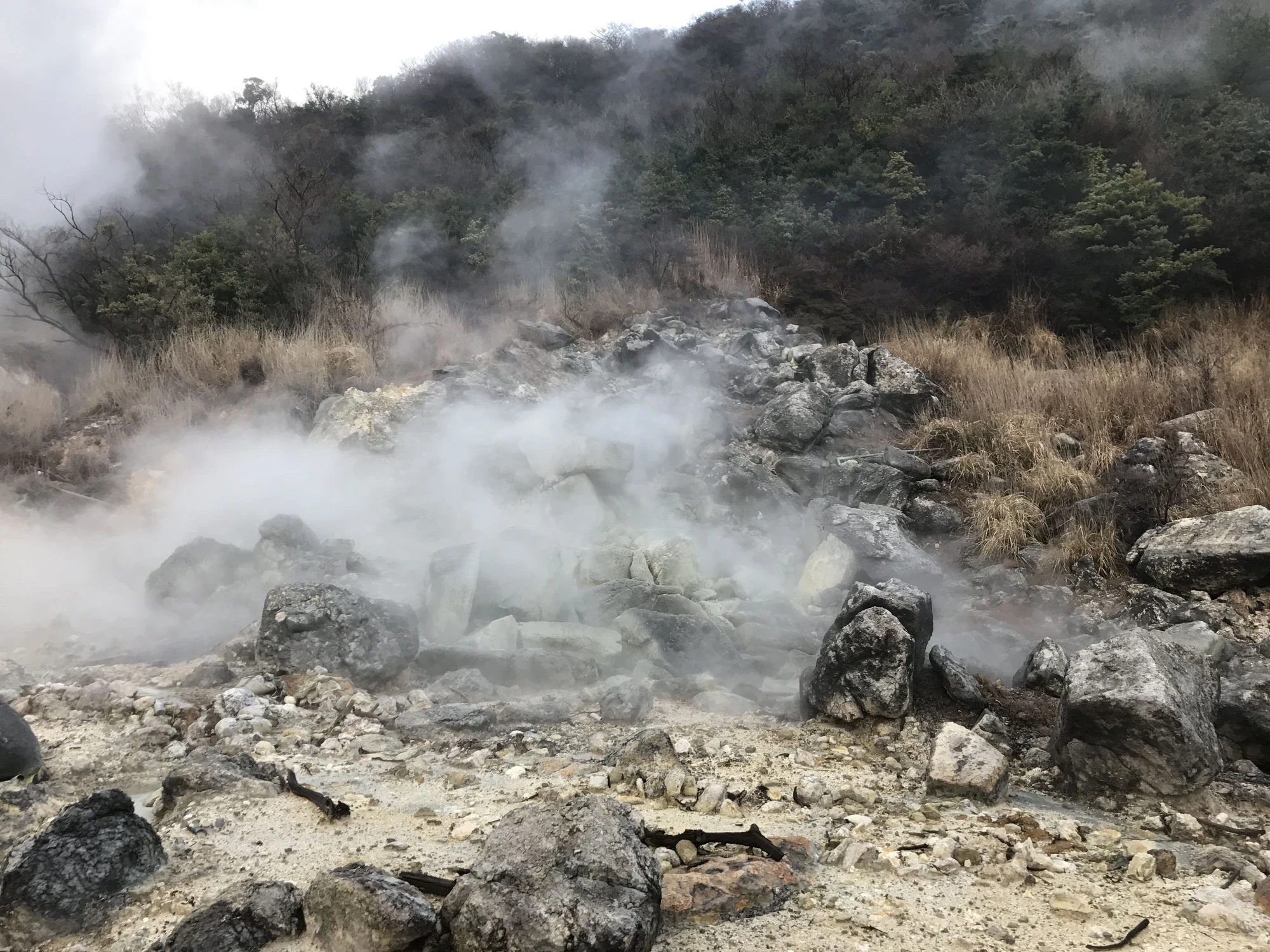
White steam drifts between pale rocks and dry grasses beneath a wooded slope at Unzen Jigoku.

Steam rising among pale rocks at Jaken Jigoku in Unzen, photographed on 26 March 2017. View geothermal features only from open marked paths.

NAGASAKI UNZEN JIGOKU.jpg — Tomo04h19, CC BY-SA 4.0 (https://creativecommons.org/licenses/by-sa/4.0/). Source: https://commons.wikimedia.org/wiki/File:NAGASAKI_UNZEN_JIGOKU.jpg. Resized and recompressed as WebP; no crop or retouching. · Creative Commons

Walks and routes

A short Jigoku exploration

After the center, use its current leaflet to choose a short route through open town-side Jigoku paths. Include the mud-cone area and a steam viewpoint if their approaches are open. Return to town whenever you have seen enough; completing every named “hell” is not the aim.

Ask for the easiest currently usable approach and a return point. Walking surfaces and changes of level vary, and steam or slippery ground may make a shorter visit preferable.

A short Jigoku exploration

A forest-and-pond extension

Ask staff for the open town approach to Shirakumo-no-ike, then walk to the wooded shore and return. The center’s bird guide places the pond around 15 minutes away on foot, but allow more for a family pace and time by the water. Keep this a pond visit rather than automatically continuing uphill.

Check the approach for slopes, wet surfaces and suitability for your mobility needs. The pond is a natural waterside setting, so supervise children closely and use a turnaround that suits the group.

A forest-and-pond extension

Kinugasayama: a separate hill walk

Kinugasayama rises above Shirakumo-no-ike and has long been known as Sunset Hill. The ministry describes the climb from Unzen town as roughly an hour, but that is not a full return-trip allowance. If you want to climb it, ask the center for the current route, descent time and footwear advice before setting off.

This is a hill climb with a different effort level from a pond pause. It is not offered as a step-free extension.

Kinugasayama: a separate hill walk

A relaxed half-day in Unzen

3–4 hours on site, including a meal and an optional pond walk

Start at the main visitor center when it opens. Look at the model, ask about closures and confirm your return transport.

Spend 45–75 minutes exploring a manageable selection of open Jigoku paths. Stop to compare steam, mineral ground and mud cones.

Return to town for lunch or a break. If the weather or walking is becoming tiring, finish here.

If the group still wants more nature, take the staff-recommended approach to Shirakumo-no-ike, pause by the forest and water, then return to town.

Things to try

Read the landscape before the walk

Spend 20–30 minutes at the center’s model and exhibits. Find Tachibana Bay, the mountain group and the hot-spring town, then ask a staff member how today’s path advice fits that landscape. Children can choose one question to answer outside: why is the ground white, where does the steam come from, or why do plants stop growing in some patches?

Watch mud build a miniature cone

From an open boardwalk, compare the mud volcano with a steam outlet. A wet mound can look quite different from a drier one because gas is moving through sticky sediment. Sketch a shape or take a close-looking photograph with zoom. Stay behind the edge rather than leaning over it, and leave the mud untouched.

Find the edge of the hot-ground habitat

Look across the geothermal field from an open marked viewing point. Compare open mineral ground, clumps of grass, low shrubs and taller pines. The changing vegetation gives a visible clue to a changing environment. The challenge is to notice the pattern from the path, not to test the ground’s temperature.

Listen at Shirakumo-no-ike

Choose an open place beside the pond where your group can stand clear of other walkers. Spend a quiet minute listening, then look for movement in the surrounding branches. Compare the sheltered woodland sounds with the hissing geothermal field. Keep children back from the water and turn around whenever the return walk feels long enough.

Ask about a guided nature walk

The Natural Parks Foundation lists roughly one-hour town walks, two-hour nature outings and three-hour hill walks, with routes discussed to suit the group. Ask the center about availability, language, price and the current route before booking. A longer advertised course is not a reason to ignore today’s closure.

Add an onsen or a seasonal water activity

A managed bath in town is an easy way to finish. For a different visit, the tourism bureau lists guided packrafting at Shirakumo-no-ike; ask about dates, weather, age and swimming requirements, equipment and supervision. Book it as an activity with its own time allowance, rather than assuming you can simply launch a boat.

Make the exhibits the main event

Spend longer with the hot-spring science displays, historical material and peninsula model. If the annex is open, use its sheltered rest area and old photographs for a quieter second stop. A town meal or a managed bath can replace the pond walk. In severe weather, follow transport advice and postpone the outing rather than treating the center as a reason to travel on unsafe roads.

Wildlife and habitats

Grey wagtail

Look for a slim bird with a long, frequently bobbing tail, a gray back and yellow underneath. Observe only from an open path; never follow it toward a vent or a nest.

Long-tailed tit

A tiny body and an exceptionally long tail give this bird a distinctive outline. Watch for small groups moving through branches and look for the dark stripes along the head.

Eurasian jay

A harsh call may be the first clue. When one moves between trees, look for the contrasting blue, black and white on its wings. A quiet stop gives you a better chance than chasing the sound.

Kousa dogwood

The showy white parts are bracts surrounding a cluster of small flowers. Look across the canopy for pale patches in June, then ask staff where a suitable open path gives a closer view. This is an extra seasonal interest in the wider mountains, rather than a required stop on the town walk.

These are things to look and listen for, not a checklist to complete. Sightings vary with season, weather and your luck. Stay on open paths, give birds space and avoid nests; the dogwood entry describes the wider Unzen mountains.

Stories and discoveries

The heat source is not simply a pool of magma beneath the path

The local geological interpretation connects Unzen’s hot springs with a magma system extending from beneath Tachibana Bay. Hot gases rise through fractures and mix with groundwater. That is why the center’s peninsula model adds so much to a short town walk.

A white surface can be altered rock

The pale ground around Jigoku includes rock changed into clay-like material by hot, acidic conditions. Mineral deposits around vents add other pale tones. The surface is interesting to look at, but it is not a stable place to stand.

A wetland can follow a geothermal landscape

The nearby Genseinuma wetland is thought to have developed where geothermal activity weakened. Its mossy wetland contrasts with the active Jigoku. Ask the center whether its viewing path is open if you would like another short nature stop. Stay on any permitted boardwalk and out of the vegetation.

Some famous flower scenery has a farming history

In the wider Unzen area, Miyama Kirishima colonies are associated with former or continuing grazing land. At Tashirobaru, conservation work helps maintain the azaleas as grazing patterns change. That landscape is a separate excursion from the hot-spring-town walk.

Mount Unzen is a group of peaks

The name covers a mountain group rather than one simple cone. Older volcanic landforms, Fugen and the newer Heisei Shinzan dome tell different parts of the story. A town geothermal walk can introduce that history without approaching the restricted lava dome.

When to visit

Spring: follow the flowers uphill

Azaleas can begin around the warm Jigoku in late April, with May the broader Unzen season. Ikenohara and Nita Pass flower at different times; ask which area is actually in bloom and reachable. Enjoy fresh leaves and woodland birds even if flowering is early or late.

Early summer: dogwood and wet-weather choices

Dogwoods are a feature of the wider mountains in June, sometimes into early July. Their pale bracts brighten the canopy. Rain can also interrupt walks, so put the exhibits first and treat any woodland extension as optional.

Autumn: the town and high slopes differ

Color often starts around Nita Pass in late October and reaches the town later, into November. Check the latest local report rather than using one date for every elevation. Autumn weekends can complicate the separate Nita Pass drive; leave breathing room in the schedule.

Winter: keep the plan close to town

Pack warm layers and check icy-road and path conditions. The high mountains may have rime ice, but reaching it requires winter-appropriate planning. The Shirakumo-no-ike campsite closes in winter, and the ropeway and access road have shorter seasonal hours. A center-and-town visit is the simpler option when the weather cooperates.

Getting there and practical advice

Main Unzen Visitor Center

Unzen Oyamano Johokan is at 320 Unzen, Obama-cho, Unzen City; telephone +81 957-73-3636. Normal hours are 9:00–17:00, with Thursday closures moved to the next day when Thursday is a public holiday. It opens during designated spring, May, summer and winter holiday periods. December 31 is 9:00–16:00; January 1 is 10:00–16:00. Admission is free. Confirm the calendar for your visit.

Historical annex and a sheltered break

The separate annex is the former visitor center and now houses history material, old images and a rest area. Its listed normal hours are 9:00–17:00 with no regular closing day; the same shortened December 31 and January 1 hours apply. The operator permits packed meals in its rest space and asks visitors to take rubbish away. Public toilets are in the front garden.

Small practical comforts

The main center offers free Wi-Fi and lists two wheelchairs for same-day loan. Luggage storage is listed at ¥300 per person for the day, available 10:00–16:30; confirm before leaving bags and return in time. English and other information leaflets help with route planning.

Food and bathing

The town has places to eat and managed bathing facilities. Ask for current opening times rather than planning around an old leaflet. Steam-cooked eggs may be available at the Jigoku kiosk; let hot food cool and use the designated visitor areas. The foot-steam facility can close in rain or excessive heat; follow its instructions and never use it barefoot or keep feet in one spot for a long time.

Arrive by bus

Use Isahaya as a practical rail-to-bus gateway, or check services from Shimabara station or port. The stop named Unzen Oyamano Johokan is beside the visitor center. Shimabara Railway’s timetable search includes the Shimabara–Unzen–Obama–Isahaya route. Look up both directions for your actual date and confirm the correct stop and last return service.

Arrive by car

Use the official town map to choose parking near your first stop. Parking charges and permitted stays vary by lot, so read the signs. Mountain roads can be disrupted by fog, snow, ice and heavy rain; check conditions before committing to an upland drive. Walking around the center and Jigoku is more useful than repeatedly moving the car.

Nita Pass needs its own transfer

The ropeway starts at Nita Pass, away from the hot-spring-town walk. Arrange a car or a confirmed taxi and a return plan if you choose this outing. The tourism bureau currently lists the shared taxi as suspended; do not rely on older guides advertising it. Check any seasonal traffic arrangements separately.

Check road and ropeway hours together

The ropeway operator lists the Nita circular road for entry 8:00–18:00 in April–October and 8:00–17:00 in November–March. Ropeway last ascents are earlier: 17:03 and 16:51 respectively, with last descents at 17:23 and 17:11. Weather can stop operation. Recheck the day’s notice and leave ample margin; these hours do not make a late summit hike sensible.

Before arriving

Call the center and describe the wheelchair, stroller or walking support you use. Ask about the main entrance, access to exhibits on both floors, toilets, parking or bus drop-off, and whether a suitable loan chair is available. Confirm bus boarding and storage directly with the bus company.

Choose a short outdoor section

Ask staff to identify the easiest open Jigoku section and where to turn back. A route can be short yet awkward because of slopes, surface changes, steam or a closure. Keep the indoor exhibits as a complete alternative if the outdoor conditions do not suit.

For sound, smell and sensory needs

The geothermal area can be noisy and strongly sulfur-smelling. Begin with a short look from an open path and leave if it becomes uncomfortable. A person who cannot tolerate fumes can still enjoy the visitor-center displays and a separate woodland stop when conditions allow.

Volcano and trail check before you go

JMA’s September 2026 report, published on 8 October, retained Alert Level 1 for Unzendake and warned that small emissions can occur suddenly. Respect local exclusion zones whatever the alert level. On 16 October, the visitor center still listed the Daikyokan Jigoku–Yadake Enchi and Azami-dani–Momiji-chaya closures. Check the latest JMA information and visitor-center notices before traveling, then follow staff instructions and barriers on site.

Sources and useful links

Wildlife you might spot

4

Each card links to a full Explore page with photos, traits, and fun facts.

Snap map for this place

Start with the big picture, then zoom in to explore individual wildlife observations around this place.

Loading map…

Good to know before you go

Check the visitor center’s current notices before traveling and again on arrival. As checked on 16 October 2026, the Kyushu Nature Trail between Daikyokan Jigoku and Yadake Enchi is closed after a slope collapse. Do not use it as a shortcut to Ikenohara.

Stay on open marked paths and viewing platforms. Hot water, steam and ground can burn; do not touch outlets, step onto pale crusts, cross barriers or try cooking food in a vent. Keep children close.

Treat fumes seriously. Follow signs and staff instructions, avoid lingering in steam, and leave the area if anyone feels unwell. If fumes trigger a health problem for you, choose the indoor visit and seek appropriate advice before a geothermal walk.

Wear shoes with grip and bring rainwear, drinking water and a warm layer. Wet surfaces and winter ice can turn a short walk into a difficult one. Visit the geothermal field in daylight; it has no general night illumination.

Sort out the return bus before starting. Use Shimabara Railway’s current timetable for the exact date and stop, and leave time to get back. A bus to Unzen town does not take you to every mountain trailhead.

Keep the afternoon flexible. Skip the pond or a longer walk if it is wet, foggy, icy or anyone is tired. Mountain views, boat activities and flowers all depend on conditions.

Leave plants, stones and mineral deposits in place. Watch birds quietly, keep away from nests, and take your litter home. Animals are easier to enjoy when they can carry on undisturbed.

For bathing, choose a managed public bath or accommodation facility and check its rules and opening times. The steaming pools and streams of Jigoku are not bathing places.

Frequently asked questions

At the main Unzen Visitor Center, also called Unzen Oyamano Johokan, at 320 Unzen, Obama-cho, Unzen City. Ask for today’s open paths before heading into the Jigoku. The historical annex is a separate building.
The main center normally opens 9:00–17:00 and closes on Thursdays, or the following day when Thursday is a public holiday. It opens during specified school-holiday periods and the May holiday period. December 31 is 9:00–16:00 and January 1 is 10:00–16:00. Check the calendar for your date. Admission is free.
Yes. The center, open Jigoku paths and a town meal make a worthwhile visit on their own. Shirakumo-no-ike is optional; Kinugasayama and the Fugen summit trails are additional hikes.
The geothermal walking area is listed as free to enter. Nearby parking, baths, food and guided experiences can cost extra. Follow temporary closures even though there is no admission gate.
Yes. JMA’s September 2026 report, published on October 8, retained Alert Level 1, which means being mindful that it is an active volcano. Sudden small emissions remain possible, and local closures still apply. Check JMA and the visitor center again before your trip.
Plan a shorter route with the center. Wheelchairs are available for same-day loan, but that does not mean every path is suitable. Ask about current surfaces, slopes, toilets and a convenient place to turn back, and confirm bus boarding arrangements with the operator.
Plan that as a separate outing. Amakusa is another part of this large park, requiring a transfer and a booked marine activity if you choose one. Check the actual departure port, transport connections, sea conditions and operator’s wildlife rules.
Do not treat it as a casual extension. Mountain access, equipment and route choice need a separate plan. The Azami-dani–Momiji-chaya section is currently closed after a landslide; ask staff about the latest permitted alternatives and stay out of the restricted Heisei Shinzan area.

Recent snaps at this place

Recent snaps will appear here as new observations are added.

View all ›

Take the discovery with you

Exploring Unzen-Amakusa National Park?

Identify the wildlife you spot, learn as you go, and keep a collection of the adventure.

  1. 1Spot it
  2. 2Snap it
  3. 3Keep the discovery