Snappit logo
Snappit
Get App
Generic illustration, not a photograph of this venueIllustration
ParkProvence-Alpes-Côte d’Azur, FR

Alpilles Regional Nature Park

The Alpilles are an inhabited landscape in Provence, with farmland fitted closely around scrub, woodland and abrupt limestone relief.

About

The Alpilles are an inhabited landscape in Provence, with farmland fitted closely around scrub, woodland and abrupt limestone relief. The change from a worked olive plot to rough ground can be more revealing than a distant panorama: agriculture and wildlife share the same small spaces. Irrigation channels add another layer to a landscape that initially looks overwhelmingly dry.

Saint-Rémy and Fontvieille offer different ways into this story. At Saint-Rémy, the Maison du Parc combines an eighteenth-century house with a contemporary extension and a teaching garden. At Fontvieille, a compact walk links woodland, mills and village streets. They are separate destinations within the same regional park, so choose one for a short visit or arrange transport between them for a longer day. Be ready to snap and learn! Get the Snappit app to identify any nature species you find here.

The park was created in 2007, following years of cooperation between Alpilles communes. Fire prevention had already helped bring local leaders together in 1989. That history explains why managing access, maintaining woodland and protecting a lived-in landscape are central to the park, alongside the visitor experience.

What to do here

Use the Maison du Parc to get your bearings, then spend time outside looking at the relationship between cultivated ground and the hills. For a short walk, follow the specific Sentier des Moulins de Daudet itinerary linked below. Its small changes of scene give children something to notice without making a summit the goal.

Seasonal info

The mistral can turn a bright day into an uncomfortable outing, while summer heat makes even a short exposed stretch demanding. Rain can leave stone slippery. Keep an indoor or town-based option in reserve rather than trying to complete a hill walk in poor conditions.

Accessibility

The park describes both Maison du Parc buildings as accessible to people with reduced mobility and provides a ramped discovery route around the garden. Ask about the precise entrance, toilets and any assistance needed. Fontvieille’s very-easy walking grade is not a wheelchair or pushchair-accessibility certification.

Don't miss

1

The Maison du Parc’s garden and visitor resources in central Saint-Rémy

2

Fontvieille’s short mill-country walk, with woodland and village sections

3

Olive-growing country beside dry limestone habitats

4

A landscape where working farms and wildlife remain closely connected

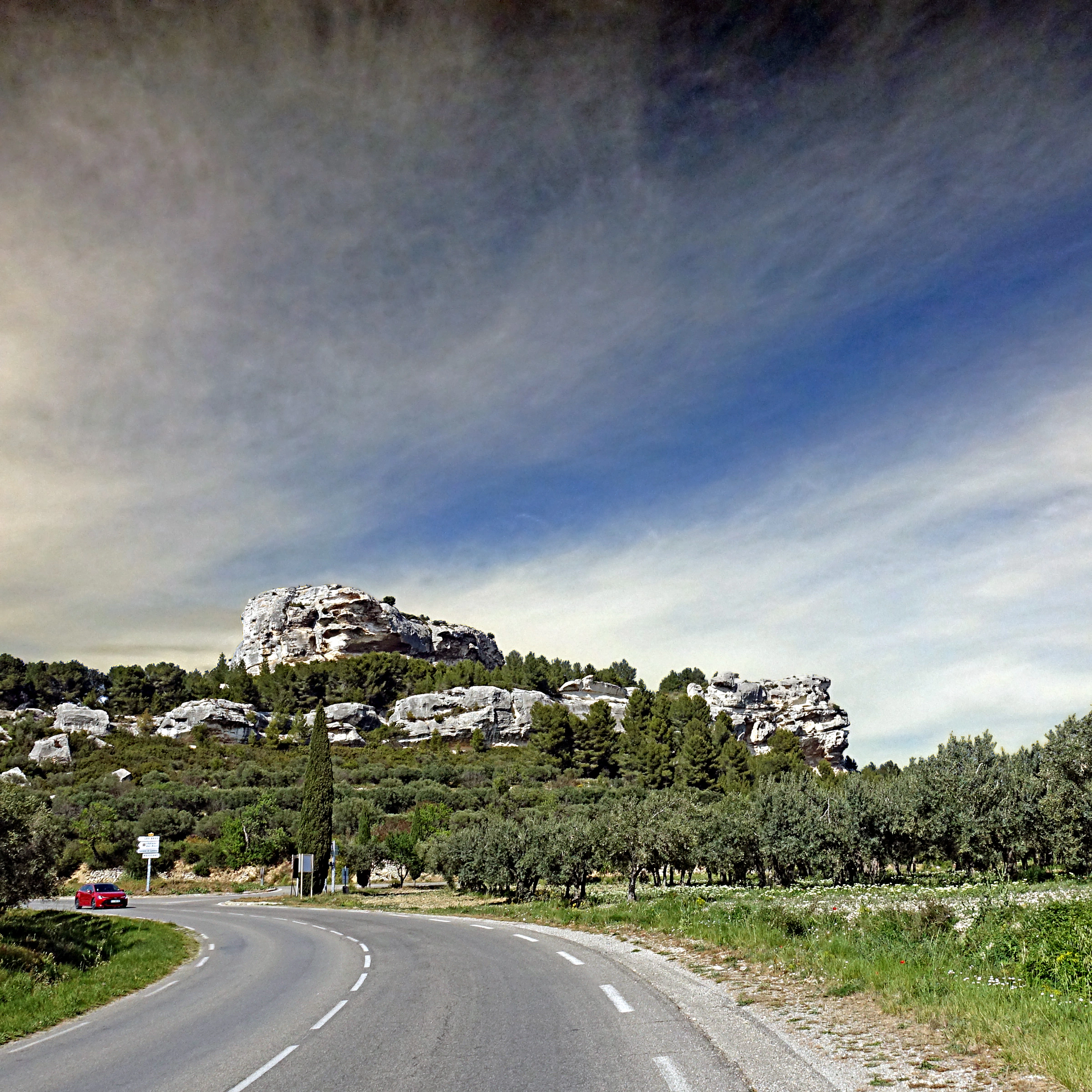
Pale limestone outcrops rise above dark trees and rows of olive trees; a curving road, a red car and signposts occupy the foreground beneath a strongly toned, streaked sky.

A roadside landscape in the Alpilles, photographed in April 2023. The photographer’s pronounced colour treatment is preserved; this is landscape context, not an illustration of the Fontvieille walk.

“Alpilles, Bouches-du-Rhône” — Pom’, CC BY-SA 2.0. Source: https://www.flickr.com/photos/pom-angers/52946938629/. License: https://creativecommons.org/licenses/by-sa/2.0/. Original photograph unchanged. · Creative Commons

Walks and routes

Fontvieille: Sentier des Moulins de Daudet

Start and finish at the Bureau d’Information Touristique in Fontvieille. The linked Chemins des Parcs version is a 2.3 km loop with 46 m of ascent and a published time of 1 hour, graded very easy. It includes the Sourdon mill branch, the Daudet, Ramet and Tissot-Avon mills, and a return through the village. Follow that page’s map and directions: other published versions are longer. Plan this as an outdoor walk. Confirm any mill or Château de Montauban interior visit separately with the tourist office.

Expect slopes, uneven outdoor surfaces and a road crossing on the Sourdon branch. The distance is modest, but the route is not presented here as step-free or suitable for a wheelchair or pushchair. If smooth, ramped access is essential, choose the Maison du Parc and confirm its facilities beforehand.


Fontvieille: Sentier des Moulins de Daudet

If you only have a short morning

In Saint-Rémy, make the Maison du Parc your main stop and leave room to ask questions and explore the garden. In Fontvieille, give the mill loop the whole available window. Picking the destination closest to your accommodation is usually more rewarding than spending a short visit travelling between the two.

A flexible day across two gateways

For a longer outing, choose a weekday and check the walk’s access conditions first. In warm weather, put the walking part in the coolest suitable period, then use the Maison du Parc’s afternoon opening if transport works. Alternatively, start with the house and garden and walk later in comfortable conditions. Leave the order flexible; neither a timetable nor the desire to see every mill should push the group into heat or wind.

Things to try

Read the landscape at the Maison du Parc

At 2 boulevard Marceau, use the garden as a small-scale introduction before going farther afield. The ramped route and visitor resources are a manageable way to discuss what makes the Alpilles distinctive. Look at the building too: local Aleppo pine has been used in its cladding, connecting the visitor centre to the woodland economy. Ask what displays and public activities are available that day.

Make the short walk a nature visit

Between the mills, give the vegetation as much attention as the buildings. Look for the contrast between tree cover and more open, rocky ground; pause at a safe, wide point rather than stopping in a road crossing. The route’s interpretation identifies ciste cotonneux, a rockrose with crumpled-looking petals. Observe any flowers in place. A sketch of one plant and one mill can be a satisfying family record of the outing.

Musée des Alpilles in Saint-Rémy

The Musée des Alpilles at Place Favier offers another way into the area’s culture and everyday history. It can replace the walk in wet or windy weather, subject to its own opening and admission arrangements. The municipal schedule lists Wednesday–Saturday, 13:00–17:30, from October to March; April–September has wider opening. Check the current page before setting out, particularly around holidays.

Wildlife and habitats

Olive

Olea europaea is the cultivated tree behind much of the view. Some Alpilles olives have several trunks rising from one base after regrowth following the severe frost of 1956. Look from the public route: these are crops tended by growers, not fruit offered for visitors to harvest.

Aleppo pine

Pinus halepensis is a principal tree of the Alpilles woodland. Its ability to cope with poor soil and dry conditions helps explain the evergreen cover on the hills. Compare the woodland’s irregular outlines with the ordered spacing of an orchard, without needing to identify every tree.

Ocellated lizard

Timon lepidus is one of the park’s emblematic wild reptiles. Its presence belongs to the wider landscape, not a guaranteed stop on this visit. If a lizard appears, stay still and allow it to move away; never turn stones or probe a shelter to find one.

Stories and discoveries

Daudet’s mill is a literary landmark

The name invites an easy misunderstanding: Alphonse Daudet never owned a mill in Fontvieille. The municipality explains that he stayed with the Ambroy family at nearby Château de Montauban. Read the mills as part of a real working landscape that also became a literary one.

The woodland has a working history

The forest has changed as grazing, farming and demand for wood have changed. The park’s forestry history describes expansion of woodland and later planting, as well as the effects of fires. A pine-covered slope is therefore part of an evolving landscape, rather than evidence of an untouched past.

When to visit

Spring: plants and sensitive wildlife

Choose comfortable conditions for observing plants, and keep the walk on the signed route. The park identifies March–June as a particularly sensitive period for birds. Enjoy activity from a distance, keep voices low around wildlife and resist following an animal into scrub or towards cliffs.

Summer: check access before choosing a trail

From 1 June to 30 September, access to forest massifs is regulated according to fire risk. Consult the official Bouches-du-Rhône access map, including the information prepared for the next day, and follow local notices. Heat, dryness and wind all matter. If access is prohibited, choose an available village attraction or indoor visit instead. Never smoke or use fire in the forest.

Autumn and winter: weather and shared use

Make the most of a mild day but take a layer for wind and leave enough daylight for the return. The park notes that hunting is mainly from September to the end of February. Respect posted hunt safety perimeters and instructions; do not press through a closure because it lies on your planned loop.

Getting there and practical advice

Maison du Parc: opening and cost

Admission is free. Published public opening is Monday–Friday, 09:00–12:00 and 14:00–17:00. The through-garden between boulevard Marceau and avenue Louis Mistral is listed as open 09:00–17:00, including the lunchtime break. Do not assume the garden has independent weekend access; confirm holiday or event arrangements with the park on 04 90 90 44 00.

Plan village stops before the trail

Use the villages for food, water and any practical needs before the outdoor section. The Fontvieille itinerary names parking at the tourist-information office; check current charges and restrictions on arrival. The route page does not establish accessible toilets or a drinking-water tap along the loop, so ask the local office if either is essential.

Arriving and moving between the two places

Avignon and Arles are useful rail gateways, and the park directs visitors to the regional ZOU network for local buses. Saint-Rémy-de-Provence and Fontvieille are both served towns, but that does not guarantee a convenient direct journey on your date. Check both the outward and return connections before choosing a car-free two-stop day. With limited services, one gateway is a better plan.

Use the actual starting point

For the short walk, navigate to the Bureau d’Information Touristique, avenue des Moulins, Fontvieille. For the house and garden, use 2 boulevard Marceau, Saint-Rémy-de-Provence. These are not adjoining entrances. Park only in an authorised place and leave emergency access clear; a roadside landscape photograph is not a recommended stopping point.

Choose the visit by surface and effort

A ramped garden route is a more useful starting point for access planning than a general “easy” label. Before travelling, explain any need for step-free entry, a suitable toilet, a resting place or assistance to the Maison du Parc team. Its published description does not give gradient measurements or a complete facilities audit. For the mill loop, make a separate decision about uneven ground, slopes and road awareness.

Keep the outing small for younger children

Use the next mill or a short observation stop as the goal, rather than promising the entire loop before you see how the group is doing. Take breaks off the walking line, supervise road crossings closely and carry enough water for everyone. The nearby high ground may look inviting, but rocky crests are a different outing and need their own planning.

Sources and useful links

Wildlife you might spot

3

Each card links to a full Explore page with photos, traits, and fun facts.

Snap map for this place

Start with the big picture, then zoom in to explore individual wildlife observations around this place.

Loading map…

Good to know before you go

Carry drinking water before leaving the village; do not plan around finding a refill in the hills.

Wear shoes with grip, including on short routes. Loose or polished stone deserves attention.

Download the chosen official itinerary before starting and follow local signs if conditions have changed.

Keep children close at the road crossing on the Fontvieille route.

Leave plants, stones and historic remains where they are; observe from the path.

Keep dogs on a lead and give grazing animals a wide berth.

Frequently asked questions

No. The garden visit and Fontvieille loop make a useful first visit in their own right. The Saint-Rémy route Entre vallon et plateau is a separate 10.5 km outing with 337 m of ascent, so do not mistake it for a short garden-side stroll.
There is no single visitor gate covering this inhabited territory. The Maison du Parc has free admission. Museums, guided activities and individual attractions have their own arrangements; allow for those separately.
No picking is part of this visit. Olive groves are working agricultural land, and the park asks visitors to leave plants and other natural objects in place. Stay on the permitted route rather than entering a field for a photograph.
Treat any wildlife sighting as a bonus. The species described here explain the wider park; they are not a checklist promised on the Fontvieille loop or in the garden. Never seek out nests, shelters or animals by leaving the path.

Recent snaps at this place

Recent snaps will appear here as new observations are added.

View all ›

Take the discovery with you

Exploring Alpilles Regional Nature Park?

Identify the wildlife you spot, learn as you go, and keep a collection of the adventure.

  1. 1Spot it
  2. 2Snap it
  3. 3Keep the discovery