Sugatami Pond circuit
A mountain circuit from the upper ropeway station, taking in ponds and volcanic scenery when the marked path is open and suitable.
Uneven mountain ground and steps; snow and ice can obscure the path.
 Illustration
Daisetsuzan is a whole mountain landscape in central Hokkaido, with forests, wetlands and volcanic peaks spread across a national park.
Daisetsuzan is a whole mountain landscape in central Hokkaido, with forests, wetlands and volcanic peaks spread across a national park. For a first visit, make Asahidake Onsen your base and keep the day focused on its visitor center and the Sugatami Pond area above the ropeway. You can enjoy the mountain’s character without adding a summit climb or trying to fit several distant park gateways into one outing.
Start inside Asahidake Visitor Center, beside the lower ropeway station. Its mountain model helps you put the landscape in order, while wildlife exhibits and films give the small things outside a name. The displays also introduce the relationship between these mountains and local people, including the Kamikawa Ainu. Ask staff about the day’s paths, visibility and bear information before deciding how far to walk. This is useful for an experienced walker, too: conditions at the top can be very different from the town you left that morning.
The ropeway takes about ten minutes to Sugatami Station at roughly 1,600 meters. You are still well below Asahidake’s 2,291-meter summit. In clear weather, the attraction is the contrast: dark, broken volcanic slopes above low green plants, little ponds and white plumes rising from the fumaroles. Sugatami Pond can reflect the mountain when its surface is calm. Enjoy that view from the established path; a visible plume is a reminder that this is an active volcano.
When the circuit is open and free of troublesome snow or ice, the Sugatami walk is the natural centerpiece. The operator gives its length as about 1.7 kilometers. Allow time to stop, look at the ponds and return without hurrying. It remains a mountain walk with uneven footing and steps, rather than a paved stroll. Children who are comfortable walking on that terrain may enjoy it, but the weather, their stamina and the adults’ mountain preparation matter more than the short distance. Turning back early is a perfectly good version of the visit.
The alpine plants reward a slower pace. Chinguruma, often called Aleutian avens, is a tiny woody shrub that can look like an ordinary wildflower. Its flowers give way to feathery seed heads, and later its leaves turn red. Lingonberry also grows in the Asahidake area. Look from the trail and leave flowers, berries and stones where they are. For a simple family activity, compare the shapes and colors of plants without trying to collect a specimen or finish a checklist.
Wildlife belongs to the landscape on its own terms. Pine grosbeaks are documented around Sugatami and Asahidake Onsen; black woodpeckers belong to the forest around the hot-spring area. Bring binoculars if you have them, and let any encounter happen at a distance. Brown bears also use this sector and its approach roads, so bear advice is part of planning even a short visit. If conditions rule out the upper paths, take time with the indoor exhibits and make the outdoor part another day. The worthwhile day here is the one that fits the mountain you actually find. Unlock an interactive field guide for this spot: get the Snappit app to identify nature on the go.
Daisetsuzan became a national park on December 4, 1934. Its history also reaches beyond that designation: the Asahidake Visitor Center presents the relationship of the Kamikawa Ainu and later local communities with the mountains. The present visitor-center building opened in June 2019. Give those displays some time before heading outside; they add a human story to a day that could otherwise be only about the views.
Begin at the visitor center, choose a route with staff, and check the ropeway’s last descent before buying a ticket. In suitable snow-free conditions, ride up and follow the marked Sugatami Pond circuit, pausing at the ponds and viewing the fumaroles from the trail. Give alpine plants as much attention as the skyline. If the circuit is unsuitable, keep to the area staff say is safe or stay with the indoor displays. The Asahidake summit, Susoaidaira and longer traverses need separate mountain plans; they are outside this short visit.
The summer circuit is not a year-round easy walk. Late snow can hide the trail, and autumn snow or ice can turn its steps into a hazard. On October 3, 2026, the visitor center reported partially frozen paths and snow obscuring the Sugatami route after the previous day’s snowfall, with winter mountaineering equipment needed for the summit. Recheck the latest report rather than treating a calendar month as permission to hike. The ropeway’s calendar checked on October 16, 2026 showed no service from November 16 through December 10, 2026. Winter outings require a separate plan and suitable equipment; ask about a guided activity. Around the lower station, a June 11, 2026 notice closed part of the Yukomanbetsu boardwalk, preventing a full loop. Ask staff whether it has reopened before using it.
The visitor center lists accessible parking, a multipurpose toilet, communication-support boards and manual-wheelchair lending. Ask staff about the entrance and the facilities you need. The Sugatami circuit has uneven terrain and steps, so do not plan it as a step-free wheelchair or stroller outing. Contact the ropeway operator before traveling to discuss boarding assistance, wheelchair dimensions and access around the upper station. For Route 66, the bus company asks passengers to confirm which departures use wheelchair-capable vehicles.
Sugatami Pond beneath Asahidake’s volcanic slopes
Fumarole plumes viewed from the established trail
Small alpine plants that change with snowmelt and autumn
A visitor center that makes the mountain’s nature and human history easier to understand
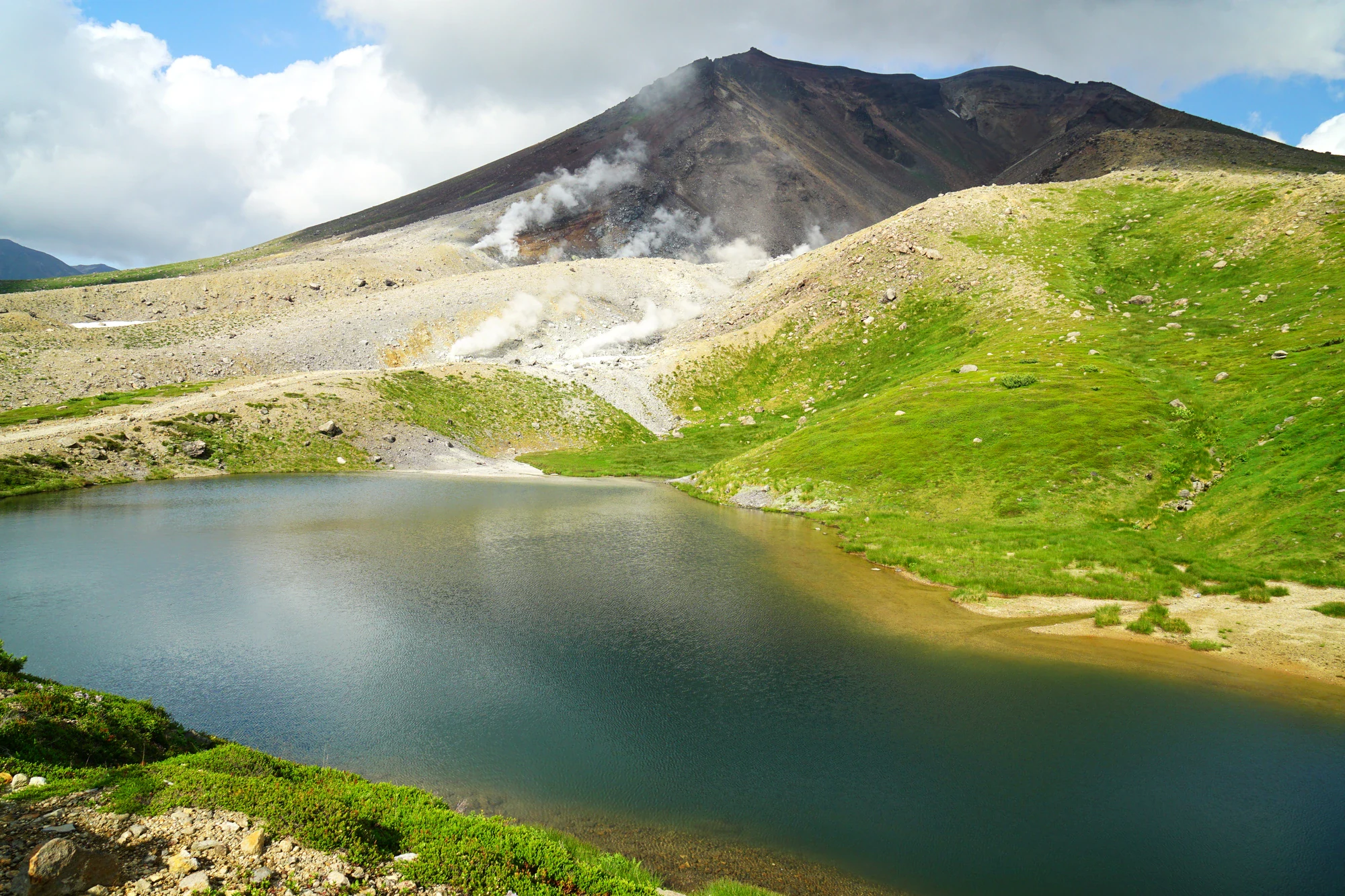
Sugatami Pond beneath Asahidake, with fumarole plumes rising from the volcanic slopes. This summer photograph was taken on 24 July 2014 and does not show current trail or volcanic conditions.
140724 Asahi-dake and Sugatami-no-ike Hokkaido Japan01bs3.jpg — 663highland, CC BY 2.5 (https://creativecommons.org/licenses/by/2.5/). Source: https://commons.wikimedia.org/wiki/File:140724_Asahi-dake_and_Sugatami-no-ike_Hokkaido_Japan01bs3.jpg. Resized and recompressed as WebP; no crop or retouching. · Creative Commons
A mountain circuit from the upper ropeway station, taking in ponds and volcanic scenery when the marked path is open and suitable.
Uneven mountain ground and steps; snow and ice can obscure the path.
Do not follow an old map around a full loop. The visitor center’s June 11, 2026 notice reports a partial boardwalk closure and directs permitted access from the ropeway side. Ask staff whether any short section is suitable that day.
Start with the visitor center and a conditions check.
Confirm the return ropeway and bus, then ride up if conditions suit your group.
Walk the open Sugatami circuit slowly, or choose the shorter option advised by staff.
Descend with plenty of margin and take a break before leaving.
Check the visitor center is open and spend time with its model, displays and films.
Ask whether any local outdoor option is suitable. If none is, keep the visit indoors and leave the pond for another day.
Use the visitor-center model, wildlife displays and films to choose one thing to notice outdoors. Ask what has changed on the paths recently.
On an open, suitable path, watch how light and wind change the pond surface, then look toward the volcanic slopes. Stay on the trail and away from vents.
Compare low leaves, flowers and seed heads without touching or collecting them. Let children sketch what is visible from the path; there is no need to identify every plant.
Use binoculars from an open, permitted path. Learn the difference between the forest’s black woodpecker and the pine grosbeak associated with the upper area; never approach nests or use food as bait.
Spend time at the visitor-center displays and films when it is open. Do not replace a weather-cancelled ropeway visit with an unplanned uphill hike.
A possible bird around Sugatami or Asahidake Onsen. Males have rosy coloring; females have yellow-brown tones. Watch quietly from the path and let the bird choose its distance.
A small evergreen shrub recorded in the Asahidake area. Notice the leaves and, in season, red fruit without picking it or stepping off the path.
A forest bird around Asahidake Onsen, with black plumage and red on the head. You may hear it before seeing it; stay away from nest holes and avoid following it into the trees.
Bears use the area, including near roads. Ask about current reports, follow restrictions and never approach a bear for a photograph.
Look for flowers, feathery seed heads or autumn leaves according to the season. Watch how this low plant changes through the season, without leaving the path.
Even after the ropeway ride, Asahidake’s summit is roughly 700 meters higher. The ponds offer a mountain view without adding that climb.
Chinguruma is a low woody shrub, despite its wildflower-like appearance. Its feathery fruit gives a later-season reason to look closely.
The visitor center’s human-history exhibits include Kamikawa Ainu relationships with Daisetsuzan.
Visible flowers do not mean all paths are clear. Ask about residual snow before leaving the station.
July and August are the starting point for a walking plan, with waterproof and warm layers still needed.
Color and freezing weather can overlap. Check current reports before committing to the full pond circuit.
Use a separately planned, suitably equipped activity. The snow-covered upper area is not the summer walk with a different view.
Information desk, displays, films, rest area and toilets. Published hours are 09:00–17:00, with year-end/New Year closure; check the current holiday notice.
Toilets at the lower and upper stations follow ropeway opening. The restaurant and shop are at the lower station; confirm food-service hours separately.
The bus operator’s timetable checked on October 16, 2026 lists four daily round trips. The outward trip from Asahikawa Station takes 1 hour 48 minutes; from Asahikawa Airport, 1 hour 3 minutes. Check both directions before departure and allow a buffer.
Allow extra time for mountain-road conditions and autumn queues. The visitor-center and ropeway car parks have different seasonal charging arrangements; check the one you intend to use. Do not plan to sleep in the car parks.
Contact the center about assistance and dimensions relevant to your visit.
The pond walk has steps and uneven ground. Confirm cabin boarding and access around the upper station with the operator before traveling.
Call the operator’s Kyoei office to ask which departure has a wheelchair-capable vehicle.
Each card links to a full Explore page with photos, traits, and fun facts.
Start with the big picture, then zoom in to explore individual wildlife observations around this place.
Check the mountain forecast, current trail notices, bear information and JMA’s Daisetsuzan volcano page before setting out; ask locally again on arrival.
Wear sturdy footwear and carry waterproof layers, warm clothing, water and food. The upper station has no drinking-water refill facility, so fill up below.
Set a turnaround time that leaves a comfortable margin before the final ropeway down and your bus. Strong wind or lightning can suspend the ropeway.
Stay inside marked paths and ropes. Do not approach fumaroles, cross closures, pick plants or step into the vegetation for a photograph.
Keep the group together in bear country, carry the equipment recommended locally and know how to use it. If you see a bear, do not run or approach; withdraw calmly and report it when safe.
Use the toilet at the visitor center or a ropeway station before the walk, and bring all rubbish and food scraps back with you.
Plan the journey home before going up. Route 66 has limited departures, and it does not wait for arriving flights.
For photographs, let other walkers pass and stay on the trail. Do not feed or touch wildlife; use binoculars or a zoom lens rather than moving closer.
Recent snaps will appear here as new observations are added.

Maryland, US
You might spot White-Tailed Deer and Eastern Gray Squirrel.
View guide →

District of Columbia, US
You might spot Eastern Gray Squirrel, Duck, and House Sparrow.
View guide →

Illinois, US
You might spot American Robin, Canada Goose, and House Sparrow.
View guide →

Virginia, US
You might spot Spotted Lanternfly and Northern Cardinal.
View guide →
Take the discovery with you
Identify the wildlife you spot, learn as you go, and keep a collection of the adventure.