Snappit logo
Snappit
Get App
Generic illustration, not a photograph of this venueIllustration
ParkProvence-Alpes-Côte d’Azur, FR

Domaine du Rayol Mediterranean Gardens

Domaine du Rayol sits below the village of Rayol-Canadel-sur-Mer, between Le Lavandou and Saint-Tropez in the Var.

About

Domaine du Rayol sits below the village of Rayol-Canadel-sur-Mer, between Le Lavandou and Saint-Tropez in the Var. The Conservatoire du littoral owns the 20-hectare protected estate. Within it, seven hectares of visitor gardens explore landscapes from around the world. Those two areas describe different things: you are visiting a designed garden within a larger coastal property.

Landscape designer Gilles Clément made climate the thread connecting the garden. Plants from California, central Chile, South Africa, Australia and the Mediterranean region face comparable challenges, particularly summer dryness. Other sections introduce wetter subtropical settings or the more severe dryness of the Americas. Moving between them makes the differences tangible: a broad leaf, a dense shrub and a fleshy stem offer very different ways of occupying a place.

The garden is deliberately allowed to change. Its gardeners observe how plants grow and adjust their work around that behaviour, rather than keeping every patch frozen in a fixed composition. A loose, apparently spontaneous edge can therefore be part of the design. Look at the shape of a whole planting before trying to name every specimen. You can enjoy the garden through colour, texture and shade even if botanical names are new to you.

For a first visit, make the Jardin des Méditerranées your main outing. Its paths, heritage buildings and sea views offer enough variety for a morning or afternoon. The shore is subject to separate access rules, so leave swimming plans out of your ordinary garden itinerary. Wondering what that bird or insect is? Find out on your visit using the Snappit nature app.

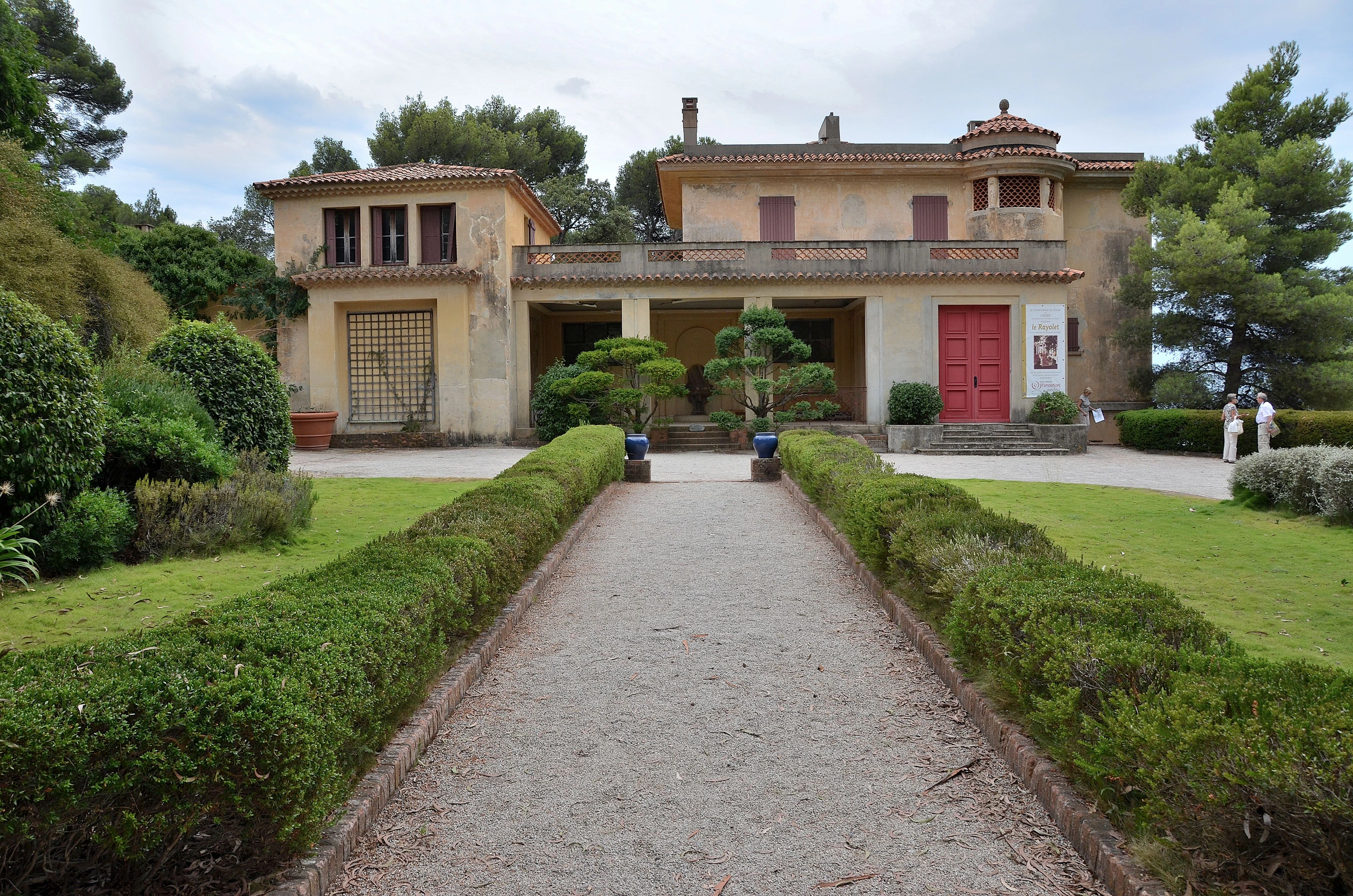
The estate’s houses and garden structures preserve a different layer of this coast’s story. The Conservatoire du littoral acquired the site in 1989 to secure its protection, and restoration has continued in stages. The Villa Rayolet’s exterior restoration was inaugurated on 5 July 2017. Its formal garden and architecture are a useful counterpoint to the freer landscape planting elsewhere: this is both a twentieth-century coastal estate and an evolving ecological garden. The photograph below records the villa before that restoration, in September 2015.

What to do here

At the Hôtel de la Mer reception, ask which paths suit your group and when the next daily guided visit starts. A guide can explain why a plant belongs in a particular landscape, while an independent walk gives children more freedom to pause. Try comparing the Australian and arid-American planting, then seek out the Espace botanique around the Bastidon if you want names to go with what you have seen.

Seasonal info

The garden normally opens throughout the year except 25 December. Closing times change with the season, and severe-weather alerts can override the normal timetable.

Accessibility

There is a step-free approach through reception and a route across part of the garden. The complete hillside network has slopes, stone paths and stairs. Choose the accessible route with staff rather than assuming every garden section is reachable.

Don't miss

1

Ten landscape gardens with a shared story about climate and plants.

2

Eucalyptus scrub, South African planting and sculptural arid-American plants.

3

A labelled Espace botanique around the historic Bastidon.

4

A daily guided garden visit included in the ordinary entry price.

Walks and routes

Jardin des Méditerranées: choose your own circuit

Start at reception and use the current visitor plan to select a manageable circuit through the landscape gardens. Let contrasting planting guide the outing: eucalyptus forms in Australia, the dry textures of South Africa, or rosettes and cactus stems in the arid-American section. These are suggested stops, not a prescribed waymarked loop. Allow 2–3 hours including pauses.

The full path network includes stone surfaces, changes of level and stairs. Leave time and energy for the return towards reception.
Jardin des Méditerranées: choose your own circuit

Daily discovery visit

For a first encounter with the garden, the daily guided visit is an easy way into its ideas. Tours are included in admission; sign up at reception. Most last 1½ hours. October’s published departure is 14:30; other months have different start times, so check the current schedule before planning lunch around a tour.

A daily public tour is not automatically the adapted route. Ask in advance about an accessible guided visit if you need to avoid stairs.

Daily discovery visit

Partial garden visit via the accessible approach

Use the accessible entrance approach and lift at the Hôtel de la Mer. The operator describes a path through six of the ten landscape areas, with views of heritage structures including the pergola, Ferme and Villa Rayolet. Ask staff to mark the suitable route on your plan.

This is partial access to a sloping estate. Confirm lift operation, surfaces and the route appropriate to your wheelchair or mobility needs before travelling; published information does not provide a gradient profile.

Partial garden visit via the accessible approach

A comfortable family half-day

Begin with a toilet stop and a look at the plan. Choose two contrasting landscape areas as the main discoveries, adding the Bastidon’s labelled plants if the route suits your group. Pause for a sketch or a photograph, then return before tired legs make the slopes a chore. If lunch matters, settle that plan before you set off: bring a picnic for the entrance courtyard or allow for a wait at the café.

Things to try

A small botanical detective game

Choose one plant with narrow leaves, one with a broad leaf and one with a water-storing stem. Sketch their outlines without touching them. Then ask a guide how each form helps the plant in its home climate. This works well across the arid-American planting and the other landscapes, and does not depend on catching a particular flower in bloom.

The Espace botanique

Opened in June 2025 around the Bastidon, this outdoor area gives plant names and origins. It is a helpful complement to the largely unlabelled landscape gardens: spend a little time identifying a few plants rather than turning the whole walk into a list. Ask reception how best to include it in your chosen circuit.

Marine activities: plan separately

The Sentier sous-marin is a seasonal, guided snorkelling activity for swimmers aged eight and over. Les pieds dans l’eau is a separate shore activity for children aged 4–12 accompanied by an adult; under-fours cannot join, even in a carrier. Both require booking and suitable conditions. Their published summer 2026 sessions have ended. Check the next programme, price, equipment requirements and cancellation arrangements before planning either one.

When the weather changes

Under an orange Météo-France alert for strong winds, rain/flooding or thunderstorms, the operator closes the garden and restaurant; reception, the bookshop and nursery remain open. Under a red alert, the whole estate closes. A bookshop stop may suit light rain when open, but do not travel into severe weather just to salvage the outing. Check the estate’s notice before setting off.

Wildlife and habitats

Strawberry tree

Look for glossy, toothed leaves and, in autumn, small pale flowers alongside rounded fruit. The estate’s own article illustrates this Mediterranean plant at Rayol. Enjoy the colours without picking or tasting; ask a guide to confirm identification.

Eucalyptus

In the Australian section, notice eucalyptus growing with several stems rather than the single tall trunk you might expect. The garden uses small mallee forms with a buried woody base that can produce new shoots after fire. Look at the branching pattern from the path: the low, many-stemmed shape is part of this landscape’s character.

Prickly pears

The flattened pads of prickly pears stand out among the arid-American planting. These are stems that store water. Compare their broad silhouette with upright columnar cacti from the path, keeping hands and clothing clear of spines. Different cactus shapes can serve a similar need to survive dry periods.

Stories and discoveries

Similar climates, different plant communities

The South African garden brings together fynbos-inspired planting and the drier character of the Karoo. Look for the contrast between fine-textured shrubs and the more solid shapes of succulents. The connection is a landscape idea rather than a claim that all plants from a country live in the same conditions.

A hedge-lined gravel path leads to an ochre villa with red shutters, surrounded by trees.

Villa du Rayolet and its formal garden at Domaine du Rayol, photographed in September 2015, before the exterior restoration inaugurated in 2017.

“Domaine du Rayol (Var) - Villa du Rayolet” — Patrick (Morio60), CC BY-SA 2.0. Source: https://www.flickr.com/photos/morio60/22138816249/. License: https://creativecommons.org/licenses/by-sa/2.0/. Original photograph unchanged. · Creative Commons

When to visit

Spring and autumn

These are good seasons for a longer visit if the forecast is mild. In autumn, the strawberry tree can carry pale flowers and ripening red-orange fruits at the same time. Exact flowering and fruiting vary with the year.

Summer

Use the early opening for the more exposed parts of your chosen circuit and take breaks before anyone becomes overheated. Carry enough drinking water for your visit. Reserve any seasonal activity separately.

Winter

A winter visit can focus on evergreen shapes and the relationship between the buildings and planting. Plan around the earlier closing time and bring a layer for a breezy coastal day. The ordinary garden season continues, apart from Christmas Day.

Getting there and practical advice

Admission and opening hours

In October 2026, admission is €14.50 for adults and €10.50 reduced; under-sixes enter free. A €37 family ticket covers two adults with one or more children aged 6–17. The reduced categories include ages 6–25, students, jobseekers and disabled visitors, with proof required. Opening is normally 09:30–17:30 in January–March and November–December, 09:30–18:30 in April–June and September–October, and 09:30–19:30 in July–August. Last entry is one hour before closing.

Food, books and useful stops

The Café des Jardiniers serves lunch from 12:00 to 14:30 and refreshments during its daytime opening. Ordinary visitors cannot reserve a table, and admission does not guarantee one. The Librairie des Jardiniers and nursery can be visited without paying garden admission. Accessible toilets are available at reception. An audioguide in English, French and German is included in entry.

Arriving by car

The entrance is on Avenue Jacques Chirac, formerly Avenue des Belges, below the village and signed from the coastal D559. Free parking P1 is near the entrance; P2 is on Avenue Courmes, with a signed pedestrian approach of about 400 metres via the Voie Verte. P2 has vehicle-size restrictions, so check the access page if travelling in a tall vehicle.

Arriving by bus or bicycle

ZOU! line 878 serves Rayol’s tourist-office stop on the Toulon–Saint-Tropez corridor. The estate describes a walk of about 15 minutes from there; allow extra time for the uphill return and verify the last suitable bus before entering. Seasonal shuttles should only be relied on when their dates and stops are confirmed. The coastal V65 cycle route is another approach; the estate lists cycle lockers and e-bike charging.

Discuss concessions and the route together

The main tariff page currently lists a €10.50 disability concession, while the accessibility page still displays €10 and free entry for a companion. Confirm the applicable concession and companion conditions when arranging the visit. A reduced ticket does not mean every path is accessible.

Sources and useful links

Wildlife you might spot

3

Each card links to a full Explore page with photos, traits, and fun facts.

Snap map for this place

Start with the big picture, then zoom in to explore individual wildlife observations around this place.

Loading map…

Good to know before you go

Wear shoes with grip; loose sandals are a poor match for stone paths and steps.

Carry drinking water, sun protection and a hat for a warm-day visit.

Ask for the French children’s activity booklet at reception: versions cover ages 4–6 and 7–12.

Use a baby carrier if that is comfortable for your family; a pushchair limits the paths you can take.

Picnic in the courtyard before the garden entrance, where it is permitted, rather than inside the garden.

Stay on paths and leave flowers, fruit and seeds on the plants.

Smoking and vaping are prohibited. Pets are not admitted; the published visitor rules make an exception for guide dogs.

Frequently asked questions

You can buy admission online or at reception on the day. Reserve themed activities in advance; they have their own schedules and availability.
No. Access from the estate is reserved for its supervised, pre-booked marine education activities. Participants return to the garden when their activity ends.
Much of the landscape garden is intentionally unlabelled. The Espace botanique around the Bastidon adds labelled plants and their origins, making it a useful stop for identification.
It is better with time to explore. If you have less than the recommended 1½ hours, ask reception for a compact selection rather than rushing to reach every landscape.

Recent snaps at this place

Recent snaps will appear here as new observations are added.

View all ›

Take the discovery with you

Exploring Domaine du Rayol Mediterranean Gardens?

Identify the wildlife you spot, learn as you go, and keep a collection of the adventure.

  1. 1Spot it
  2. 2Snap it
  3. 3Keep the discovery