
Snappit logo
Snappit
Get App
Generic illustration, not a photograph of this venueIllustration
ParkKR

Ilsan Lake Park

This is a large city park with several different ways to spend an afternoon.

About

This is a large city park with several different ways to spend an afternoon. You can make a short visit around one bridge, follow a signed walking course or add an indoor exhibition. Start by choosing your priority rather than trying to see every facility. Garden displays, ecological areas and events all share the grounds, so the route that suits a quiet weekday may need adjusting during a festival. Take the ultimate field guide with you: use the Snappit app to identify birds, plants, and animals on your trip.

Ilsan Lake Park grew out of the development of Ilsan New Town. Construction ran from December 1992 to December 1995, and the park opened on May 4, 1996. Its lake is artificial, but the intention was broader than creating a decorative pool: the city planned recreation and ecological space together. Today, the contrast between open water, planted walks and the surrounding city is part of its appeal. [Goyang’s park history and wider walking route](https://www.goyang.go.kr/gynuri/street/list7.do) provide useful background.

What to do here

For a first visit, pair a stretch of lakeshore with one distinctive stop: the rose garden for flowers, Dalmaji Island for a pavilion view, or the Metasequoia Path for a walk among trees. Families can make the nature-learning area their main destination. Leave room to sit beside the water; a short visit here need not become a full circuit.

Seasonal info

Planning for autumn 2026? The music-fountain season finished on October 11. A notice posted on October 12 anticipates restarting in late April 2027. Do not use the older April–October timetable to plan a show. [Read the operator’s latest notice](https://www.gys.or.kr/music/Bbs/BbsNotice/BbsNotice_View.php?board_index=101864&board_kind_code=BbsNotice).

Accessibility

The city lists accessible parking and toilets, plus wheelchair loans. That does not establish a continuous step-free route to every garden, island viewpoint or building. Choose your starting point with the information center, particularly if you need a short, firm-surface route.

Don't miss

1

Dalmaji Island and Wolpajeong pavilion for a view across the lake.

2

The rose garden, with its main flowering window usually in May–June.

3

Metasequoia Path, a named woodland-style walk with an earth surface.

4

The nature-learning area, where the park’s ecological story comes into focus.

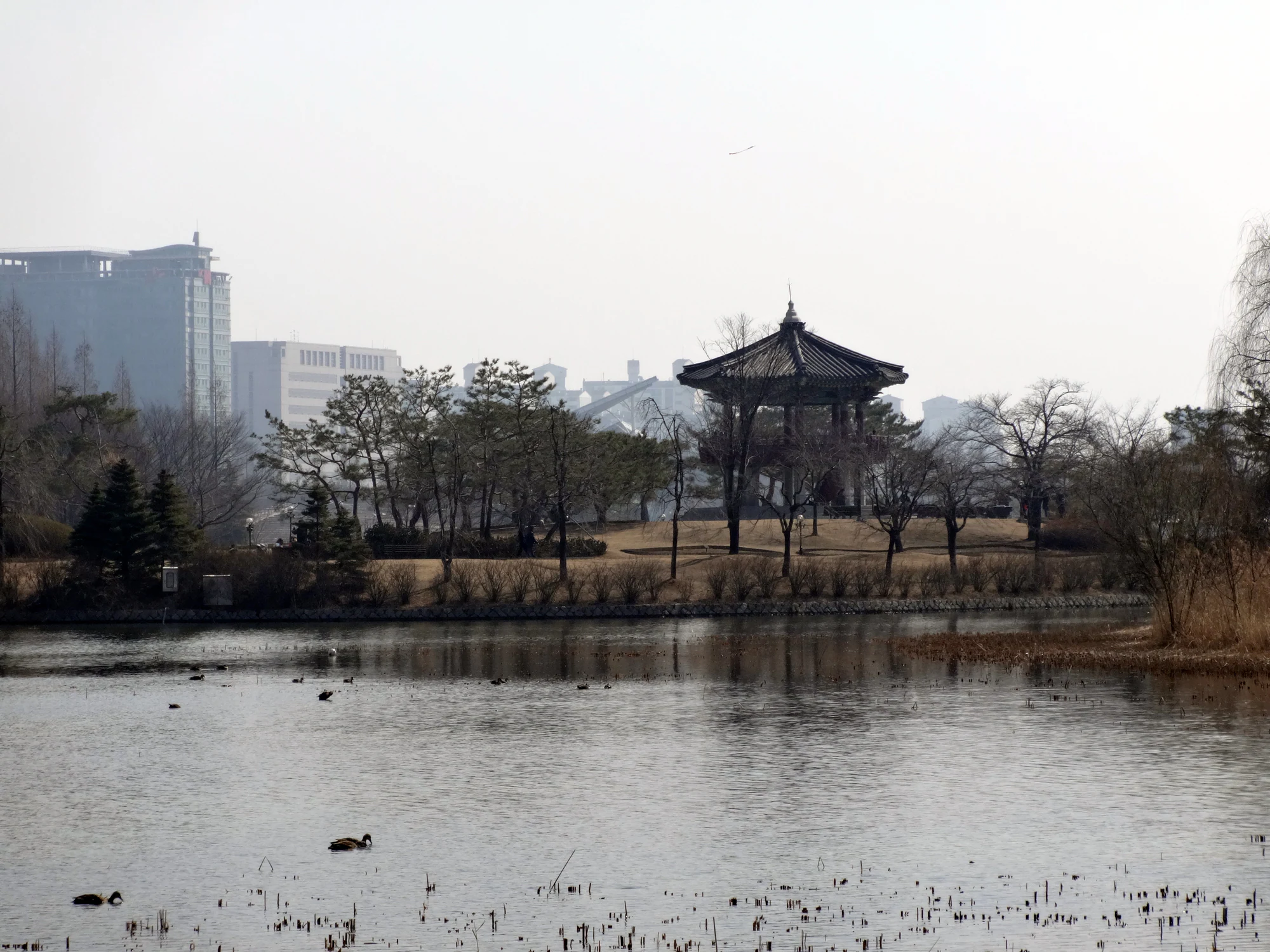
Waterbirds on a lake in front of bare trees and a traditional-style pavilion, with city buildings in the background.

A lakeside view at Ilsan Lake Park, photographed on March 16, 2014. The scene is historical and does not show current conditions.

“Ilsan Lake Park” by Jean & Nathalie, CC BY 2.0. Source: Flickr. No changes. · Creative Commons 1 · Creative Commons 2

Walks and routes

Metasequoia Path: the tree-lined option

The city lists this earth-surface walk as 1.7 km, with an indicative walking time of about 23 minutes. Give yourself 40–60 minutes if you want a relaxed pace and pauses. Use the official walking-page map to find the marked section; the distance is for the published route, not a complete circuit of the lake.

An earth surface may be soft or uneven. If you need firm paving, ask for a suitable parallel or alternative walk rather than assuming this path is step-free.


Metasequoia Path: the tree-lined option

Official walking course 3: a compact bridge circuit

The published 1.0 km course runs from Aesu Bridge via Naksu Bridge, the court-training-building landmark and Waterfall Plaza, back to Aesu Bridge. The city estimates about 20 minutes of walking. Allow 30–45 minutes to take it slowly. The building is a wayfinding landmark on the route, not an invitation to enter its grounds.

If using wheels, check bridge approaches for slopes, kerbs and any steps before committing to the circuit.

Official walking course 3: a compact bridge circuit

A flexible garden-and-lake visit

Choose the rose garden and Dalmaji Island as your two stops, following the public paths and current park signs between them. Add a lakeside pause and return toward your chosen entrance when you are ready. This is a suggested combination of sights, not a measured or officially named course; allow around 60–90 minutes and shorten it if crowds or weather make walking tiring.

Island and pavilion access may involve a different surface or level from the main promenade. A view from the shore is a good alternative if the approach is unsuitable.

A flexible garden-and-lake visit

An easy half-day without rushing

Arrive by subway, choose a short walk and leave the second half of the visit flexible. If flowers are your priority, start with the garden-and-island option; if you want a quieter walking focus, choose the Metasequoia Path. Stop for a drink or an exhibition only after checking that building’s opening arrangements. Finish with enough time to return to your original entrance before tackling the journey home. Avoid stacking several published courses together unless everyone in the group wants a longer outing.

Things to try

Ride the signed cycle circuit

The city describes a 4.7 km cycle circuit and also marks a cycle diversion. Follow the cycling signs rather than treating every walking path as a riding route. Slow down at crossings, keep entrances clear and dismount wherever posted. The total 9.1 km of walking paths in the park overview is a network figure, not the length of one lakeside lap.

Make ecology the focus of a family visit

The lake’s nature-learning center was established in 2014 to support learning about conservation and restoration. For a guided activity, check the ecological education booking portal for the location, age range, language and booking requirement. Choose a session explicitly at the lake center; Goyang’s separate ecological education center is not the same destination.

A book café or a shorter indoor visit

The Flower Book Café inside the flower exhibition building is listed at 10:00–18:00, closed Mondays and the day of Seollal and Chuseok, with possible changes when the exhibition building’s schedule changes. Call 031-908-7643 before relying on it. Haeum, an art-residency space, lists 11:00–17:00 and Monday closure, but access depends on exhibitions and programs. Neither should be treated as a guaranteed all-weather refuge. In persistent heavy rain, postpone the lakeside part rather than completing a circuit for its own sake.

Wildlife and habitats

Dawn redwood

The named Metasequoia Path is the best starting point for these planted trees. The park’s monitoring list identifies them as Metasequoia glyptostroboides, and the city still describes the avenue as a walking feature. These are planted park trees, enjoyed as part of a designed walking landscape.

Japanese zelkova

The city includes zelkova among the trees that bring autumn color to the walking paths. The park’s older species list supplies the scientific identification. Use on-site labels to find them among the planted trees. Leaf color changes with the season and weather.

Mallard

Mallards occur in the park’s cumulative 1997–2016 bird records. That gives a reason to bring binoculars, but it is not a recent sighting report. Look over the water from the public shore if birds are present, and leave enough distance that they can rest and feed undisturbed.

Grey heron

Grey herons are also recorded in the same historical park inventory. A walk may produce a sighting or none at all. Watch from the paths beside the water and give resting birds space. Keep out of planted or fenced habitat, even if a closer photograph looks tempting.

Stories and discoveries

A village memory inside a new-town park

The pagoda tree highlighted by the city has a story older than the modern landscape. Local tradition describes it as a guardian tree for the former Sangju and Haju villages and a place where people gathered. Villagers are said to have read the tree as an omen of good or poor harvests.

A lake supported by an engineered water system

The city’s water-system description traces incoming water from the Han River through treatment and Cheongpyeongji before it reaches the lake. Its planted and ecological-looking edges sit within a managed system. This is a useful detail to notice on a walk: an artificial urban landscape can be designed with both recreation and ecological processes in mind.

When to visit

Spring: choose gardens or a ticketed show

Dalmaji Island is described by the city as a spring-blossom spot. If you are coming for the flower exhibition, check that year’s organizer announcement and ticket rules separately. The park is worth visiting without the show, and a future date should not be inferred from the previous year’s program.

Summer: shorten the exposed stretches

Start early or choose a cooler part of the day, carry drinking water and keep an indoor option in reserve. Cut the walk short if heat becomes uncomfortable. In heavy rain or thunderstorms, move away from the exposed waterfront and follow official safety directions; a pavilion is not a dependable storm shelter.

Autumn and winter: a walk can be the whole plan

The tree-lined paths remain a worthwhile reason to come even when shows finish. Plan for changing daylight and a colder breeze beside the water. After frost or snow, avoid slippery steps and do not step onto a frozen lake. Keep the route flexible rather than relying on an indoor facility being open on a holiday.

Getting there and practical advice

Information, equipment and family facilities

The general information center lists 08:00–20:00 hours and free stroller and wheelchair loans on presentation of identification. Call 031-8075-4347 if your visit depends on equipment; availability and accepted identification should be checked beforehand. The city also lists a nursing room and infant bed in the center, and changing tables in seven named toilet facilities. Use the facilities page to find the nearest option instead of walking farther than necessary.

Buildings keep their own hours

The city lists the cactus botanical garden at 09:30–17:30, closed Mondays, January 1 and the day of Seollal and Chuseok. Its plant collection offers a different experience from the outdoor gardens. The Toilet Culture Exhibition Hall is a more unusual indoor stop, listed at 10:00–17:00 with the same named closure days. Confirm opening and any current admission charge before making either the main purpose of your trip. See the exhibition directory.

Arrive at Jeongbalsan Station

The park’s directions recommend Line 3 to Jeongbalsan Station, exit 1, followed by roughly 10 minutes on foot toward the park. That is an indicative approach time to the grounds, not to every attraction. Add time for road crossings and for your chosen destination inside. If you need a station lift, check the accessible exit rather than following the stair-based exit number automatically. Official directions.

Driving and parking

The park portal gives 595 Hosu-ro, Ilsandong-gu, Goyang as its main address, but choose a named park lot for navigation. The published passenger-car rate is KRW 90 per five minutes in ordinary operation; the city also lists KRW 2,000 per parking space during events, with larger-vehicle multipliers. Read the applicable entrance tariff, particularly for a festival visit, and do not assume every event uses the same parking arrangement.

Choose the surface, not just the distance

A short course can still include an awkward bridge approach, while a longer paved section may be easier for your group. The small hill called Araetmalsan has stone steps, so leave that optional detour out if stairs are unsuitable. Ask the information center for the nearest accessible toilet and a route that returns to the same entrance. Equipment loans do not replace checking your own transfer, seating and support needs.

Sources and useful links

Wildlife you might spot

4

Each card links to a full Explore page with photos, traits, and fun facts.

Snap map for this place

Start with the big picture, then zoom in to explore individual wildlife observations around this place.

Loading map…

Good to know before you go

Save your entrance or parking-lot name before setting off; the nearest exit may not be the way you arrived.

Bring water and sun protection for exposed stretches beside the lake.

Wear shoes with grip after rain, especially if you choose an earth path or stone steps.

Keep children close at the water and bridges, and stay out of the lake.

Leave birds undisturbed and watch from the public paths without feeding them.

Check the event calendar before choosing a quiet picnic or photography day.

Frequently asked questions

The Korea Tourism Organization currently lists general park admission as free, with 24-hour, year-round access. Individual buildings, shows, parking and ticketed events have separate arrangements. Temporary barriers and safety closures still apply. [Check the general visitor listing](https://english.visitkorea.or.kr/svc/whereToGo/locIntrdn/rgnContentsView.do?vcontsId=75425).
Treat the flower show as a separate event with its own admission rules and enclosure. The 2026 spring show ran from April 24 to May 10, with published hours of 09:00–19:00. Those dates and hours are past event information, not the park’s opening schedule or next year’s dates.
The park requires a leash and cleaning up after your pet. A separate dog playground is listed as free and for registered dogs accompanied by their owners; check its posted entry rules before using it. Children aged 12 or younger must be accompanied by a guardian there.
The park has a designated cycle circuit. Keep to the signed cycling arrangement and give people space at crossings. The published park rules prohibit electric kick scooters and other listed motorized devices; do not assume a cycle path makes them permissible.
Bring a simple ready-to-eat picnic and take your rubbish away. Cooking, tents and shade canopies are prohibited. The city publishes photography and filming facility-use fees without clearly separating every type of shoot, so contact park management before arranging an organized or commercial session.

Recent snaps at this place

Recent snaps will appear here as new observations are added.

View all ›

Take the discovery with you

Exploring Ilsan Lake Park?

Identify the wildlife you spot, learn as you go, and keep a collection of the adventure.

  1. 1Spot it
  2. 2Snap it
  3. 3Keep the discovery




