Snappit logo
Snappit
Get App
Generic illustration, not a photograph of this venueIllustration
ParkAuvergne-Rhône-Alpes, FR

Livradois-Forez Regional Nature Park

Think of Livradois-Forez as a lived-in mountain region rather than a single enclosed attraction.

About

Think of Livradois-Forez as a lived-in mountain region rather than a single enclosed attraction. Its territory extends across Puy-de-Dôme, Haute-Loire and Loire, in Auvergne-Rhône-Alpes. The Dore valley helps you find your bearings between the wooded Livradois and the Forez uplands. Ambert is a useful base for the central part of the park; the short forest outing described here starts outside Saint-Amant-Roche-Savine, not in Ambert itself.

The variety is the attraction. Hedgerows, hay meadows, rivers, damp woodland and high moorland support different communities of plants and animals. You can enjoy a small piece of that variety in an hour, then use a longer stay to change altitude and habitat. Resist the temptation to stitch distant highlights into one hurried day. A forest walk, a village lunch and a visit connected with local craft can make a more satisfying introduction.

Up on the Hautes-Chaumes, the wide views come with wind, exposure and working grazing land. Jasseries, the upland farm buildings, help explain how people shaped these apparently wild spaces. Choose that landscape deliberately on a suitable day. The easy grading of a woodland discovery trail says nothing about conditions on the high plateaux. Wondering what that bird or insect is? Find out on your visit using the Snappit nature app.

The park has held regional nature park status since 1986, but the relationship between people and landscape is much older. Upland grazing helped create and maintain open ground among the forests; jasseries recall the seasonal work associated with livestock and fourme cheese. Down near Ambert, paper-making shows another relationship with natural resources, using streams to power mills. These stories explain why villages, farms and workshops belong in a nature visit here. The park’s work includes helping biodiversity survive in productive landscapes, rather than treating every wooded slope as untouched wilderness.

What to do here

Start with La forêt de Gaspard if you want a compact woodland outing. For a longer walk with plant interpretation and a viewpoint, choose Botanique à la Renaudie on another visit or as your main outing for the day. Keep time for the place between the attractions: a village stop, a view across the valley or a conversation with the tourism office about tomorrow’s conditions.

Seasonal info

Forest paths can remain wet after rain, and winter ice or snow can make a short loop awkward. In hunting season, ask locally about the actual day and route, and obey temporary signs. In summer, carry water even for a brief outing and avoid wooded walks during strong winds or thunderstorms. High-plateau weather needs its own check.

Accessibility

La forêt de Gaspard is officially rated very easy and suitable for families, but its description begins with an uphill path. No continuous wheelchair-accessible or pushchair-friendly surface is confirmed. La Renaudie adds more climbing, grassy paths and road sections. Ask the tourism office about present surfaces, gates and resting places before choosing either route for someone with limited mobility.

Don't miss

1

A short forest discovery loop near Saint-Amant-Roche-Savine

2

Tree and shrub interpretation on the walk from La Renaudie

3

The contrast between Dore-valley landscapes and the open Hautes-Chaumes

4

A region where woodland, farming and traditional crafts remain closely connected

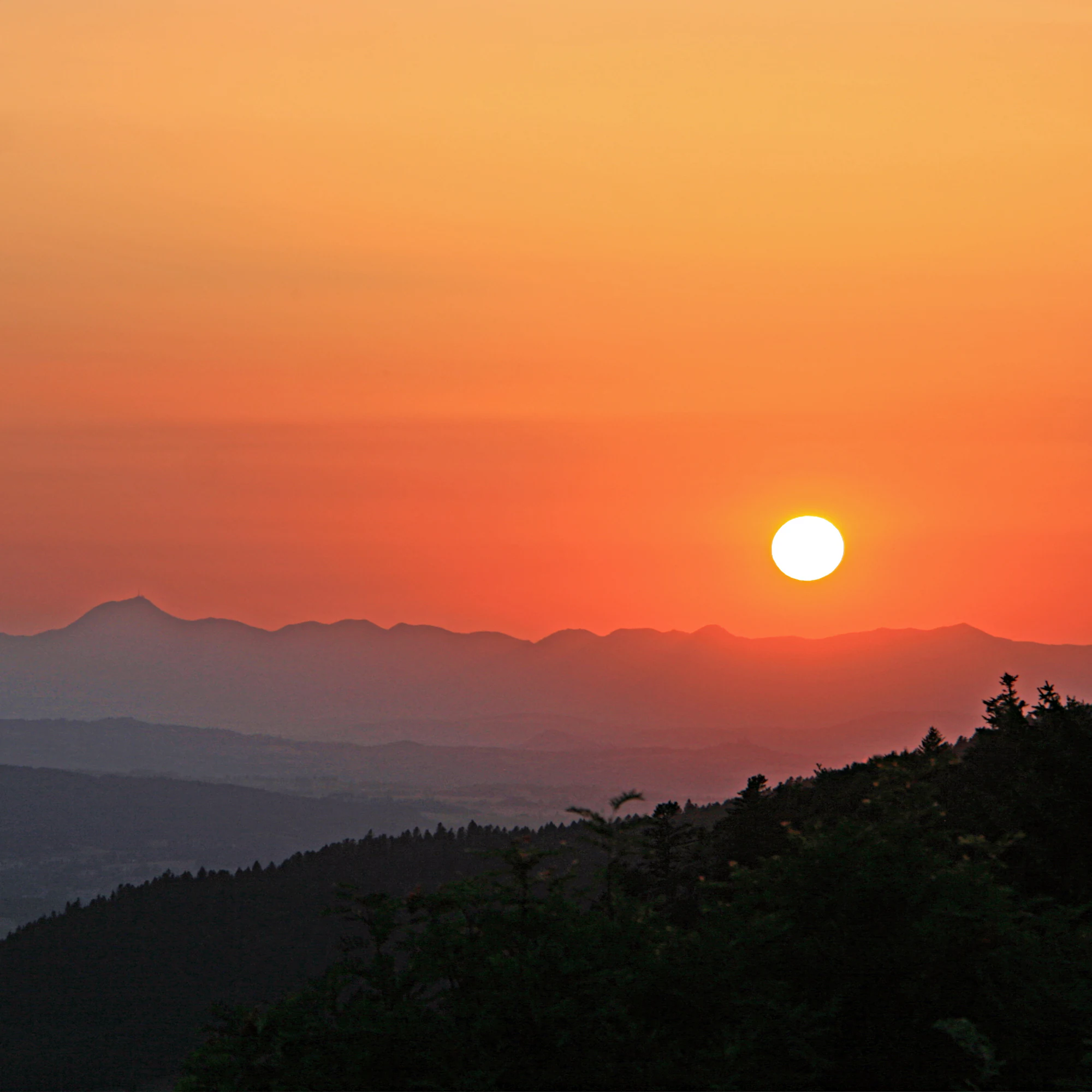
Bright evening sun above layered dark mountain ridges under an orange sky, with wooded slopes in the foreground.

Sunset viewed from Col des Supeyres on 12 August 2022. This outward view includes distant land beyond Livradois-Forez; it does not show the family forest routes.

“Col des Supeyres, Monts du Forez” © Pom’, CC BY-SA 2.0, via Flickr. Unmodified original file. · Creative Commons

Walks and routes

La forêt de Gaspard

A compact loop for a first woodland visit. The official sheet gives 662 m, 13 m of ascent and 45 minutes, rated very easy. From the departure board, the path climbs left; at the cabin, follow the right-hand path and remain on the main loop back to the start. Make the small distance an advantage: there is time to stop without needing to cover ground quickly.

Natural forest path with an initial climb. The family label does not establish a surfaced or step-free route; ask about the ground after rain and any obstacles.


La forêt de Gaspard

Botanique à la Renaudie

This easy-rated loop starts by the mairie in La Renaudie. Its official figures are 2.2 km, 96 m of ascent and one hour. Tree and shrub interpretation leads towards a viewpoint with an orientation table; the published introduction also highlights a dolmen. Use the official directions for the return, which includes road sections. Allow longer than the walking estimate if you want to read the panels.

A more demanding choice than Gaspard: climbing, grassy ground and road walking, including parts of the D102. Keep children alongside you near traffic. No wheelchair suitability is confirmed.

Botanique à la Renaudie

An unhurried half-day from Ambert

Collect water and food before leaving town, then make La forêt de Gaspard your main outdoor stop. After the loop, choose a village break or return to Ambert for a paper-making visit if its timetable fits. Allow for the drive in both directions and resist adding a high pass simply because it looks close on a regional map. This is a suggested sequence, not a waymarked combined route.

With two or three days

Give each day a different purpose: a short woodland introduction, a botanical walk from La Renaudie, then a separately planned upland or valley outing. Keep the most exposed day flexible around the weather. This approach also leaves room for a guided nature activity, where local knowledge can make a habitat or animal story much easier to understand.

Things to try

Read a forest as a living habitat

Choose one small patch beside the path and look for several stages of woodland life: young growth, mature trees and fallen wood. The park’s old-wood programme connects retained habitat trees, ageing stands and managed forest. A dead branch is therefore more than untidiness. Observe from the trail without pulling bark away or climbing unstable wood; the useful question is what might depend on it remaining there.

Understand the open heights

On a separate fine-weather day, explore the story of the Hautes-Chaumes through a locally recommended outing. Grazing and the seasonal use of jasseries helped maintain the contrast between woodland, pasture and heath. These are working places as well as scenic ones. Follow marked public paths, leave gates as found and give livestock space. Choose a route with a length and forecast your group can genuinely manage.

See conservation as a changing landscape

The Vallée du Fossat offers a different woodland story for a later, more substantial outing. Its trails reopened after restoration and storm-repair work, confirmed by the park in July 2026. Some areas may look newly open while vegetation recovers. Stay on marked paths to protect young growth, and choose a current route suited to your group rather than assuming this is another short discovery loop.

Follow the paper-making story indoors

The Moulin Richard de Bas near Ambert is a useful alternative when outdoor conditions are poor. The working paper mill connects local craft with water-powered industry and hand-made paper. Check the operator’s current tour times, prices and any workshop booking requirements; do not assume you can arrive at any hour. Ask about stairs and visit accessibility if that matters to your group.

Wildlife and habitats

European beech — Fagus sylvatica

Beech is a useful starting point for noticing how these mountain woods differ from the open uplands. The park atlas records it in Saint-Amant-Roche-Savine and many other local communes. Look at the shape of the canopy and how the light changes beneath it; use a field guide or the interpretation at La Renaudie to test an identification. The record is local context, not a promise about a particular tree on the Gaspard loop.

Black woodpecker — Dryocopus martius

This large, dark woodpecker has red on its head and is recorded around Ambert, Job and La Renaudie. A woodland walk may offer a call or a brief moving silhouette rather than a clear portrait. Pause where you can stand safely on the path and scan trunks through binoculars. Never approach an occupied cavity or play calls to attract a bird.

European pine marten — Martes martes

A mostly nocturnal forest mammal, the pine marten is an agile climber that uses places such as hollow trees and stumps for shelter. Records from Ambert and Job establish its place in the park’s wildlife, but an ordinary daytime family walk is unlikely to produce a sighting. Its presence is another reason to leave cavities and piles of wood undisturbed.

Stories and discoveries

The spaces between highlights matter

A hedge, streamside strip or small wood can help connect larger habitats. That is why Livradois-Forez’s conservation story reaches into ordinary farming landscapes as well as celebrated sites. Watch how the scenery changes on your journey, but stop only where parking is permitted and sightlines are safe.

When to visit

Spring and early summer

Use a woodland visit to notice changing foliage and bird activity. Keep a respectful distance from nests and young animals. After persistent rain, shorten the plan if surfaces are muddy; the best day is one when everyone can look around without concentrating on each slippery step.

Summer

Carry shade-independent essentials: water, sun protection and an extra layer for a change in weather. For an upland outing, review the mountain forecast and grazing notices before leaving. Avoid fires and barbecues in the countryside; check the department’s current restrictions.

Autumn and winter

Autumn brings a different light to the woods, but also shorter days and hunting activity. Obtain local information for the route and date. In winter, choose an ordinary walking circuit only when snow, ice, wind and access conditions allow it; the short summer description is not a winter route assessment.

Getting there and practical advice

Pack for a self-contained walk

Do not rely on toilets, drinking-water taps or refreshments at either trailhead. Check practical needs in the village or with the tourism office before starting. The cabin mentioned in the Gaspard directions is a wayfinding feature, not a confirmed staffed refuge or service point.

Getting to the woodland start

From Saint-Amant-Roche-Savine, take the D996 towards Ambert, then the D39 towards Fournols before the Col des Fourches. The official directions place the departure parking on the right after 700 m along the D39. Leave forest access clear. For La Renaudie, use parking in the village and begin at the mairie.

Arriving without a car

Cars Région publishes the P02 link between Clermont-Ferrand, Ambert and Arlanc. Check the timetable for your exact date and the return journey before committing to a walk. Getting to Ambert does not solve the onward journey to the forest: arrange that separately and confirm the final walking approach. Do not assume a village bus stop has a safe footway to a rural trailhead.

Choose by surface as well as distance

Ask specifically about gradients, roots, mud, barriers, path width and places to rest. A 662 m circuit may still be difficult with wheels or limited balance. If the present conditions do not fit your group, ask the tourism office for a currently suitable alternative rather than attempting the loop because of its short length.

Sources and useful links

Wildlife you might spot

3

Each card links to a full Explore page with photos, traits, and fun facts.

Snap map for this place

Start with the big picture, then zoom in to explore individual wildlife observations around this place.

Loading map…

Good to know before you go

Download the official route sheet before setting out and use the departure board to confirm you are on the intended circuit.

Bring shoes with grip, an extra layer and drinking water; a small daypack is useful even on the short loop.

Keep children close on road sections at La Renaudie and whenever a path approaches traffic.

Leave dead wood, fungi and plants where they are. A photograph or sketch is a better souvenir than collecting.

Check for forestry work and temporary restrictions at the trailhead. Turn back rather than stepping around a barrier.

Save the sunset photograph for inspiration; plan your own return while there is enough light to follow the path comfortably.

Frequently asked questions

Start with La forêt de Gaspard if your group can manage an uneven woodland path and a short climb. Keep the outing flexible. La Renaudie is a more substantial choice with road sections, so it suits children who can walk attentively beside an adult.
This is a large inhabited territory, so choose a named trailhead or attraction rather than looking for a central entrance gate. The two route pages describe self-guided walks without a ticketing step. Museums, guided activities and accommodation have their own prices and booking arrangements.
Check the rules for the specific route and any protected site you add. Keep your dog close and under control, and use a lead around livestock. On the Hautes-Chaumes, give grazing herds a wide berth and follow the local advice about livestock-protection dogs.
Only in suitable conditions. Trees do not make a safe refuge from strong winds or storms. When the forecast is poor, choose an indoor visit and save the trail for another day.

Recent snaps at this place

Recent snaps will appear here as new observations are added.

View all ›

Take the discovery with you

Exploring Livradois-Forez Regional Nature Park?

Identify the wildlife you spot, learn as you go, and keep a collection of the adventure.

  1. 1Spot it
  2. 2Snap it
  3. 3Keep the discovery