
Snappit logo
Snappit
Get App
Generic illustration, not a photograph of this venueIllustration
ParkOccitanie, FR

Montpellier Botanical Garden

Begin with the Montagne de Richer.

About

Begin with the Montagne de Richer. Its name sounds grand for a garden mound, but the idea behind it was ambitious: different exposures and growing conditions let a botanist study plants with different needs. The terraces are part of the garden’s early scientific design, rather than a miniature hiking destination. Looking from a path towards the sunny and shaded planting gives the history a visible shape.

The garden still belongs to the University of Montpellier and is attached to its Faculty of Medicine. Living plants here have a teaching and research purpose. Some collections need controlled access: the École de systématique, where plants are arranged by botanical family, is reserved for scheduled group visits. A barrier can mark a working collection, not a shortcut waiting to be explored.

For a first visit, make the open-air garden your focus. The orangery’s long façade offers an architectural pause between plant stops; the English garden and its pond provide a different, less formal scene. The restored south gate reopened in December 2025, adding a view into the upper garden from the Peyrou side. Its restoration is a welcome change, but it does not establish that every garden path is step-free. Wondering what that bird or insect is? Find out on your visit using the Snappit nature app.

Henri IV commissioned the garden in 1593, with physician and botanist Pierre Richer de Belleval responsible for its creation. Training doctors to recognise medicinal plants was a starting point, but the garden developed a much broader botanical role. The first garden was devastated during the siege of Montpellier in 1622; Richer rebuilt it. Later expansion brought new planting areas and buildings, so the present garden contains several periods of scientific work rather than one untouched Renaissance layout.

What to do here

Enter from Boulevard Henri IV and choose three stops: the historic planting around the Montagne de Richer, the orangery exterior, and the English garden’s pond. Add a tree stop if everyone is still interested. Use the university’s illustrated garden leaflet to locate the named features; follow the paths actually open on the day rather than treating its diagram as a guaranteed accessible circuit.

Seasonal info

The winter garden makes branches and buildings easier to read. From the restored gate, the orangery is more visible before spring foliage fills the view. Summer offers a fuller canopy and the pond’s growing-season interest. In either season, strong weather can close the grounds at short notice.

Accessibility

Ask the entrance staff which paths suit your wheelchair, walking aid or pushchair. The university directs visitors with access needs to the guards. Confirm the surfaces, slopes and any steps along your intended route before travelling; the terraced Montagne de Richer should not be assumed accessible throughout.

Don't miss

1

The terraced Montagne de Richer and its early botanical design

2

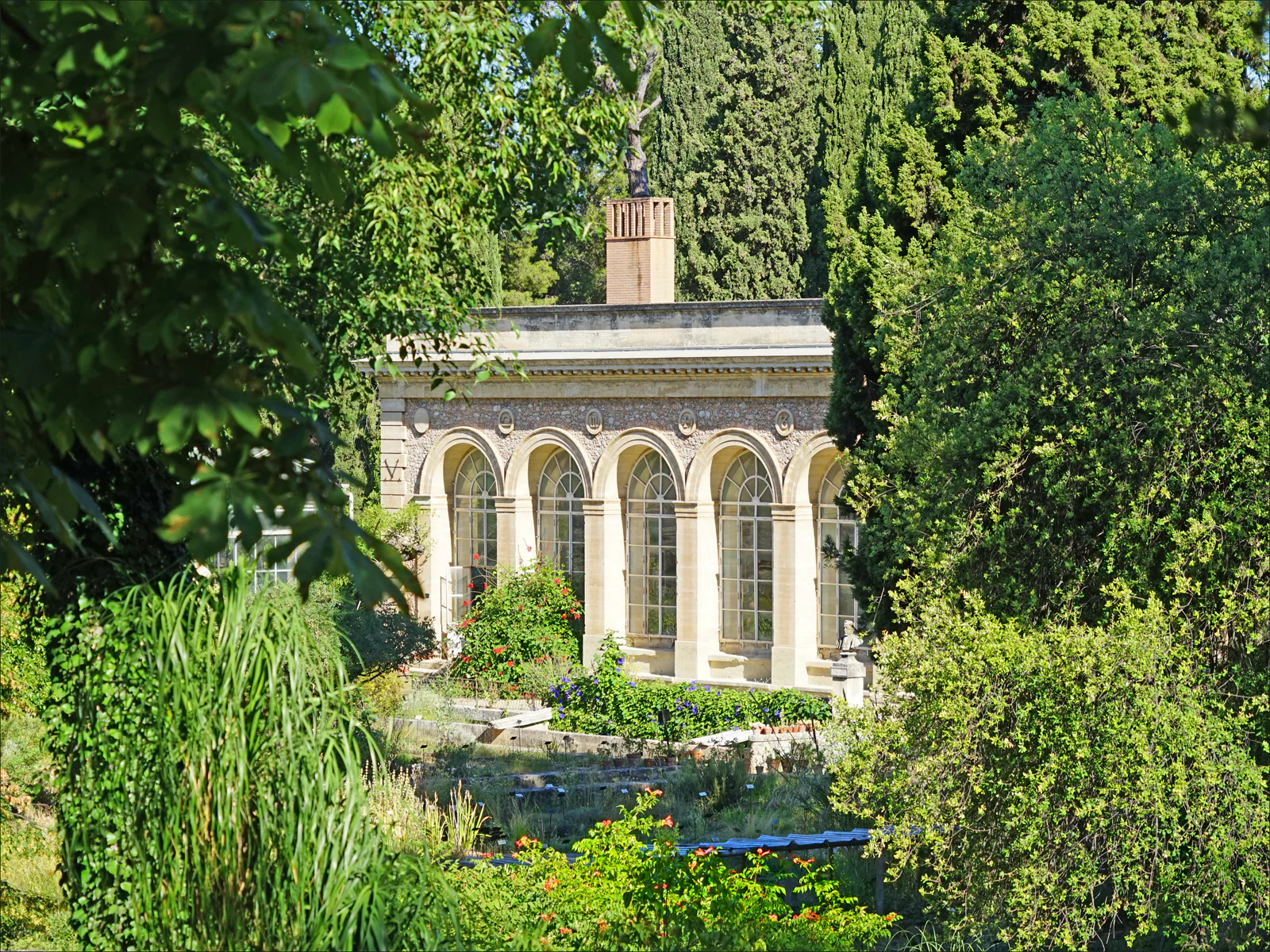
The orangery framed by cultivated planting

3

The English garden, lotus pond and astronomical pavilion exterior

4

Mature specimen trees with very different outlines

An orangery with tall arched windows appears between dense trees, shrubs and planted garden beds.

The orangery framed by planting at Montpellier’s Jardin des plantes, photographed on 7 July 2016. This outdoor view does not indicate current access to the building.

“L’orangerie du jardin des plantes (Montpellier)” — Jean-Pierre Dalbéra, CC BY 2.0. Source: https://www.flickr.com/photos/dalbera/28123923021/. License: https://creativecommons.org/licenses/by/2.0/. Original photograph unchanged. · Creative Commons

Walks and routes

A first circuit of the outdoor garden

Start by asking at the Boulevard Henri IV entrance which areas are open. Use the official leaflet to find the Montagne de Richer, then choose an open path towards the orangery and continue to the English garden’s pond. Pause at each place rather than following a fixed pace. Near the water, look for the small astronomical pavilion. Return by open garden paths, leaving enough time to reach the exit before closing. Allow 60–90 minutes with stops, shortening the visit whenever needed.

Adapt the sequence with staff before setting out if steps, slopes or uneven ground are a concern. Skip the terraced section when necessary; do not assume the leaflet’s connected lines form a continuous step-free route.


A first circuit of the outdoor garden

With a younger child

Pick one tree, the orangery exterior and the pond, and stop while the visit is still enjoyable. Give the child a small job at each stop: choose a leaf shape, count a few windows, then spot a reflection. You can leave the longer history and extra collections for another visit. Eat and use a toilet before entering.

Things to try

Make a three-leaf sketchbook

Choose three living plants visible from an open path. Draw each leaf’s outline in a small square, then add one word such as narrow, round or divided. If a readable label is present, copy its name underneath. Compare the drawings at the end: which feature would help you recognise the same plant next time?

Read a building through its plants

At the orangery, ask why a garden needs a building with so many windows. The building provides winter shelter for plants that cannot stay outside through Montpellier’s coldest weather. Children can sketch a window and the plants around it, then imagine what changes when pots are moved indoors. Enjoy the façade from outside unless an advertised opening admits visitors.

Give the pond five quiet minutes

Stand back from the edge with an adult beside younger children. Look for leaves lying on the water and leaves rising above it; compare their shapes and shadows. Let each person choose one detail to describe without pointing, then see whether everyone else can find it. Keep stones, food and hands out of the water.

When weather changes the plan

Check the faculty garden homepage for closures before leaving. Weather closures can override regular opening hours. If the grounds close, postpone the garden; neither the orangery nor the Serre Martins should be treated as an automatic rainy-day refuge. A booked visit can also be cancelled.

Wildlife and habitats

Ginkgo

The university’s tree leaflet identifies a ginkgo planted in 1795. When it has leaves, try sketching their fan-like outline without removing one. In winter, switch to the branching pattern and the tree’s position among its neighbours. It is one of the garden’s cultivated collection trees.

Osage-orange — Maclura pomifera

The city’s tree guide singles out the garden’s Osage-orange for its large reclining trunk. Its English name can mislead: it belongs to the mulberry family rather than the citrus family. Look at the whole shape from the path and leave any fruit alone. Do not climb onto the trunk for a photograph.

Stories and discoveries

A garden observatory with a new chapter

The small astronomical pavilion beside the pond was inaugurated in 1879. After a restoration, it was inaugurated again on 9 April 2026. Its presence connects the garden’s study of living things with another tradition of observation, astronomy. Possible exhibitions were announced, but the restoration does not establish regular access to the interior.

The “wishing tree” is a living veteran

The old broad-leaved phillyrea is known for the folded and hollowed texture of its trunk. People have tucked wishes into its crevices, and the garden’s staff remove the papers. Make your own wish in your notebook instead: the tree is more interesting as a living organism than as a place to leave litter.

Getting there and practical advice

Admission and opening times

Individual outdoor visits are free. The faculty’s practical page lists Tuesday–Sunday, 12:00–20:00 from 1 April to 30 September, and 11:00–18:00 from 1 October to 31 March. Monday is closed. Check the garden’s current notices before travelling, especially during unsettled weather.

Organised groups and guided visits

Organised groups visiting independently must complete the faculty’s group information form. For a guided group, contact [email protected] at least 15 days ahead. Public themed tours have their own arrangements: some are free with registration, while tourist-office visits can be paid. Book the actual session you want, including any language or access requirements.

Arriving from central Montpellier

Use Boulevard Henri IV as the visitor destination, rather than the garden administration’s street address. The faculty lists the Albert 1er–Saint-Charles and Albert 1er–Cathédrale tram stops and paid parking at Pitot. Check TaM’s current journey planner for your departure point and any changed service. Walk the last stretch to the gate; cycling is not permitted inside.

Plan the parts that matter to you

For a visit centred on the orangery or pond, ask specifically whether there is a suitable continuous route from the entrance and back. Mention your equipment and whether you need seating or help with slopes. Contact the garden before travelling at [email protected] or +33 4 34 43 36 20. There is no public toilet inside, so include that in your access planning.

Sources and useful links

Wildlife you might spot

2

Each card links to a full Explore page with photos, traits, and fun facts.

Snap map for this place

Start with the big picture, then zoom in to explore individual wildlife observations around this place.

Loading map…

Good to know before you go

Plan food before or after the visit

picnics are prohibited. There are no public toilets inside the garden; the faculty points visitors towards Place Albert 1er.

Leave pet dogs and cats at home. Bicycles, scooters and roller skates are also prohibited in the garden.

Do not pick plants, collect fruit or seeds, or taste any part of the collection. Keep children on the paths and close beside you at the pond.

Bring water, a hat and a notebook. A drawing or photograph is a better souvenir than a leaf taken from a living plant.

Read the event listing before attending a guided visit. Free admission to the grounds does not mean every tour is a walk-up event.

Frequently asked questions

Ordinary public access starts at noon in April–September and at 11:00 in October–March. Earlier access is for authorised activities, such as booked teaching or guided visits. A morning event reservation does not open the whole garden to casual visitors.
Treat buildings as separate from the outdoor visit. The orangery shelters plants in winter and sometimes hosts events. The Serre Martins has scheduled visits, including sessions requiring advance registration. Check the specific event for access rather than expecting an indoor attraction to be open throughout garden hours.
Choose it for observation and conversation. Picnics are prohibited, and the collections need calm visits on the paths. For young children, a short sequence of discoveries works better than trying to see every section.

Recent snaps at this place

Recent snaps will appear here as new observations are added.

View all ›

Take the discovery with you

Exploring Montpellier Botanical Garden?

Identify the wildlife you spot, learn as you go, and keep a collection of the adventure.

  1. 1Spot it
  2. 2Snap it
  3. 3Keep the discovery




