Snappit logo
Snappit
Get App
Generic illustration, not a photograph of this venueIllustration
ParkChugoku, Japan

Shukkeien Garden

Shukkeien rewards a small change of pace.

About

Shukkeien rewards a small change of pace. Instead of heading straight for the arched bridge, stop at your first clear view of the pond and choose one detail to follow: a pine reflected in the water, a stone shoreline or the gap between two islands. Walk a little farther and look again. The pleasure is in seeing familiar ingredients rearrange themselves as you move.

This is a daimyo's strolling garden in central Hiroshima, first created in 1620. Its name expresses the idea of gathering scenery into a smaller space. Around Takuei-chi pond, little hills, islands, waterside buildings and winding paths suggest a much larger landscape. The nearby city remains part of the view, so enjoy the garden for its careful composition rather than expecting a remote woodland escape.

Kokō-kyō, the rounded stone bridge across the pond, gives the garden its most recognizable silhouette. It is worth viewing from the bank before deciding whether to cross: the arch is steep, and the garden specifically warns visitors about slipping. You can appreciate the bridge without making it part of your route. Keep younger children close beside the water and leave plenty of room for other people on narrow stretches.

Flowers give the walk a changing focus. Plum blossom comes before the main cherry season; summer offers green foliage, and late autumn brings colored leaves. You do not need a famous flowering week to enjoy the garden. Watching a reflection settle, noticing a carefully framed opening or sitting down before taking the next photograph can be just as satisfying.

Make room, too, for the garden's history. Shukkeien was devastated by the atomic bombing of 6 August 1945, and people died here. Its memorial and surviving trees deserve an unhurried, respectful pause. The restored landscape is also the result of years of work after the war, not an untouched survival of the seventeenth century.

For a first visit, allow 60–90 minutes, or closer to two hours if you want a guide and tea. Pick up the garden map at the entrance, decide how much walking suits your group, and finish with a rest at Sensuitei if it is open. Hiroshima Prefectural Art Museum next door makes a convenient longer outing, especially when the weather turns. Wondering what that bird or insect is? Find out on your visit using the Snappit nature app.

The garden began in 1620 as a villa garden for Hiroshima lord Asano Nagaakira, designed by his retainer and tea master Ueda Sōko. Later generations changed and restored it, including substantial work after the 1758 fire. The Asano family donated it to Hiroshima Prefecture in 1940, when it also received national Scenic Beauty designation. The atomic bombing on 6 August 1945 caused immense loss of life and extensive destruction. The pond, artificial hills and stone bridge retained their form despite damage. Restoration began in 1949 and continued over many years, with major rebuilding completed in 1974. The garden’s beauty today sits alongside that history: the memorial and registered bomb-surviving trees are part of the visit, not separate from it.


What to do here

Follow the pond views, compare the bridge from different angles, and use the entrance map to choose between a longer stroll and a shorter visit. Look for seasonal planting, take a quiet moment by the memorial, and ask whether a volunteer guide is available. A small sketchbook or a camera gives children and adults a reason to stop and look closely.

Seasonal info

The garden publishes flowering windows rather than guaranteed peak dates. Plum, cherry and autumn-color timing moves with the weather. Seasonal evening openings are special events; ordinary closing time still applies on other days.

Accessibility

The official map marks wheelchair-accessible paths, but much of the garden is unpaved and not every bridge or hill is suitable. Ask staff to help choose a route for your wheelchair or stroller. An accessible toilet and a limited number of loan wheelchairs are listed; confirm availability before relying on them.

Don't miss

1

Takuei-chi

a pond walk that changes character as you move around its islands.

2

Kokō-kyō

the arched stone bridge, best appreciated at an unhurried pace.

3

The surviving trees and memorial

a place to reflect on Hiroshima’s history.

4

Seasonal planting and a tea break

a gentle, flexible outing close to the city center.

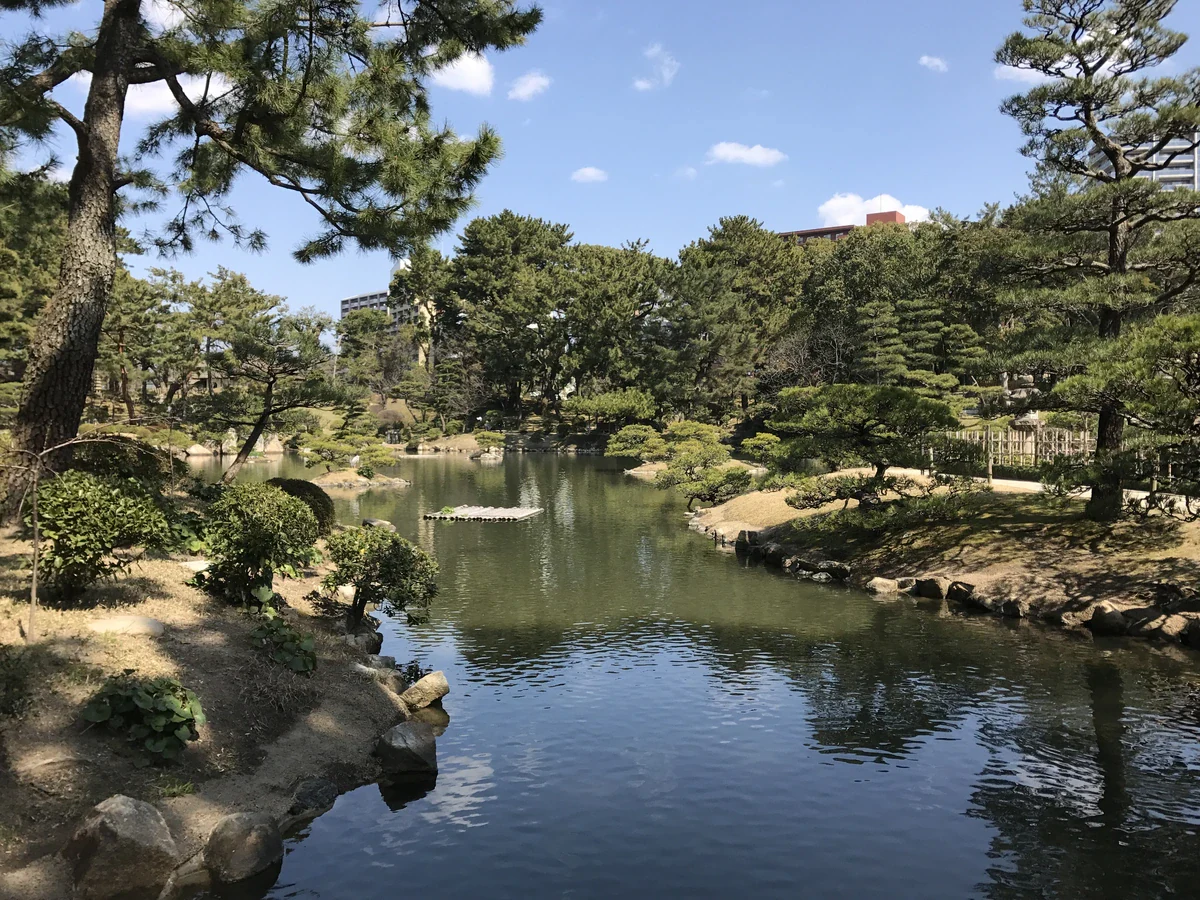
A still pond bordered by rocks, low garden banks and spreading pines, with branches reflected in the water.

Pines and sculpted banks frame the pond at Shukkeien, photographed in March 2017.

© そらみみ / Wikimedia Commons / CC BY-SA 4.0. Takueichi_Pond_in_Shukkei_Garden_1.jpg. Source: https://commons.wikimedia.org/wiki/File:Takueichi_Pond_in_Shukkei_Garden_1.jpg. License: https://creativecommons.org/licenses/by-sa/4.0/. Proportional downsampling to fit 1200 × 1200 pixels without enlargement; WebP quality 92, method 6. No crop, retouch, recoloring or added text. EXIF omitted. EXIF software 10.2.1; modification date 2017-03-11. Source rendering retained; no specific retouch is declared. · Creative Commons

Walks and routes

A pond-centered first visit

The official map’s red “Leisurely Stroll” circles both sides of the pond, taking in the great ginkgo and the Geiki-hō hill area. It is listed as about 40 minutes of walking; allow 60–90 minutes for a relaxed visit. Follow the map, then choose the branches that interest you. Return to a favorite view near the end and see what you notice the second time.

This walking circuit includes terrain beyond the marked wheelchair paths. Choose the accessible option with staff if slopes, bridges or uneven surfaces are a concern.

A pond-centered first visit

A shorter look around the pond

The map’s blue “Short Stroll” combines west-side pond views with a crossing of Kokō-kyō. It is listed as 20 minutes of walking; allow 30–45 minutes with stops. If time or energy is limited, make one pond view your main stop and leave the longer circuit for another visit.

The short circuit is not the wheelchair circuit and uses Kokō-kyō. Avoid its steep arch if it does not suit you, and ask staff for an alternative.

A shorter look around the pond

Choose a wheelchair-friendly visit

Ask for the map’s marked wheelchair-accessible paths at the entrance. Choose a comfortable turning point and allow time to rest, rather than trying to follow one of the timed walking circuits.

Unpaved surfaces can be harder work after rain. Ask staff about the paths, toilet and loan-wheelchair availability that day; check whether assistance is useful for your chair.

Choose a wheelchair-friendly visit

A gentle morning plan

Arrive near opening, pick up the map and take a few minutes to choose a route. Walk for about an hour with stops wherever a view catches your attention. Pause quietly for the garden’s history, then decide whether tea or another short look around suits the group. If you continue to the museum, check its day’s gallery opening before buying a ticket.

Things to try

Make a three-view photo story

Choose three pictures: a wide pond scene, a closer arrangement of rocks or branches, and a reflection. Take them from established paths, keeping your group out of the way. Comparing the results over tea is a simple way to notice how a garden is composed.

Look for a landscape in miniature

Ask each person to choose a scene that feels like a coast, a hill country or a small valley. Explain what creates that impression without needing to identify every plant. With children, let everyone choose one favorite view and tell the others why.

Ask a garden guide

Volunteer guides are usually present, though weather and heat alerts can cancel guiding at short notice. Ask what is available and whether someone can guide in your language. A conversation about one feature can be more memorable than trying to learn every name.

Leave room for tea

Sensuitei, just inside the entrance to the left, serves refreshments including a matcha-and-sweet set. Check the current menu and hours, then use the break to compare favorite views. A café stop is easy to fit into a normal visit; formal tea gatherings follow their own event schedule.

Use the neighboring art museum

Hiroshima Prefectural Art Museum is the natural indoor companion to the garden. Check the day’s gallery schedule: collection displays can close for changeovers, and special exhibitions have separate tickets. If showers ease, decide whether a shorter garden visit still appeals.

Keep a rainy visit simple

If the garden remains open and conditions are comfortable, concentrate on a few easy-to-reach views. Wet leaves and reflections can be lovely, but there is no need to complete a circuit. Skip slippery bridges and follow staff advice during heavy rain or strong winds.

Wildlife and habitats

Ginkgo: a living connection with 1945

Use the garden signs to find the great ginkgo and read its history. Hiroshima City estimates that it is more than 200 years old and records damage from the bombing. Give yourself a moment simply to look at its shape and the space around it; leave the bark and roots undisturbed.

Japanese black pine: look beyond the silhouette

Hiroshima City also registers a Japanese black pine in Shukkeien as a bomb-surviving tree. Let the label distinguish that particular tree from the many pines shaping the scenery. Compare its form with the smaller planted pines without assuming every pine in the garden is the same species.

Common kingfisher: watch the water patiently

The garden’s guides list kingfishers among its wild visitors. A quick blue-green flight close to the water or a still bird watching from a perch can catch your eye. Stop quietly and look with binoculars if you have them; do not follow it into planting or crowd the pond edge.

The garden’s planted trees are a dependable focus; visiting birds come and go. Watch quietly from the paths, give wildlife space, and use binoculars rather than moving closer or playing calls.

Stories and discoveries

The pond has a connection to the sea

Water drawn from the nearby Kyōbashi River makes the pond brackish: fresh and salt water mix. The garden’s guides describe both carp and mullet here. Its crane and turtle islands have a different role: their shapes express wishes for a long life.

A landscape rebuilt over generations

The garden changed under successive Asano lords and was restored after fire and war. Thinking of it as a landscape repeatedly cared for helps explain why historical form and later rebuilding sit together.

When to visit

Late winter into early spring

Look for plum blossom, with the garden’s calendar giving a broad January-to-early-March window. Camellias also feature in the colder months. Bring a warm layer for pauses and check the current flower news if blossom is the main reason for your trip.

Spring

Cherry blossom is usually listed for mid-to-late March into early April, followed by other spring flowers. Peak weekends and special openings can change the feel of a visit, so leave extra time and check the event notice before planning an evening outing.

Summer

Green foliage is the main backdrop, with hydrangeas among the early-summer flowers. Choose a shorter walk when it is hot, carry a fully closable water bottle and take breaks. Guiding may be suspended during heat alerts.

Autumn

For foliage, aim broadly for late November into early December, then check how the season is developing. The garden’s online calendar gives this later window; actual color varies from year to year. Do not assume that an evening illumination runs every night.

Getting there and practical advice

Tickets and concessions

Garden entry costs ¥350 for adults and ¥150 for university students; high school and younger children and visitors aged 65 or over are free. Present official age proof for the senior concession. Disability exemptions require qualifying Japanese-issued certificates; check the visitor page for companion eligibility. Prices checked 16 October 2026.

Opening hours and closure

Regular opening is 09:00–18:00 from 16 March to 15 September, and 09:00–17:00 from 16 September to 15 March. Enter at least 30 minutes before closing. The garden closes 29–31 December; check the latest notice for temporary changes.

Toilets and places to rest

The official accessibility listing describes a wheelchair-accessible toilet with baby-changing, a large changing bed and ostomate facilities, plus seating around the garden. Ask staff for the most convenient facilities before beginning your walk.

With a baby or a loan wheelchair

The tourism accessibility listing places a nursing room in the neighboring art museum’s free-access first-floor area. It also lists two free loan wheelchairs at the garden, without advance reservations. Confirm access and availability for your visit.

Sensuitei rest stop

The garden lists Sensuitei opening from 09:00 to 17:00. Tea, sweets and light meals are offered, with seasonal menu changes. Check service before counting on a late meal.

Walking from Hiroshima Station

Allow roughly 15–20 minutes from Hiroshima Station, depending on your exit and pace. Use a current street map for the garden’s main entrance at 2-11 Kaminobori-chō, Naka-ku. Give yourself more time with luggage or young children.

Meipuru-pu sightseeing bus

From Hiroshima Station’s Shinkansen side, take the Meipuru-pu bus to Kenritsu Bijutsukan-mae (Shukkeien-mae). Since 18 July 2026 the routes share the same main sightseeing section; the operator confirms that all services pass the prefectural art museum. Use its latest timetable rather than an old color-route map.

Bus fare and onward sightseeing

The operator currently lists ¥240 per adult ride and ¥600 for an adult day pass, with child fares of ¥120 and ¥300. The pass is worth comparing if you plan more rides around Hiroshima. Timetables and fares were checked on 16 October 2026; allow for traffic delays.

Arriving by tram

Shukkeien-mae is on the Hakushima tram line, a short walk from the garden. From the city center, use a current Hiroden journey planner for your starting point and transfer; check today’s platform signs.

If you are driving

Garden parking is limited, and the operator recommends public transport. Passenger-car parking is listed at ¥400 for the first hour and ¥200 for each further 30 minutes. The official accessibility listing identifies two designated accessible parking spaces; check availability and eligibility in advance.

Choose the route before you set off

Ask the entrance staff which marked paths suit your chair, stroller or walking needs. A short-looking route can still involve a bridge or slope. Let everyone know where you plan to turn back, so changing plans feels easy.

Treat the stone bridge as optional

The garden warns that Kokō-kyō has a slope and can be slippery. View it from a comfortable bank-side position if crossing is awkward. Do not let a photograph become a reason to take a route that feels unsafe.

Sources and useful links

Wildlife you might spot

3

Each card links to a full Explore page with photos, traits, and fun facts.

Snap map for this place

Start with the big picture, then zoom in to explore individual wildlife observations around this place.

Loading map…

Good to know before you go

Pick up the entrance map before choosing your walk; its wheelchair route is different from the longer walking circuits.

Wear shoes with a good grip, especially after rain. Skip the arched bridge if the slope feels uncomfortable.

Keep children close to pond edges and watch your footing while taking photographs.

Bring drinks in a fully closable bottle. Open cups and cans, alcohol, picnic sheets and pets are prohibited.

Eat only at the designated tables beneath the wisteria trellis by the museum-side lawn; check with staff if you are unsure.

Use a quiet voice around wildlife and the memorial. Leave plants, stones and animals where they are.

For personal landscape photographs, keep paths clear. Ask in advance about commercial, model, art or academic shoots and prolonged fixed-position photography.

Check the garden’s latest notice before departure and allow time to arrive before last admission.

Frequently asked questions

Checked on 16 October 2026: garden admission is ¥350 for adults and ¥150 for university students. High-school-age children and younger, and visitors aged 65 or over, enter free. Bring official proof of age for the senior exemption. Other concessions have specific documentation requirements.
Regular hours are 09:00–18:00 from 16 March to 15 September and 09:00–17:00 from 16 September to 15 March, with last admission 30 minutes before closing. The regular closure is 29–31 December. Check for temporary changes or separately announced evening events.
Yes. Choose a few pond views and one place to pause rather than trying to see every corner. The official map offers a 20-minute short stroll; allow longer for photographs and a comfortable pace.
There are mapped wheelchair-accessible paths, but the whole garden is not accessible. Ask at the entrance which paths suit you that day, particularly after rain. Avoid assuming that the arched bridge or hill routes form part of the accessible circuit.
Sensuitei offers tea and light refreshments; the menu can change with the season. A formal tea gathering is a separate event, so check its date, fee and participation arrangements rather than expecting one on every visit.
No. A combined garden and museum collection-exhibition ticket is listed at ¥660 for adults and ¥350 for university students. Special exhibitions have separate arrangements, and collection galleries may close between displays. Check what is open before buying a combined ticket.

Recent snaps at this place

Recent snaps will appear here as new observations are added.

View all ›

Take the discovery with you

Exploring Shukkeien Garden?

Identify the wildlife you spot, learn as you go, and keep a collection of the adventure.

  1. 1Spot it
  2. 2Snap it
  3. 3Keep the discovery