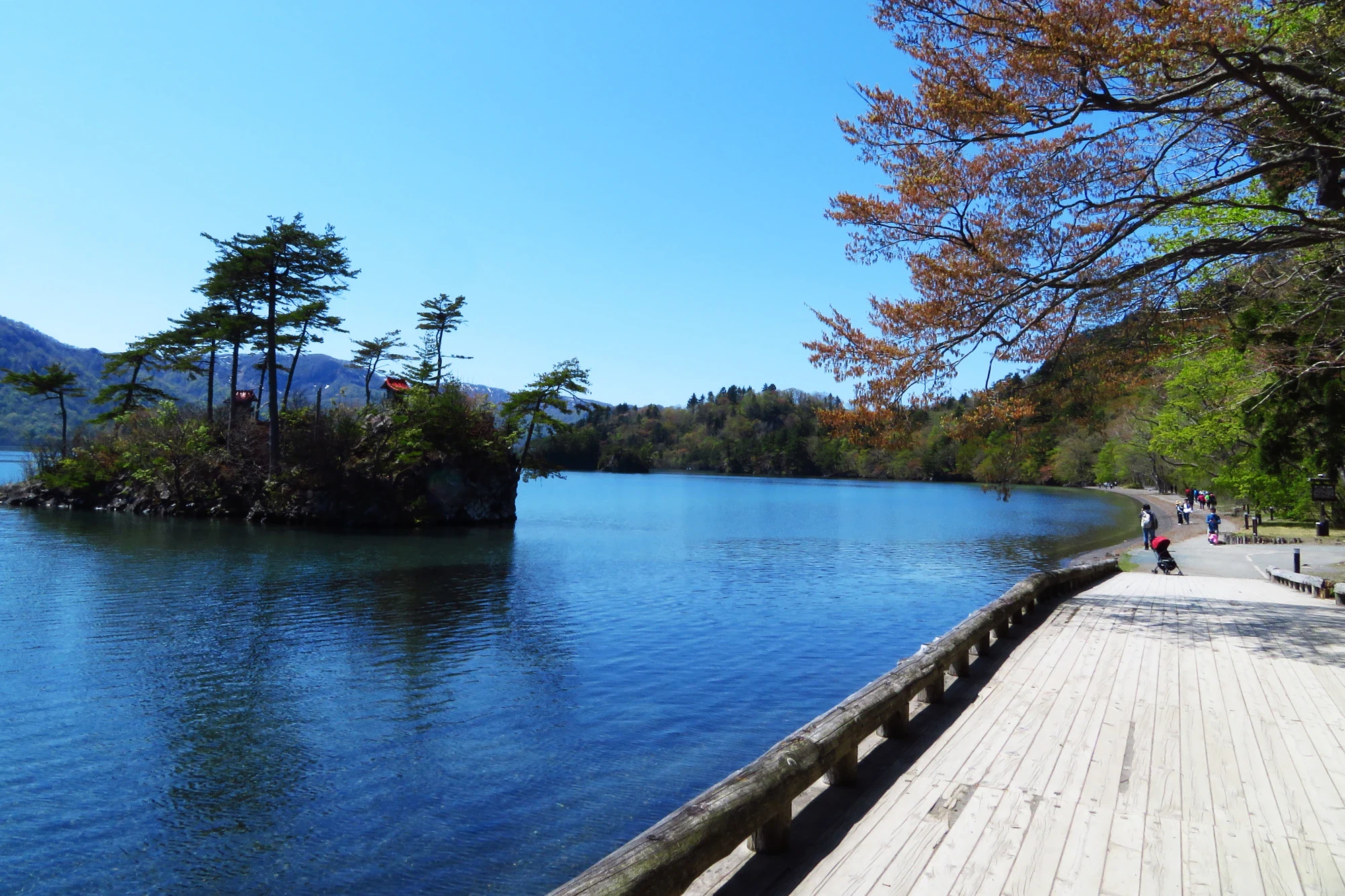
Start beside the water at Yasumiya, where Lake Towada gives you a gentle introduction to a very large national park. The national park stretches across Aomori, Akita and Iwate, with Towada–Hakkoda in the north and Hachimantai farther south. For this visit, stay around Towada Visitor Center and the southern lakeshore. You can enjoy the lake, a short walk and some nature learning without fitting mountain roads and distant trailheads into the same day.
Inside the visitor center, use the caldera model to get your bearings before looking out over the real lake. The exhibitions connect Lake Towada with Oirase Stream and the Hakkoda Mountains; bird models and seasonal films give younger visitors something specific to look for outside. The observation lounge is also a useful pause when the weather turns. The lake occupies a volcanic depression shaped by repeated eruptions and collapse, and reaches about 327 metres at its deepest point. From the shore, that hidden depth is hard to picture.
Follow the signed lakeside walk toward Gozengahama and the Otome no Zō, the Maiden Statue. Aomori's visitor information puts the statue about 15 minutes on foot from the Towadako (Yasumiya) bus stop, but allow longer to stop and look. Close to shore, Ebisu-Daikoku Island is a small outcrop of volcanic rock with trees above the water. Near the statue, fractured rock shows how cooling lava can split into columns. These are good details to notice before turning back, especially if a long woodland walk would be too much.
The paired bronze figures at the end of the shore walk were created by sculptor and poet Kōtarō Takamura in 1953. If the paths are open and everyone has energy left, the wooded connection toward Towada Shrine adds a change of mood: large deciduous trees replace the broad lake view. Keep the steep lookout steps as a separate decision rather than an automatic continuation. The old ladder route down to the fortune-telling place is closed to entry.
Look between the lake and the trees as you walk. Eurasian nuthatches and great spotted woodpeckers belong to the lakeshore woodland, while winter brings diving ducks such as tufted ducks and common pochards onto the water near Gozengahama. Binoculars are more useful than trying to get close, and sightings are never certain. Leave food packed away and give all wildlife room.
If you'd like more lake scenery without another walk, consider a seasonal sightseeing cruise from Yasumiya. The round-trip peninsula cruise brings you back to the same departure area; the Nenokuchi service is a one-way journey and needs a return plan. Oirase Gorge starts at Nenokuchi, elsewhere on the lakeshore. Treat it as a separate outing, with its own transport and walking time, rather than a short extension of the Yasumiya stroll. Take the ultimate field guide with you: use the Snappit app to identify birds, plants, and animals on your trip.
The Towada area became Towada National Park on February 1, 1936. Hachimantai was added on July 10, 1956, giving the park its present name. The Maiden Statue was erected in 1953 as part of a commemorative project honouring people who helped bring wider recognition and national-park protection to Lake Towada. Towada Shrine represents an older layer of the landscape’s history: the local park association describes its role as a place of mountain ascetic practice before the Kamakura period and a spiritual site under the Nanbu domain in the Edo period.