

African Giant Snail
lissachatina fulica
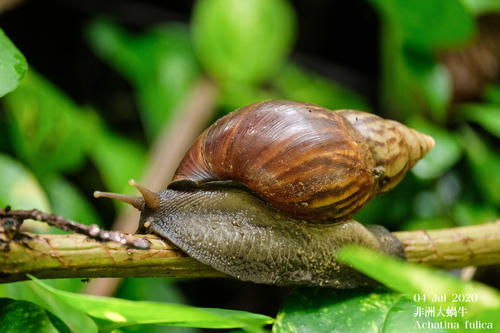
The African Giant Snail (Lissachatina fulica) is one of the largest land snails in the world, renowned for its massive size and voracious appetite. Native to East Africa, this impressive gastropod has unfortunately become one of the most invasive species globally, adapting quickly to various tropical and subtropical climates. Characterized by its beautifully striped, conical shell and slow, deliberate movements, it is a fascinating creature to observe, despite the severe ecological and agricultural challenges it poses in non-native habitats. Often kept as exotic pets in some regions where legal, they are marvels of the mollusk world, possessing complex sensory tentacles and the ability to aestivate during harsh dry spells.
Habitat: Found in warm, humid tropical environments, often hiding beneath damp leaf litter or dense undergrowth.
This giant land snail is easily recognized by its large, elongated, conical shell that typically spirals in a clockwise direction with 7 to 9 whorls when fully grown. The shell is strikingly patterned with distinct bands of reddish-brown and pale yellowish vertical stripes, though coloration can vary depending on diet and environment. The snail's soft, fleshy body is typically dark brown or greyish, exhibiting a moist, textured surface. Its head features two prominent pairs of tentacles: the longer upper pair houses the eyes at their tips, while the shorter lower pair is highly specialized for smelling and feeling its way around.
Category
InvertebrateRarity
Common
Danger
1/5 · Very low
Snaps
3
African Giant Snails require so much calcium for their massive shells that they have been known to eat stucco off the sides of houses.
Because they are hermaphrodites, every single snail in a given population has the potential to lay eggs, meaning just one imported snail can spawn an entire invasion.
During periods of extreme drought, they can seal themselves inside their shells and survive without food or water for up to three years.
They are officially listed as one of the top 100 worst invasive alien species in the world by the International Union for Conservation of Nature.
It can survive extreme heat or drought by retreating into its shell and sealing the opening with a papery membrane called an epiphragm, remaining dormant for months.
Possessing both male and female reproductive organs, any two mature individuals can mate and lay eggs, rapidly accelerating population growth.
It uses its lower pair of tentacles to detect complex chemical signatures in the environment, helping it locate specific food sources from considerable distances.
Highly polyphagous, they consume over 500 different types of plant species, as well as decaying organic matter and essential calcium sources.
Age differences: Juveniles typically consume softer, decaying vegetation and require immense amounts of calcium to build their rapidly growing shells, while adults tackle tougher, living plants.
Platydemus manokwari
Introduced as a biological control to hunt the snail, this flatworm aggressively preys on the African Giant Snail.
Carica papaya
The snail voraciously consumes the leaves and fruits of the papaya tree, causing significant agricultural damage.
Angiostrongylus cantonensis
The snail acts as an intermediate host for this parasitic nematode, which can cause meningitis in humans who mishandle or undercook them.
No trait badges are assigned for this object yet.
No aliases listed yet.
Collections for this object will appear here as more themes are added.
Danger
1/5 · Very low
No special safety notes yet.
The easiest way to identify African Giant Snail is to use the Snappit nature identifier app.
7-20 cm
0.05-0.5 kg
3-5 years
Highly polyphagous, they consume over 500 different types of plant species, as well as decaying organic matter and essential calcium sources.
Found in warm, humid tropical environments, often hiding beneath damp leaf litter or dense undergrowth.
Foraging
100-500
Zoom in to split clusters and explore where this object has been snapped.

Hawaii, US
You might spot Brown Anole, Gold Dust Day Gecko, and Red-Crested Cardinal.
View guide →

Hawaii, US
You might spot Gold Dust Day Gecko, Yellow Tang, and Saffron Finch.
View guide →

Hawaii, US
You might spot White-Rumped Shama, Koster's Curse, and Red Button Ginger.
View guide →

Hawaii, US
You might spot Brown Anole, Red-Crested Cardinal, and Gold Dust Day Gecko.
View guide →

Hawaii, US
You might spot Brown Anole, Red-Crested Cardinal, and Gold Dust Day Gecko.
View guide →

Hawaii, US
You might spot Gold Dust Day Gecko, Red Junglefowl, and Brown Anole.
View guide →
Take the discovery with you
Snap it with Snappit to identify it, learn what makes it special, and add the discovery to your collection.