
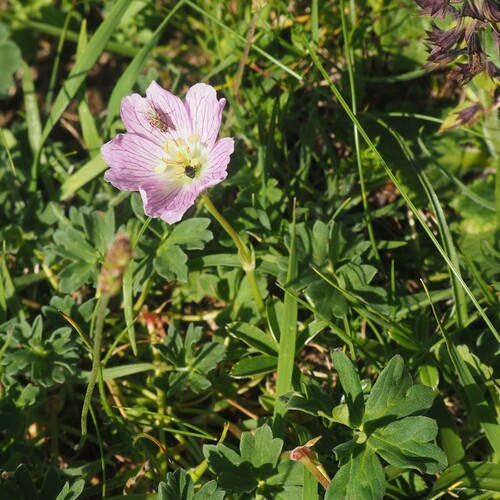


Ashy Crane'S-Bill
geranium cinereum
The Ashy Crane's-Bill (Geranium cinereum) is a charming and resilient perennial plant native to the high-altitude regions of the Pyrenees mountains. Renowned for its delicate yet striking appearance, it thrives in challenging alpine environments, bringing a splash of color to rocky slopes and meadows. Its compact growth habit and distinctive silvery-grey foliage make it a popular choice for rock gardens and alpine enthusiasts worldwide, a testament to its adaptability and ornamental value. This species embodies the hardy beauty of montane flora, captivating observers with its unique blend of grace and toughness as it endures cold, wind, and dry conditions.
Habitat: The Ashy Crane's-Bill is typically found in alpine and subalpine zones, inhabiting rocky meadows, scree slopes, sparse montane grasslands, and open woodlands where sunlight is abundant and drainage is excellent.
This low-growing perennial forms neat, dense mounds, typically reaching heights of 10-20 cm. Its most distinguishing feature is its finely dissected, deeply lobed leaves, which are covered in tiny hairs, giving them a beautiful silvery-grey or ashy appearance. The flowers, borne singly or in loose clusters, are cup-shaped and measure about 2-3 cm across. They range in color from pale pink to rose-purple, often adorned with prominent darker purple veins that radiate from the center, creating a delicate striped effect. The sepals are typically tinged with reddish-brown.
Category
PlantsRarity
Common
Danger
1/5 · Very low
Snaps
Be the first to snap!
Despite its wild origins, Ashy Crane's-Bill is a popular choice for alpine and rock gardens due to its drought tolerance, compact growth, and attractive flowers, with many cultivars developed.
Its deeply lobed leaves are a classic characteristic of the Geranium genus, often resembling a "crane's bill" when the seed pods develop, giving the plant its common name.
The species name "cinereum" is Latin for "ash-grey," referring to the distinctive silvery color of its foliage, which helps it reflect intense sunlight in its high-altitude habitat.
This hardy perennial can grow in very poor, stony soils, demonstrating its remarkable adaptability to nutrient-scarce environments found in the Pyrenees.
Adapted to withstand harsh alpine conditions, including cold temperatures, strong winds, and fluctuating moisture levels, ensuring its survival in challenging environments.
Its hairy, silvery foliage helps reduce water loss through transpiration, allowing it to thrive in dry, well-drained, and often nutrient-poor soils characteristic of its native habitat.
The conspicuous, veined flowers act as strong visual cues, efficiently attracting various insect pollinators such as bees and butterflies to facilitate reproduction.
As a plant, Geranium cinereum produces its own energy through photosynthesis, converting sunlight, carbon dioxide, and water into sugars, supplemented by essential nutrients absorbed from the soil.
Apis mellifera
Pollination of flowers
Rupicapra rupicapra
Grazing on foliage
Formica rufa
Seed dispersal by ants

Glomeromycota
Soil nutrient uptake enhancement
No trait badges are assigned for this object yet.
No aliases listed yet.
Collections for this object will appear here as more themes are added.
Danger
1/5 · Very low
No special safety notes yet.
Start with the whole plant, then compare leaf arrangement, leaf edges, stems and any flowers or fruit. Opposite leaves grow in pairs; alternate leaves come one at a time along the stem. These details tell you far more together than a single green leaf does. Plant Identifier: upload a photo and compare the visible details.
10-20 cm
0.01-0.05 kg
3-10 years
As a plant, Geranium cinereum produces its own energy through photosynthesis, converting sunlight, carbon dioxide, and water into sugars, supplemented by essential nutrients absorbed from the soil.
The Ashy Crane's-Bill is typically found in alpine and subalpine zones, inhabiting rocky meadows, scree slopes, sparse montane grasslands, and open woodlands where sunlight is abundant and drainage is excellent.
Photosynthesis
Zoom in to split clusters and explore where this object has been snapped.
Recent snaps will appear here as new observations are added.
Take the discovery with you
Snap it with Snappit to identify it, learn what makes it special, and add the discovery to your collection.


















