

Bankclimber
plectomerus dombeyanus
The Bankclimber (Plectomerus dombeyanus) is a robust and fascinating freshwater mussel native to the river systems of the southern United States. Belonging to the family Unionidae, this bivalve plays an essential role in its aquatic ecosystem by acting as a natural water filter, cleaning algae, bacteria, and organic particles from the water column. The name Bankclimber comes from its preference for soft riverbanks and mud slopes, where it can frequently be found anchored or slowly shifting through the substrate. Despite its stationary appearance, it engages in an intricate, parasitic reproductive cycle that relies on specific host fish to disperse its offspring. This remarkable mollusk serves as an indicator of river health, showcasing the complex interdependencies within freshwater habitats.
Habitat: Found in large slow-moving rivers, reservoirs, and bayous, typically embedded in deep mud, silt, or sandy clay substrates.
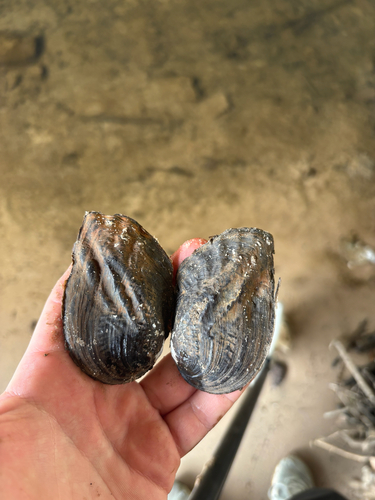
The Bankclimber is easily identified by its large, heavy, and solid shell which is distinctly rhomboid or trapezoidal in shape. Its exterior periostracum ranges from a dark brown to a solid, matte black, often exhibiting prominent, heavy ridges and sculpturing on the posterior slope that resemble a washboard. The posterior ridge is high and sharp, ending in a blunt point at the base. Inside, the nacre is typically white, but it frequently shows beautiful purple or iridescent pinkish highlights toward the back, with deeply set hinge teeth near the margin.
Category
InvertebrateRarity
Common
Danger
1/5 · Very low
Snaps
Be the first to snap!
Its larvae must hitchhike on the gills of specific catfish species for several weeks to complete their metamorphosis into juvenile mussels.
Scientists use the growth rings on a Bankclimber's shell, much like tree rings, to estimate its exact age and past water quality conditions.
The Bankclimber is one of the heaviest freshwater mussels in its range, with a thick shell that was historically sought after for the button-making industry.
Efficiently filters gallons of river water daily to feed on micro-particles, which dramatically clarifies and purifies its surrounding aquatic habitat.
Releases specialized larval packages called conglutinates that mimic aquatic prey to lure host catfish, ensuring successful dispersal of its offspring.
Utilizes a strong muscular foot to burrow deep into soft mud or clay, preventing it from being swept away by strong river currents.
Feeds by filtering tiny organic particles, algae, and microorganisms directly from the water column.
Age differences: Larval glochidia are temporary parasites that absorb nutrients from host fish tissues, while adults are strictly filter feeders.
No trait badges are assigned for this object yet.
No aliases listed yet.
Collections for this object will appear here as more themes are added.
Danger
1/5 · Very low
No special safety notes yet.
Compare body symmetry, shells, segments, legs, tentacles and how the animal moves. Invertebrates span many unrelated groups, so start with body structure. Invertebrate Identifier: upload a photo and compare the visible details.
8-16 cm
0.1-0.6 kg
15-40 years
Feeds by filtering tiny organic particles, algae, and microorganisms directly from the water column.
Found in large slow-moving rivers, reservoirs, and bayous, typically embedded in deep mud, silt, or sandy clay substrates.
Filtering
10000-80000
Zoom in to split clusters and explore where this object has been snapped.
Recent snaps will appear here as new observations are added.

Alabama, US
You might spot Spanish Moss, Mediterranean House Gecko, and Anole.
View guide →

Alabama, US
You might spot Spanish Moss, Mapleleaf, and Mediterranean House Gecko.
View guide →
Take the discovery with you
Snap it with Snappit to identify it, learn what makes it special, and add the discovery to your collection.