
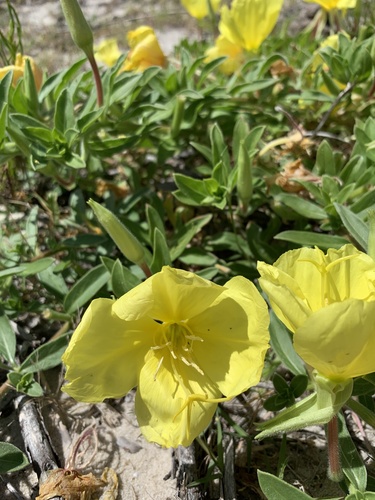


Beach Evening-Primrose
oenothera drummondii
The Beach Evening-Primrose (Oenothera drummondii) is a hardy, sprawling plant that thrives where few others can—on the sun-drenched, wind-swept sand dunes of coastal environments. Native to the coastal regions of the Gulf of Mexico and the southeastern United States, this resilient plant plays a crucial ecological role by anchoring shifting sands with its deep taproot and low-growing, mat-forming stems. Its ability to tolerate salt spray, intense heat, and nutrient-poor soils makes it a true survivor of the beach frontier. What makes this plant truly enchanting is its crepuscular blooming cycle. As evening approaches, its large, saucer-shaped yellow flowers unfurl within minutes, releasing a sweet fragrance to summon nocturnal pollinators. By the following afternoon, these golden blossoms undergo a dramatic transformation, fading to a beautiful reddish-pink before wilting. This rapid, daily cycle of birth, pollination, and color-shifting decay makes the Beach Evening-Primrose a captivating find for coastal nature-watchers.
Habitat: Found on coastal dunes, sandy beaches, and coastal grasslands, often tolerating salt spray and wind.
This low-growing, sprawling herbaceous plant forms dense mats up to 50 centimeters high and over a meter wide. Its stems and leaves are covered in a dense coat of fine, grayish-green, velvety hairs that give the foliage a dusty appearance. The leaves are simple, oblanceolate to elliptic, often with wavy or slightly toothed margins. Its most prominent feature is the large, four-petaled flower, which measures up to 7 centimeters across. The flowers open bright yellow with central yellow stamens, but fade to a distinct peach or reddish-pink as they age.
Category
PlantsRarity
Common
Danger
1/5 · Very low
Snaps
Be the first to snap!
As the flowers age and prepare to wilt the next day, they undergo a striking color change, fading from bright yellow to a deep reddish-pink.
Its dense, fuzzy hairs on the leaves act like a natural sunblock and windbarrier, protecting the plant from scorching coastal sun and abrasive blowing sand.
The flowers of the Beach Evening-Primrose open rapidly at dusk, a spectacle that can sometimes be watched in real-time over just a few minutes.
Able to withstand harsh, salty winds on coastal dunes by using a dense layer of leaf hairs and a specialized waxy cuticle.
Utilizes a deep taproot and sprawling, rooting stems to anchor itself and hold shifting sands in place, helping stabilize beaches.
Flowers open rapidly at dusk to target evening pollinators, minimizing water loss from heat during the day.
As a photosynthetic plant, it produces its own energy using sunlight, water, and carbon dioxide, while absorbing essential minerals from sandy soils.

Hyles lineata
The fragrant yellow flowers open at dusk to attract evening pollinators like hawkmoths.
Apis mellifera
Bees visit the flowers in the early morning hours before they close or fade.
No trait badges are assigned for this object yet.
No aliases listed yet.
Collections for this object will appear here as more themes are added.
Danger
1/5 · Very low
No special safety notes yet.
Start with the whole plant, then compare leaf arrangement, leaf edges, stems and any flowers or fruit. Opposite leaves grow in pairs; alternate leaves come one at a time along the stem. These details tell you far more together than a single green leaf does. Plant Identifier: upload a photo and compare the visible details.
10+ cm
As a photosynthetic plant, it produces its own energy using sunlight, water, and carbon dioxide, while absorbing essential minerals from sandy soils.
Found on coastal dunes, sandy beaches, and coastal grasslands, often tolerating salt spray and wind.
Photosynthesis
Zoom in to split clusters and explore where this object has been snapped.
Recent snaps will appear here as new observations are added.

US
You might spot Brown Pelican, Laughing Gull, and Cannonball Jelly.
View guide →

US
You might spot Brown Pelican, Cannonball Jelly, and Laughing Gull.
View guide →
Take the discovery with you
Snap it with Snappit to identify it, learn what makes it special, and add the discovery to your collection.

















