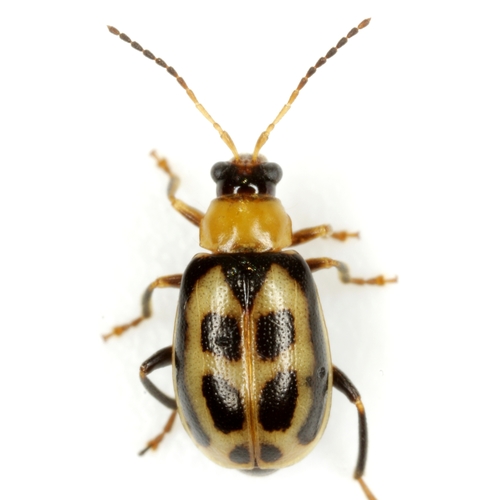


Bean Leaf Beetle
cerotoma trifurcata
The Bean Leaf Beetle (Cerotoma trifurcata) is a common and highly adaptable agricultural beetle found across North America. Belonging to the leaf beetle family Chrysomelidae, this small insect plays a major role in local ecosystems and crop environments. While often recognized as a pest due to its fondness for soybeans and other legumes, the beetle showcases incredibly interesting biological variations, including diverse color morphs that can range from yellow to red with varying spot patterns. In the spring, they emerge from forest margins to colonize young host plants, where they feed on leaves and pods. Despite their agricultural impact, they are an essential food source for many native birds, spiders, and predatory insects. Their life cycle relies on leguminous plants, where adults feed on foliage while their larvae live underground, consuming roots and nitrogen-fixing nodules. This dual-habitat lifestyle highlights their specialization and complex interaction with their environment.
Habitat: Typically found in agricultural fields, pastures, gardens, and grassy borders where leguminous plants are grown.
The Bean Leaf Beetle is a small, oval-shaped insect measuring approximately 0.3 to 0.6 centimeters in length. Its color is highly variable, ranging from light yellow and tan to vibrant red. The most reliable identifier is a distinct black, backward-pointing triangle located at the front margin of the wing covers, right behind the black head. Most individuals also display four prominent rectangular black spots on their back, bordered by a thin black band along the outer edges of the wing cases, although some individuals may lack spots entirely.
Category
InsectsRarity
Common
Danger
1/5 · Very low
Snaps
1
Bean Leaf Beetles overwinter as adults in leaf litter and can survive freezing temperatures by producing glycerol, a natural antifreeze.
Their color variation is so dramatic that early entomologists mistakenly classified different color morphs of this single species as entirely separate species.
They are major vectors for plant diseases, transmitting the devastating Bean Pod Mottle Virus through their saliva as they feed.
When threatened, this beetle will immediately drop from foliage and play dead, blending into the soil below to escape predators.
This species exhibits extreme genetic variation in coloration, allowing individuals to appear red, yellow, or orange, which helps confuse predatory search images.
In their larval stage, they can burrow directly into the underground nitrogen-fixing root nodules of legume plants, exploiting a specialized subterranean food source.
Both larvae and adults feed exclusively on leguminous plants, targeting roots underground and foliage aboveground.
Age differences: Larvae feed underground on roots and nitrogen-fixing nodules, whereas adults feed aboveground on leaves, flowers, and bean pods.

Glycine max
Adults feed on the leaves and pods, while larvae consume the roots and nitrogen-fixing nodules.
Podisus maculiventris
A generalist predatory stink bug that preys on both adult and larval bean leaf beetles.
Celatoria diabroticae
A parasitoid fly that deposits eggs on the beetle, with the developing larvae eventually killing the host.
No trait badges are assigned for this object yet.
No aliases listed yet.
Collections for this object will appear here as more themes are added.
Danger
1/5 · Very low
No special safety notes yet.
The easiest way to identify Bean Leaf Beetle is to use the Snappit nature identifier app.
0+ cm
1+ cm
0.00001+ kg
0+ years
Both larvae and adults feed exclusively on leguminous plants, targeting roots underground and foliage aboveground.
Typically found in agricultural fields, pastures, gardens, and grassy borders where leguminous plants are grown.
Grazing
Zoom in to split clusters and explore where this object has been snapped.
Take the discovery with you
Snap it with Snappit to identify it, learn what makes it special, and add the discovery to your collection.













.jpg&width=800)




