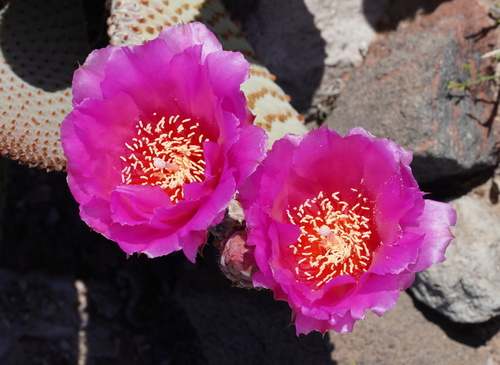


Beavertail Pricklypear
opuntia basilaris
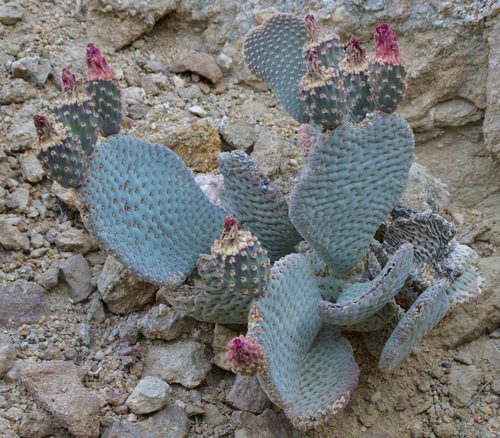
The Beavertail Pricklypear (Opuntia basilaris) is an iconic, low-growing cactus that adds dramatic splashes of color to the harsh landscapes of the American Southwest. Named for its wide, flattened, grayish-green pads that closely resemble the tail of a beaver, this striking succulent thrives in extreme desert conditions. In spring, it puts on a spectacular floral display, erupting with large, vibrant magenta or rose-pink flowers that attract a variety of specialized desert pollinators. What makes the Beavertail Pricklypear particularly fascinating is its deceptive appearance. Unlike most of its pricklypear relatives, it appears completely spineless at first glance. However, those familiar with the desert know not to be fooled; the cactus is densely dotted with tiny, hair-like barbed bristles called glochids. These nearly invisible defenses easily detach upon contact, providing a painful reminder to admire this rugged survivor from a respectful distance.
Habitat: Found in arid desert landscapes, often on dry, rocky slopes or sandy washes.
This low, spreading cactus typically forms clumps less than 40 cm tall but can span over a meter across. Its signature cladodes (pads) are fleshy, flattened, and obovate to spatulate, typically blue-green to grayish-green with a slightly wrinkled texture, often taking on a purplish tinge during times of drought or cold. While it lacks large, protruding spines, the areoles (small bumps on the pads) contain dense clusters of fine, reddish-brown to grayish glochids. From late winter to early summer, it produces stunning, cup-shaped flowers that are brilliant magenta to purplish-pink, measuring up to 7 cm across, eventually giving way to small, spineless, egg-shaped grayish-brown fruits.
Category
PlantsRarity
Common
Danger
1/5 · Very low
Snaps
4
Because it lacks traditional long spines, the Beavertail Pricklypear's fruit is completely spineless, though it remains heavily armored with the same irritating glochids found on the pads.
Despite appearing perfectly smooth and touchable, the Beavertail Pricklypear's tiny glochids are notoriously irritating and much harder to remove from human skin than standard cactus spines.
Native American tribes like the Cahuilla historically used the Beavertail Pricklypear extensively, boiling the pads to dissolve the glochids and eating them as a vegetable.
When the plant is exposed to extreme cold, drought, or intense sunlight, it produces purple pigments to protect itself, turning the green pads a striking shade of violet.
Like many desert succulents, it opens its stomata at night to collect carbon dioxide, drastically reducing water loss during scorching daytime hours.
While lacking long spines, it utilizes dense clusters of microscopic, barbed bristles called glochids that easily detach and embed deeply into the skin of potential herbivores.
It produces betalain pigments under environmental stress like drought or cold, turning the pads purple and acting as a natural sunscreen that protects plant tissues.
As a photosynthetic plant, the Beavertail Pricklypear produces its own energy using sunlight, water, and atmospheric carbon dioxide.
Ovis canadensis nelsoni
Feeds on the fleshy pads of the cactus during times of extreme drought to obtain essential moisture.
Diadasia rinconis
A solitary bee that specializes in pollinating Opuntia cacti, relying heavily on their pollen for rearing young.
Neotoma lepida
Consumes the cactus pads for hydration and utilizes the plant's dense structure for shelter and protection.
No trait badges are assigned for this object yet.
No aliases listed yet.
Collections for this object will appear here as more themes are added.
Danger
1/5 · Very low
No special safety notes yet.
The easiest way to identify Beavertail Pricklypear is to use the Snappit nature identifier app.
15-40 cm
1-10 kg
10-50 years
As a photosynthetic plant, the Beavertail Pricklypear produces its own energy using sunlight, water, and atmospheric carbon dioxide.
Found in arid desert landscapes, often on dry, rocky slopes or sandy washes.
Photosynthesis
Zoom in to split clusters and explore where this object has been snapped.
Apr 9, 2026
Rainbow BasinPhoto attribution
(c) Donald Hampton, some rights reserved (CC BY-SA)
License: CC BY-SA 4.0 ↗
Image may be shown cropped inside the card frame.

California, US
You might spot Desert Holly, Western Joshua Tree, and Creosote Bush.
View guide →

California, US
You might spot Frémont's Phacelia and Devil's Spineflower.
View guide →

Nevada, US
You might spot Creosote Bush, Brittlebush, and Beavertail Pricklypear.
View guide →

California, US
You might spot Sand Blazingstar, Red Rock Tarplant, and Lacy Phacelia.
View guide →

California, US
You might spot Creosote Bush, Desert Holly, and Cottontop Cactus.
View guide →

California, US
You might spot Western Joshua Tree and Engelmann's Hedgehog Cactus.
View guide →
Take the discovery with you
Snap it with Snappit to identify it, learn what makes it special, and add the discovery to your collection.












.jpg&width=800)



_001.jpg&width=800)




