
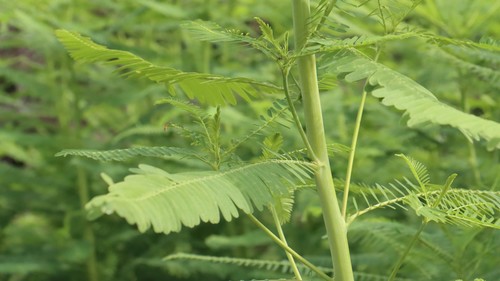


Bigpod Sesbania
sesbania herbacea
Bigpod Sesbania, scientifically known as Sesbania herbacea, is a fast-growing annual legume native to the southern United States and northern Mexico. Often reaching impressive heights of up to four meters, this robust herb is frequently encountered in moist, disturbed environments, floodplains, and agricultural fields—particularly rice paddies, where it is sometimes viewed as a weed. Despite its weed-like persistence, it plays a vital role in its ecosystem by forming symbiotic relationships with soil bacteria to fix nitrogen, enriching the surrounding soil. This plant features delicate, feather-like compound leaves that give it an airy, elegant appearance despite its towering stature. During the late summer and autumn, it produces clusters of charming yellow flowers mottled with purple spots. These blooms later mature into remarkably long, thread-like seed pods, which dangle gracefully from the branches. For nature enthusiasts, spotting Bigpod Sesbania offers a glimpse into the dynamic ways pioneering plants colonize wet soils and contribute to the nitrogen cycle.
Habitat: Found in moist, open areas, agricultural fields, floodplains, ditches, and disturbed wetlands.
Bigpod Sesbania is a tall, erect annual herb that can grow 1 to 4 meters high, characterized by a smooth, fibrous stem that branches widely near the top. Its leaves are pinnately compound, measuring up to 30 cm long, with numerous small, oblong leaflets arranged in pairs. The plant produces drooping clusters of pea-like flowers that are bright yellow, often brushed or speckled with reddish-purple on the outer petals. These flowers give way to the plant's most distinctive feature: extremely long, slender, curved green seed pods that measure 10 to 20 cm in length and only a few millimeters wide, hanging down like thin beans.
Category
PlantsRarity
Common
Danger
1/5 · Very low
Snaps
Be the first to snap!
Despite being considered a noxious weed in crops like rice and soybeans, Bigpod Sesbania is highly valued in some restoration projects for its rapid soil-enriching nitrogen fixation.
Its scientific name herbacea means herbaceous, highlighting its non-woody, annual growth habit despite reaching the height of a small tree.
The seeds of Bigpod Sesbania contain sesbanimide, a compound that is toxic to livestock, particularly cattle and goats, if consumed in large quantities.
It forms a symbiotic relationship with rhizobia bacteria in its root nodules, converting atmospheric nitrogen into a form usable by plants.
It possesses specialized spongy tissue called aerenchyma in its roots, allowing it to survive and thrive in saturated, oxygen-poor soils.
It can grow several meters in a single season, outcompeting neighboring vegetation for sunlight in disturbed habitats.
As a photoautotrophic plant, Bigpod Sesbania produces its own food through photosynthesis, utilizing sunlight, carbon dioxide, and water while absorbing key nutrients through its root system.

Abaeis nicippe
Provides larval food for the caterpillars of this sulfur butterfly.
Euschistus servus
A common pest insect that feeds on the seeds and pods of the plant.
Oryza sativa
Competes with this crop for nutrients, sunlight, and water in agricultural fields.
No trait badges are assigned for this object yet.
No aliases listed yet.
Collections for this object will appear here as more themes are added.
Danger
1/5 · Very low
No special safety notes yet.
Start with the whole plant, then compare leaf arrangement, leaf edges, stems and any flowers or fruit. Opposite leaves grow in pairs; alternate leaves come one at a time along the stem. These details tell you far more together than a single green leaf does. Plant Identifier: upload a photo and compare the visible details.
100-400 cm
0.2-1.5 kg
1 years
As a photoautotrophic plant, Bigpod Sesbania produces its own food through photosynthesis, utilizing sunlight, carbon dioxide, and water while absorbing key nutrients through its root system.
Found in moist, open areas, agricultural fields, floodplains, ditches, and disturbed wetlands.
Photosynthesis
Zoom in to split clusters and explore where this object has been snapped.
Recent snaps will appear here as new observations are added.

Illinois, US
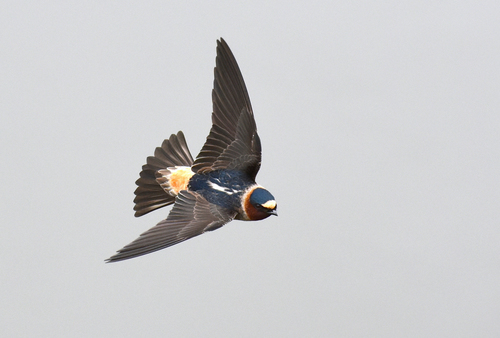
You might spot Cliff Swallow, Baldcypress, and Indian Heliotrope.
View guide →
Illinois, US
You might spot Cliff Swallow, Baldcypress, and Indian Heliotrope.
View guide →
Take the discovery with you
Snap it with Snappit to identify it, learn what makes it special, and add the discovery to your collection.

















