





Bitterweed
Helenium amarum
Bitterweed is a bright yellow flower that grows in sunny places. It has a fun name because its leaves can taste a little bitter! These flowers are great for attracting butterflies and bees.
Habitat: Grasslands
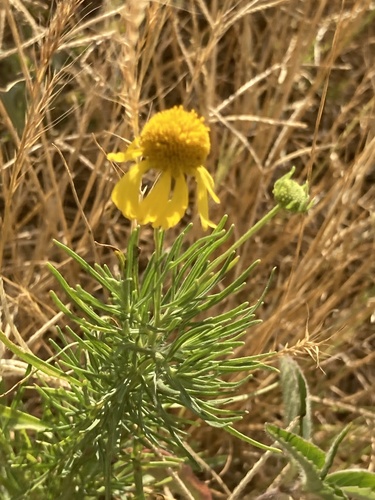
The Bitterweed has many slender, branched stems topped with numerous bright yellow, daisy-like flowers. Each flower features a prominent yellow-brown center surrounded by 7-13 short, wedge-shaped petals. Its narrow, sparse leaves distinguish it from other broader-leafed wildflowers.
Category
PlantsRarity
Common
Danger
1/5 · Very low
Snaps
22
Crush its leaves to smell a strong, unique, and bitter scent!
Despite its name, many bees and butterflies love its nectar-rich flowers.
If cows eat bitterweed, their milk can actually taste bitter!
It often grows in open fields, painting them yellow with its blooms!
Bitterweed has chemicals that make it taste very bitter, which helps it defend against most animals trying to eat it.
Bitterweed can thrive in full sun and dry, poor soils, helping it grow in places where other plants struggle.
Its cheerful yellow flowers bloom in late summer and fall, offering nectar when many other plants have finished flowering.
Bitterweed produces many tiny, light seeds that are easily carried by wind, helping it quickly spread to new areas.
Apis mellifera
Visits flowers for nectar and pollen

Bombus impatiens
Collects nectar and pollen from blooms
Syrphus ribesii
Adults feed on nectar and pollen
Flowering plants are any plants that produce flowers as part of their reproductive cycle.
Summer blooming plants produce their flowers during the summer season, often providing vibrant color when many other plants have finished.
Colorful describes organisms or objects displaying a wide range of bright and distinct colors.
Edible plants are those parts of a plant that are considered safe for human consumption.

Grassland habitats are terrestrial biomes dominated by grasses and herbaceous plants, supporting a variety of grazing animals.

Describes plants that are particularly attractive and beneficial to a wide range of pollinating organisms.
No aliases listed yet.
Danger
1/5 · Very low
Don't eat any plants unless a grown-up says it's safe!
The easiest way to identify Bitterweed is to use the Snappit nature identifier app.
10-60 cm
15-30 cm
1-2.5 cm
Summer-fall
No
Moderate
Annual
Zoom in to split clusters and explore where this object has been snapped.
Jul 3, 2022
Clover Bend Historic DistrictPhoto attribution
(c) Joseph McPhail, some rights reserved (CC BY)
License: CC BY 4.0 ↗
Image may be shown cropped inside the card frame.

Arkansas, US
You might spot Widow's-Cross, Yucca Giant-Skipper, and Outis Skipper.
View guide →

US
You might spot Wharf Louse, Osprey, and Ruddy Turnstone.
View guide →

Texas, US
You might spot Question Mark, Buttonbush, and Pomegranate.
View guide →

Alabama, US
You might spot Red-Headed Woodpecker and Hardwood Stump Borer.
View guide →

Texas, US
You might spot Giraffes, Tiger, and Hippopotamus.
View guide →

Alabama, US
You might spot Red Buffalo-Bur, Eastern Box Turtle, and Anole.
View guide →
Take the discovery with you
Snap it with Snappit to identify it, learn what makes it special, and add the discovery to your collection.








.jpg&width=800)



_001.jpg&width=800)



