

Black Tar Spot
rhytisma acerinum
The Black Tar Spot, scientific name Rhytisma acerinum, is a fascinating and common fungal pathogen primarily affecting maple trees. It's easily recognized by the distinctive, shiny black spots it forms on leaves, particularly prominent in late summer and autumn. While its appearance might initially cause concern for tree health, R. acerinum is largely considered a cosmetic disease, rarely causing significant harm to its host. Its presence is often seen as an indicator of good air quality, as it is sensitive to sulfur dioxide pollution, making it an interesting bio-indicator in urban and rural environments.
Habitat: Found on the leaves of maple trees (Acer species) in deciduous forests, parks, gardens, and urban green spaces where maples are prevalent.
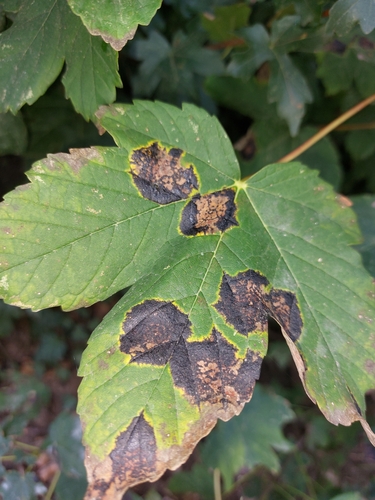
This fungus is characterized by its glossy, raised, tar-like black spots that develop on the upper surface of maple leaves. These spots are typically circular to irregular in shape, ranging from 0.5 to 3 centimeters in diameter, and are often surrounded by a bright yellow or yellowish-green halo, particularly in their earlier stages. As the season progresses, the yellow margin may fade, leaving a stark black patch. Multiple spots can coalesce to form larger, more irregular blotches.
Category
FungiRarity
Common
Danger
1/5 · Very low
Snaps
Be the first to snap!
Despite its alarming appearance, this fungal infection causes no significant harm to its host maple tree, primarily being a cosmetic issue.
Its life cycle involves two distinct phases: a parasitic phase on living maple leaves and a saprophytic phase on fallen, decaying leaves during winter.
The distinctive yellow halo often seen around the black spots is actually a reaction of the maple leaf tissue to the fungal infection.
The presence of Black Tar Spot on maple leaves is often used as a natural indicator of good air quality, as the fungus is highly sensitive to sulfur dioxide pollution.
Rhytisma acerinum is highly sensitive to sulfur dioxide pollution, meaning its presence often indicates relatively clean air environments. In areas with significant air pollution, this fungus is rarely observed.
The fungus overwinters within the fallen infected leaves on the forest floor. In spring, it produces tiny, fruiting structures that release spores to infect new, emerging maple leaves.
Despite its parasitic nature and visible impact, Black Tar Spot typically causes no serious damage to its host tree. It is primarily a cosmetic issue, not affecting the tree's overall vigor or survival.
Rhytisma acerinum absorbs nutrients from the living cells of maple leaves during its initial parasitic phase. Once the leaves fall, the fungus continues to derive nutrients saprophytically from the decaying leaf tissue on the ground.
Age differences: The fungus transitions from a parasitic lifestyle on living maple leaves to a saprophytic lifestyle once the leaves senesce and fall to the ground.

Acer platanoides
Primary host for parasitic growth

Acer pseudoplatanus
Primary host for parasitic growth

Lumbricus terrestris
Decomposers of infected fallen leaves
Homo sapiens
Fungal diseases like this can be impacted by atmospheric composition, particularly pollution
No trait badges are assigned for this object yet.
No aliases listed yet.
Collections for this object will appear here as more themes are added.
Danger
1/5 · Very low
No special safety notes yet.
Compare the cap shape, the underside, the stem and base, and whether the fungus grows on wood or soil. Some fungi have gills, others pores or teeth. A cap seen only from above often hides the most useful features. Mushroom Identifier: upload a photo and compare the visible details.
0-3 cm
0-1 years
Rhytisma acerinum absorbs nutrients from the living cells of maple leaves during its initial parasitic phase. Once the leaves fall, the fungus continues to derive nutrients saprophytically from the decaying leaf tissue on the ground.
Found on the leaves of maple trees (Acer species) in deciduous forests, parks, gardens, and urban green spaces where maples are prevalent.
Absorption
Zoom in to split clusters and explore where this object has been snapped.
Recent snaps will appear here as new observations are added.
Take the discovery with you
Snap it with Snappit to identify it, learn what makes it special, and add the discovery to your collection.