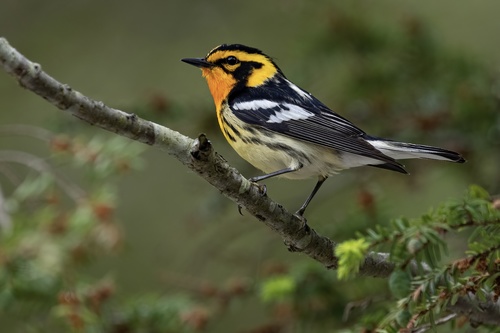


Blackburnian Warbler
setophaga fusca
A gem of the spruce forests, the Blackburnian Warbler is a breathtaking wood-warbler celebrated for its brilliant, glowing throat. This tiny migratory songbird breeds in the mature coniferous and mixed forests of eastern North America and winters in the Andes of South America. Its high-pitched, ascending song is a quintessential sound of the boreal canopy in early summer, where it flits actively among the outermost branches searching for insects. Birdwatchers treasure sightings of this stunning species, which often requires straining one's neck to view its canopy-dwelling activities.
Habitat: Typically found high in the canopy of mature coniferous forests, especially those dominated by hemlocks, spruces, and pines.
The breeding male is unmistakable, boasting a brilliant, fiery orange-yellow throat and face, offset by a black crown, cheek patch, and back with white streaks. Females and non-breeding males are more subdued but still display a pale yellow version of this facial pattern, accompanied by olive-green tones on the back and distinct white wing bars on dark wings. It is a small songbird, measuring around 11 to 13 centimeters in length with a slender, pointed bill and a short tail.
Category
BirdsRarity
Common
Danger
1/5 · Very low
Snaps
Be the first to snap!
During migration, some individuals fly non-stop across the Gulf of Mexico, a journey of up to 18 hours or more.
The species was named after Anna Blackburne, an English botanist and naturalist of the 18th century.
They are colloquially known as 'fire-throats' due to the brilliant, almost glowing orange plumage on the male's neck and head.
Highly adapted to foraging at the absolute tops of mature coniferous trees, occupying a feeding niche higher than most other warblers.
Sings an extremely high-pitched song that reaches frequencies up to 10 kHz, sitting right at the upper limit of human hearing.
Navigates thousands of kilometers annually between North American breeding grounds and South American wintering territories using stellar cues and geomagnetic sensing.
Primarily insectivorous, feeding on a wide variety of caterpillars, beetles, spiders, and flies gleaned from the outer foliage of trees.
Age differences: Chicks are fed soft-bodied insect larvae and spiders, while adults may occasionally consume berries or nectar during winter migration.

Tsuga canadensis
Builds nests almost exclusively in the high branches of this conifer.
Choristoneura fumiferana
A major food source, especially during seasonal outbreaks in northern forests.

Accipiter striatus
Preys upon adult warblers in the forest canopy.
No trait badges are assigned for this object yet.
No aliases listed yet.
Collections for this object will appear here as more themes are added.
Danger
1/5 · Very low
No special safety notes yet.
Compare the silhouette, bill shape, tail length, wing bars and markings around the eyes. The same small brown bird at your feeder can look quite different in breeding plumage, winter plumage or its first year. Bird Identifier: upload a photo and compare the visible details.
11-13 cm
20-22 cm
0.008-0.013 kg
3-8 years
40 km/h
Primarily insectivorous, feeding on a wide variety of caterpillars, beetles, spiders, and flies gleaned from the outer foliage of trees.
Typically found high in the canopy of mature coniferous forests, especially those dominated by hemlocks, spruces, and pines.
Zoom in to split clusters and explore where this object has been snapped.
Recent snaps will appear here as new observations are added.
Take the discovery with you
Snap it with Snappit to identify it, learn what makes it special, and add the discovery to your collection.