

Blackside Snubnose Darter
etheostoma duryi
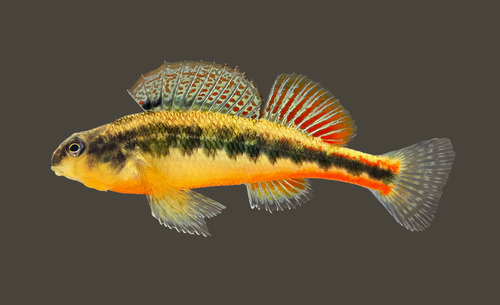
The Blackside Snubnose Darter is a small, energetic freshwater fish endemic to the pristine streams and creeks of the Tennessee River drainage in the southeastern United States. Belonging to the diverse darter family, this species is named for the dark, square-shaped blotches lining its sides and its uniquely blunt snout. While typically displaying subtle, earthy camouflaged tones, males undergo a spectacular transformation during the spring breeding season, flaring vibrant reds, oranges, and greens along their fins and underbellies. These benthic fish are captivating to watch as they hop, skip, and dart across gravelly creek beds in search of tiny aquatic prey. Their presence is a classic indicator of clean, oxygen-rich stream ecosystems, making them a favorite find for keen stream explorers and conservationists alike.
Habitat: Found in clear, rocky creeks and small rivers, typically resting in pools and slow-moving riffles with gravel or cobble substrates.
This small, slender darter averages 5 to 7 centimeters in length and is distinguished by a blunt, rounded snout and a series of dark, blackish blotches along its midline. The base coloration is olive-tan, which provides excellent camouflage against gravelly stream bottoms. Breeding males showcase brilliant coloration, including a bright orange-red band in the spinous dorsal fin, a blue-green edge, and warm orange wash on the breast and belly. Their eyes are placed high on the head, and they lack a swim bladder, keeping them close to the substrate.
Category
FishRarity
Common
Danger
1/5 · Very low
Snaps
6
Because they lack a functional swim bladder, they sink to the bottom when they stop moving, effectively spending their entire lives on the riverbed.
The 'snubnose' name comes from their short, rounded facial profile, which is perfectly adapted for nudging rocks to stir up hidden insect prey.
Unlike most fish that spawn in open water, female snubnose darters carefully attach their sticky eggs individually or in small clusters to the undersides of rocks or submerged plants.
Lacking a fully functional swim bladder, this fish uses its large, fan-like pectoral fins to hop and sit directly on the stream floor rather than swimming in open water.
During the spring breeding season, males can rapidly enhance their color intensity to exhibit striking oranges and iridescent blues to attract females and ward off competitors.
Their speckled olive and tan dorsal patterning mimics the exact textures of river gravel and sand, allowing them to remain virtually invisible to predators from above.
They primarily feed on small aquatic invertebrates and insect larvae found on the stream floor, using their snub noses to poke into gravel.

Baetis tricaudatus
Predates on the larvae of this common aquatic insect found under stones.

Micropterus salmoides
Predates on the Blackside Snubnose Darter in deeper river pools.
Etheostoma blennioides
Competes for benthic macroinvertebrates in the same gravel riffles.
No trait badges are assigned for this object yet.
No aliases listed yet.
Collections for this object will appear here as more themes are added.
Danger
1/5 · Very low
No special safety notes yet.
Look at body shape, where the fins sit and their outline, mouth position, stripes and spots. Young fish and breeding adults can wear different patterns, and aquarium color varieties can look nothing like wild fish. Fish Identifier: upload a photo and compare the visible details.
4-8 cm
0.002-0.006 kg
2-4 years
5 km/h
They primarily feed on small aquatic invertebrates and insect larvae found on the stream floor, using their snub noses to poke into gravel.
Found in clear, rocky creeks and small rivers, typically resting in pools and slow-moving riffles with gravel or cobble substrates.
Foragingpositioningedgewiseedgingintoallrocksandpebblestobringupinsectprey.theblacksidesnubnosedarteractivelyforagesbysensingvibrationsandvisuallyspottingmicroscopicpreymovementsalongthesubstrate.thespeciesisessentiallyabenthicopportunisticfeeder.juvenilesfeedonmicroscopicplanktonandsmallrotifers,transitioningtolargerinsectlarvaeasmaturefishes.thefishutilizesitssnubnosetoforagewithingravelcrevices.thehuntisdoneviaactivesearchingandforaging Ratherthanambushorpursuit.thesnubnosedshapeisextremelyadaptivetothistypeoffeeding.thesedartersalsorightthemselvesonpebblebottomsandstabythemselveswithfinswhilesearching.thespeciesmainlyforagesforthesepreyitemsduringthedaylight.theyremainsactiveprimarilyintheshallowsandgravelriffles.aspecializedbenthicforagingstrategyisemployedasprimaryhuntingmethod.foragingonbenthosistheirmsourcelivelihood.thedietprimarilyconsistsofsmallaquaticarthropods.thishelpsmaintainthespecies'energybalance.theirpreyisabundantinriffles.thematurespecimensconsumewiderarrayofpreythanyoungerfry.theyrelymostlyoninsectlarvae.theypreyontheseforhours.
Zoom in to split clusters and explore where this object has been snapped.
Take the discovery with you
Snap it with Snappit to identify it, learn what makes it special, and add the discovery to your collection.