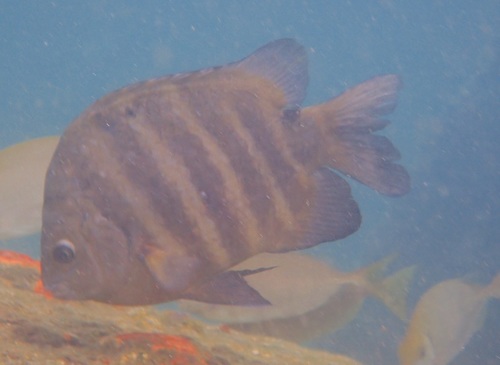


Blackspot Sergeant
abudefduf sordidus
The Blackspot Sergeant (Abudefduf sordidus) is a resilient and territorial damselfish commonly encountered in the shallow surge zones and tide pools of the Indo-Pacific. Known for their spirited nature, these fish are an entertaining sight for snorkelers and beachgoers, often darting aggressively to defend their small patches of turf. While many reef fish retreat to deeper, calmer waters, the Blackspot Sergeant thrives in highly oxygenated, wave-swept environments where they graze on algae and small invertebrates. Their adaptability allows them to flourish even in marginally degraded or highly dynamic habitats, making them a familiar and lively staple of rocky shorelines. Observing their fast-paced, industrious behavior provides a wonderful window into the complex social dynamics of shallow-water reef ecosystems.
Habitat: Found in the shallow waters of the Indo-Pacific, typically inhabiting wave-swept rocky shores, coral reef flats, and tidal pools.
This sturdy damselfish features a light gray to silvery body adorned with five to six dark, vertical bands that fade slightly towards the belly. Its most defining characteristic, giving it its common name, is a prominent black saddle-like spot located on the upper edge of the caudal peduncle, just before the tail fin. Juveniles often display brighter overall coloration with a distinct black spot at the base of the dorsal fin. They possess a moderately deep, compressed body shape typical of the Abudefduf genus, allowing them to maneuver easily in turbulent waters, and can grow up to 24 centimeters in length.
Category
FishRarity
Common
Danger
1/5 · Very low
Snaps
3
During extreme low tides, juveniles are frequently trapped in tide pools, relying on their incredible hardiness to survive rising temperatures until the tide returns.
The genus name 'Abudefduf' is derived from Arabic, translating roughly to 'father of the prominent sides,' a nod to their deep-bodied, compressed shape.
Unlike many reef fishes that migrate to deeper, safer waters as they mature, this species spends almost its entire life in very shallow, highly turbulent waters.
When preparing a nesting site, the male Blackspot Sergeant vigorously cleans a patch of rock or dead coral and then performs a rapid mating dance to attract females.
Perfectly adapted to withstand powerful wave action, allowing them to forage safely in highly turbulent, oxygen-rich shallow waters where competitors cannot.
Males fiercely protect their benthic egg clutches from predators and territorial intruders, often charging at creatures much larger than themselves.
Juveniles exhibit a remarkable biological tolerance for rapid fluctuations in salinity and temperature, enabling them to survive low tides in isolated rock pools.
They are opportunistic feeders that primarily graze on benthic algae while also actively consuming a variety of small invertebrates.
Age differences: Juveniles rely heavily on small crustaceans found in tide pools, while mature adults graze more extensively on filamentous algae.
Gymnothorax javanicus
Larger reef predators like the Giant Moray ambush resting Blackspot Sergeants in the reef crevices at night.
Abudefduf vaigiensis
Competes directly for territory and algal resources on shallow reef flats.
Harpacticoida
Blackspot Sergeants actively hunt these tiny crustaceans in the water column and along the benthos.
No trait badges are assigned for this object yet.
No aliases listed yet.
Collections for this object will appear here as more themes are added.
Danger
1/5 · Very low
No special safety notes yet.
Look at body shape, where the fins sit and their outline, mouth position, stripes and spots. Young fish and breeding adults can wear different patterns, and aquarium color varieties can look nothing like wild fish. Fish Identifier: upload a photo and compare the visible details.
10-24 cm
0.05-0.3 kg
3-6 years
15 km/h
They are opportunistic feeders that primarily graze on benthic algae while also actively consuming a variety of small invertebrates.
Found in the shallow waters of the Indo-Pacific, typically inhabiting wave-swept rocky shores, coral reef flats, and tidal pools.
Foraging
Zoom in to split clusters and explore where this object has been snapped.

Hawaii, US
You might spot Brown Anole, Gold Dust Day Gecko, and Red-Crested Cardinal.
View guide →

Hawaii, US
You might spot Gold Dust Day Gecko, Yellow Tang, and Saffron Finch.
View guide →

US
You might spot Brown Anole, Zebra Dove, and Red-Crested Cardinal.
View guide →

Hawaii, US
You might spot Gold Dust Day Gecko, Brown Anole, and White-Rumped Shama.
View guide →
Take the discovery with you
Snap it with Snappit to identify it, learn what makes it special, and add the discovery to your collection.