
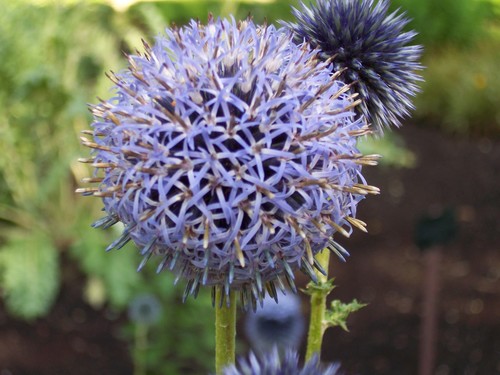


Blue Globe-Thistle
echinops bannaticus
The Blue Globe-Thistle, Echinops bannaticus, is a striking herbaceous perennial cherished for its unique spherical, steel-blue flower heads that bloom in mid to late summer. A member of the thistle family, it brings architectural interest and vibrant color to gardens, attracting a host of pollinators, particularly bees and butterflies. Its drought tolerance and low maintenance requirements make it a popular choice for xeriscaping and informal garden styles. This distinctive plant adds a bold texture and a touch of the wild to any landscape, proving that thistles can be both beautiful and beneficial while supporting local ecosystems.
Habitat: This species thrives in dry, sunny locations with well-drained soil, often found in rocky slopes, meadows, and steppe-like environments.
The Blue Globe-Thistle is easily identified by its perfectly spherical, metallic-blue flower heads, typically 4-6 cm in diameter, atop sturdy, branched stems. Each globe is composed of numerous small, star-like florets. The foliage is deeply lobed, spiny, and silvery-green on the underside, providing a striking contrast to the vibrant blue flowers. Plants typically grow 60-120 cm tall, forming an upright, bushy clump.
Category
PlantsRarity
Common
Danger
1/5 · Very low
Snaps
Be the first to snap!
It's often called 'Globe Thistle' which encompasses several Echinops species, but 'Blue Globe-Thistle' specifically refers to Echinops bannaticus due to its intense blue color.
Its dried flower heads are popular in floral arrangements and can retain their blue color for a long time.
The 'thistle' in its name comes from its spiky leaves, but its flowers are less prickly than true thistles.
The genus name Echinops comes from the Greek words 'echinos' (hedgehog) and 'ops' (appearance), referring to the spiky, globe-like flower heads.
Its nectar-rich, spherical blue flower heads are highly attractive to a wide range of pollinators, including various bee species and butterflies, making it a vital food source in late summer.
Echinops bannaticus is exceptionally drought-tolerant once established, able to thrive in arid conditions thanks to its deep root system and adaptation to dry, sunny climates.
The plant possesses strong structural form with its stiff, branched stems and perfectly globular flower heads, providing significant visual interest in gardens even after the blooms fade.
As an autotrophic plant, the Blue Globe-Thistle produces its own food through photosynthesis, converting sunlight into energy. It absorbs water and essential mineral nutrients from the soil via its root system.
Apis mellifera
Pollinates the plant, collecting nectar and pollen.
Vanessa cardui
Feeds on nectar, aiding in pollination.

Capreolus capreolus
Feeds on leaves and stems, though the plant is generally deer-resistant.

Glomus intraradices
Forms a symbiotic relationship with roots, enhancing nutrient absorption.
No trait badges are assigned for this object yet.
No aliases listed yet.
Collections for this object will appear here as more themes are added.
Danger
1/5 · Very low
No special safety notes yet.
Start with the whole plant, then compare leaf arrangement, leaf edges, stems and any flowers or fruit. Opposite leaves grow in pairs; alternate leaves come one at a time along the stem. These details tell you far more together than a single green leaf does. Plant Identifier: upload a photo and compare the visible details.
60-120 cm
0.5-2.5 kg
3-10 years
As an autotrophic plant, the Blue Globe-Thistle produces its own food through photosynthesis, converting sunlight into energy. It absorbs water and essential mineral nutrients from the soil via its root system.
This species thrives in dry, sunny locations with well-drained soil, often found in rocky slopes, meadows, and steppe-like environments.
Photosynthesis And Nutrient Uptake
Zoom in to split clusters and explore where this object has been snapped.
Recent snaps will appear here as new observations are added.
Take the discovery with you
Snap it with Snappit to identify it, learn what makes it special, and add the discovery to your collection.


















