


Branched Pencil Cholla
cylindropuntia ramosissima
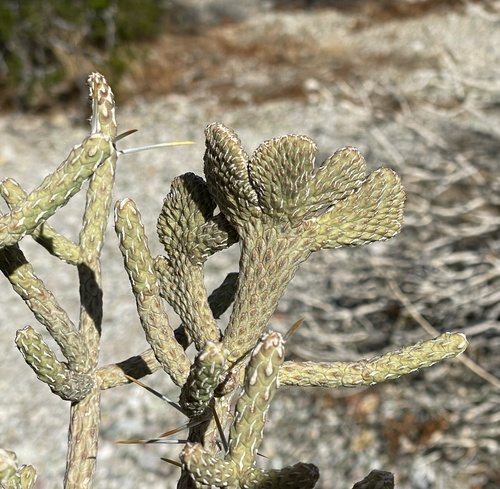
The Branched Pencil Cholla (Cylindropuntia ramosissima) is a fascinating, highly branched cactus native to the arid expanses of the Mojave and Sonoran Deserts. Characterized by its pencil-thin, woody stems and unique tessellated surface pattern, this resilient plant thrives in some of the harshest environments in North America. Unlike many of its densely-spined relatives, it features a more delicate, geometric structure, growing into a low-spreading or erect shrub that blends beautifully into the desert landscape.
Habitat: Typically found on dry sandy or gravelly plains, alluvial fans, and desert slopes in desert scrub communities.
This cactus grows as a highly branched shrub up to 2 meters tall, with slender, cylindrical joints measuring only 0.5 to 1 centimeter in diameter. The stems are distinctive for their diamond-shaped, flat tubercles, giving them a scaled or tessellated texture. Spines are often solitary (or entirely absent), measuring 2 to 5 centimeters long, and are encased in yellowish, papery sheaths that catch the light. During late spring, it produces small, inconspicuous bronze-to-pinkish-purple flowers that develop into dry, spiny seed burrs.
Category
PlantsRarity
Common
Danger
1/5 · Very low
Snaps
Be the first to snap!
Its spines are covered in a thin, papery sheath that acts like a miniature greenhouse, reflecting intense desert heat away from the stem.
Skeletal remains of dead branched pencil chollas reveal a beautiful, hollow, mesh-like wooden cylinder structure.
The species name 'ramosissima' is Latin for 'most branched,' referring to its highly complex, shrubby growth form.
Its diamond-patterned stems and paper-sheathed spines help reflect harsh solar radiation, reducing moisture loss.
It opens its stomata at night to absorb carbon dioxide, minimizing water loss during the hot desert days.
Stem joints easily detach when brushed by animals, allowing the plant to root nearby and reproduce vegetatively.
As a photosynthetic organism, this cactus synthesizes its own sugars from carbon dioxide, sunlight, and soil nutrients.

Campylorhynchus brunneicapillus
Provides safe nesting sites defended from predators by formidable spines.
Neotoma lepida
Feeds on the fruits and soft tissues, while using dried joints to build protective nests.

Gopherus agassizii
Occasionally browses on the lower segments and fallen parts of the cactus for moisture and nutrients.
No trait badges are assigned for this object yet.
No aliases listed yet.
Collections for this object will appear here as more themes are added.
Danger
1/5 · Very low
No special safety notes yet.
Compare leaf arrangement, rosette shape, ribs, spines and flowers. Keep in mind that drought and strong sun can shift a plant's color and shape. Succulent Identifier: upload a photo and compare the visible details.
50-200 cm
2-25 kg
30-100 years
As a photosynthetic organism, this cactus synthesizes its own sugars from carbon dioxide, sunlight, and soil nutrients.
Typically found on dry sandy or gravelly plains, alluvial fans, and desert slopes in desert scrub communities.
Zoom in to split clusters and explore where this object has been snapped.
Recent snaps will appear here as new observations are added.
Take the discovery with you
Snap it with Snappit to identify it, learn what makes it special, and add the discovery to your collection.


















