
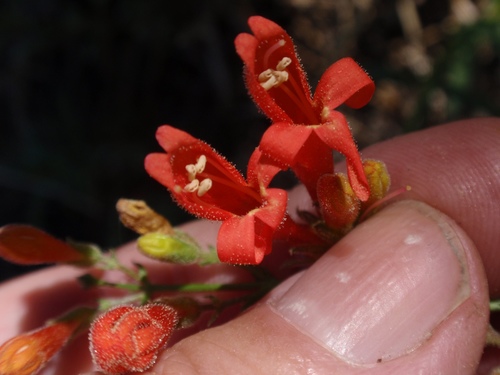


Bridges' Penstemon
penstemon rostriflorus
Bridges' Penstemon is a resilient and eye-catching perennial subshrub native to the mountain ranges and dry canyons of the southwestern United States. Known for its brilliant scarlet to orange-red tubular blooms, this plant stands out dramatically against its dusty, arid backdrops. It is woody at the base and produces multiple upright stems that erupt into spectacular floral displays from mid-summer through early autumn. Its nectar-rich, downward-facing flowers are incredibly popular with hummingbirds, making it a critical component of local montane ecosystems. Gardens and wild spaces alike benefit from this tough, drought-tolerant species, which brings vibrant color to dry, rocky environments where few other plants can thrive.
Habitat: Found on dry, rocky slopes, canyon walls, and within open coniferous forests and sagebrush scrub at high elevations.
This subshrub typically grows in clumps from 30 to 100 centimeters tall, supported by a woody base. Its leaves are narrow, lance-shaped, and grey-green, growing oppositely along the stems. The most defining feature is the array of horizontal or downward-curved tubular flowers, which are vibrant scarlet or orange-red. The flowers feature a strongly two-lipped structure where the lower lobes are noticeably reflexed or turned backwards, resembling a tiny open beak. This unique floral shape and bright coloration distinguish it from other penstemons in its geographic range.
Category
PlantsRarity
Common
Danger
1/5 · Very low
Snaps
Be the first to snap!
Its scarlet color is highly visible to birds but virtually invisible to most bees, helping ensure its nectar goes to its most effective pollinators.
The scientific name 'rostriflorus' translates to 'beaked flower', referring to the distinctive recurved lip of the tubular blossom.
Unlike most herbaceous penstemons, this species has a woody trunk-like base, technically classifying it as a subshrub.
The downward-curved, tubular red flowers are shaped specifically to accommodate the long bills of hummingbirds while excluding less efficient insect pollinators.
Possesses a woody caudex and narrow, specialized foliage that significantly reduces moisture loss, allowing it to thrive in arid, sun-baked soils.
Can resprout from its woody root crown after light to moderate wildfires, helping it reclaim disturbed mountain slopes quickly.
This plant produces its own organic nutrients using sunlight, water, and carbon dioxide through the process of photosynthesis, while absorbing essential minerals from dry rocky soils.
Selasphorus platycercus
Feeds on the flower's abundant nectar and serves as its primary pollinator in high-altitude environments.
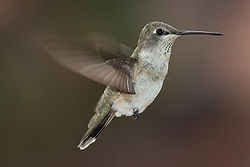
Archilochus alexandri
Visits the scarlet flowers for nectar and aids in cross-pollination.
Euphydryas chalcedona
The caterpillars of this butterfly species occasionally feed on the foliage of Penstemon species.
No trait badges are assigned for this object yet.
No aliases listed yet.
Collections for this object will appear here as more themes are added.
Danger
1/5 · Very low
No special safety notes yet.
Start with the whole plant, then compare leaf arrangement, leaf edges, stems and any flowers or fruit. Opposite leaves grow in pairs; alternate leaves come one at a time along the stem. These details tell you far more together than a single green leaf does. Plant Identifier: upload a photo and compare the visible details.
30-100 cm
3-10 years
This plant produces its own organic nutrients using sunlight, water, and carbon dioxide through the process of photosynthesis, while absorbing essential minerals from dry rocky soils.
Found on dry, rocky slopes, canyon walls, and within open coniferous forests and sagebrush scrub at high elevations.
Zoom in to split clusters and explore where this object has been snapped.
Recent snaps will appear here as new observations are added.
Take the discovery with you
Snap it with Snappit to identify it, learn what makes it special, and add the discovery to your collection.


















