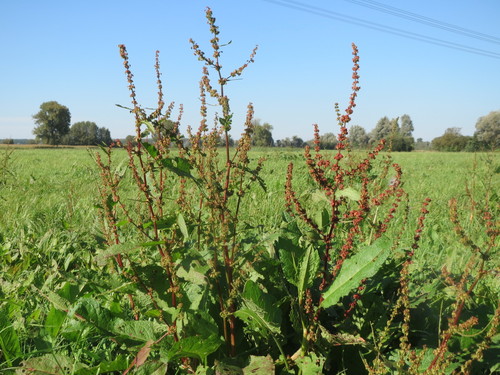


Broad-Leaved Dock
rumex obtusifolius
The Broad-Leaved Dock (Rumex obtusifolius) is a highly resilient, perennial weed native to Europe but now widely naturalized across the globe. Known for its expansive, emerald leaves and tough, deep taproot, it is a familiar sight in pastures, roadsides, and disturbed soils. While gardeners often view it as a persistent agricultural weed, this hardy plant has a rich history in folk medicine, most famously as a natural soothing remedy for stinging nettle burns. Its ability to thrive in compacted, nutrient-rich soils makes it an ecological pioneer, preparing degraded land for subsequent plant successions.
Habitat: Commonly found in disturbed grounds, agricultural fields, waste places, and damp meadows with nutrient-rich soils.
Broad-Leaved Dock is easily identified by its massive, oblong-ovate leaves that can reach up to 40 cm in length, featuring heart-shaped bases and slightly wavy margins. The plant grows from a dense basal rosette to produce tall, erect, reddish-green stems that branch near the top. In summer, it produces dense clusters of tiny green flowers that mature into distinctive, three-winged, reddish-brown dry fruits, each containing a single glossy seed. It typically stands between 60 to 150 cm tall.
Category
PlantsRarity
Common
Danger
1/5 · Very low
Snaps
4
According to folklore, rubbing a crushed dock leaf on a stinging nettle sting helps neutralize the pain, a practice still widely used by hikers today.
Historically, the tough roots of the plant were used to extract a yellow dye for wool and other textiles.
The seeds of the broad-leaved dock can pass through the digestive systems of farm animals completely unharmed, helping the plant spread across pastures.
Develops a massive, deep taproot that can penetrate over a meter into compacted soil, allowing it to access deep water reserves and survive harsh droughts.
Leaves produce oxalic acid and tannins, which deter many generalist herbivores and give the foliage its signature bitter taste.
A single mature plant can produce up to 60,000 seeds per year, which can remain viable in the soil for several decades waiting for the right conditions to germinate.
As a photoautotrophic plant, it produces its own organic compounds through photosynthesis, utilizing sunlight, carbon dioxide, water, and soil minerals.
Gastrophysa viridula
This beetle feeds heavily on the leaves of the broad-leaved dock, often skeletonizing them.
Urtica dioica
Often found growing alongside nettles in similar nutrient-rich soils, sharing the same ecological niche.

Phragmatobia fuliginosa
The caterpillars of this moth species use dock leaves as a primary larval food plant.
No trait badges are assigned for this object yet.
No aliases listed yet.
Collections for this object will appear here as more themes are added.
Danger
1/5 · Very low
No special safety notes yet.
The easiest way to identify Broad-Leaved Dock is to use the Snappit nature identifier app.
50-150 cm
0.1-2 kg
3-20 years
As a photoautotrophic plant, it produces its own organic compounds through photosynthesis, utilizing sunlight, carbon dioxide, water, and soil minerals.
Commonly found in disturbed grounds, agricultural fields, waste places, and damp meadows with nutrient-rich soils.
Photosynthesis
Zoom in to split clusters and explore where this object has been snapped.

Pennsylvania, US
You might spot American Robin, Red-Winged Blackbird, and Lesser Celandine.
View guide →

Connecticut, US
You might spot American Robin, Eastern Poison Ivy, and Duck.
View guide →

Virginia, US
You might spot Spotted Lanternfly and Northern Cardinal.
View guide →
Ohio, US
You might spot White-Tailed Deer, Mayapple, and American Beech.
View guide →
Take the discovery with you
Snap it with Snappit to identify it, learn what makes it special, and add the discovery to your collection.











.jpg&width=800)



_001.jpg&width=800)




