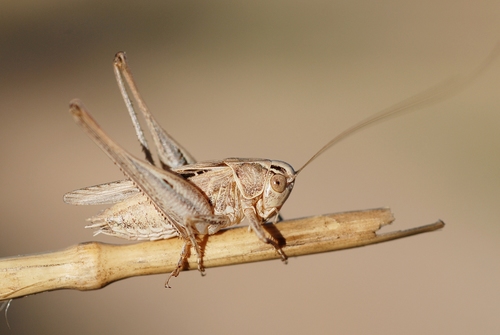


Brown-Spotted Bush-Cricket
tessellana tessellata
The Brown-Spotted Bush-Cricket (Tessellana tessellata) is a small, charming orthopteran native to the warm, sun-drenched grasslands of Southern and Central Europe. This agile bush-cricket is famous for its intricate, mosaic-like coloration, which allows it to blend seamlessly into dry grasses and sandy soils. Unlike its larger, louder relatives, this species maintains a subtle profile, relying on its cryptic appearance to evade predators while hunting for tiny insects or nibbling on wild herbs. Observant nature lovers will find delight in uncovering this miniature marvel, whose delicate, rhythmic song is a quintessential soundtrack of late summer afternoons.
Habitat: Found in warm, dry, and sandy habitats such as arid grasslands, coastal dunes, and sun-exposed meadows with sparse vegetation.
This small bush-cricket typically measures between 1 and 2 centimeters in length, boasting a light brown to greyish-beige body covered in a distinctive pattern of dark brown tessellated spots, particularly along its forewings and the sides of its pronotum. Its hind legs are strongly developed for leaping, marked with dark stripes. Females feature a relatively short, upward-curved, blade-like ovipositor, while their wings are moderately developed, often extending just to or slightly beyond the tip of the abdomen, aiding in short, fluttering escapes rather than sustained flight.
Category
InsectsRarity
Common
Danger
1/5 · Very low
Snaps
Be the first to snap!
The species name 'tessellata' comes from the Latin word for mosaic, referencing the exquisite checkered patterns on their wings.
Their high-frequency courtship song is so high-pitched that many humans over the age of forty cannot hear it without the aid of a bat detector.
To escape predators, they rely on a jump-and-drop strategy, leaping high into the air and then plummeting into the deep grass where they remain perfectly still.
Its intricate pattern of brown and beige spots creates a perfect visual disruption, allowing it to hide in plain sight among dry grasses.
Males produce a rapid, high-pitched stridulation by rubbing their wings together, creating a sound used to attract mates that is often at the upper limit of human hearing.
Using its powerful, muscular hind legs, it can catapult itself several times its body length to escape predators in an instant.
It feeds on a balanced mix of small soft-bodied insects and various plant materials like grasses and clover.
Mantis religiosa
Preys on this insect as a source of protein.

Trifolium pratense
Forages on this common grassland plant.
Myzus persicae
Predator of this small insect, helping control its population.
No trait badges are assigned for this object yet.
No aliases listed yet.
Collections for this object will appear here as more themes are added.
Danger
1/5 · Very low
No special safety notes yet.
Look for six legs, antennae, three body sections and the shape of the wings. Beetles have hardened front wings; flies have just one working pair. Tiny insects may need a close view before their group is clear. Insect Identifier: upload a photo and compare the visible details.
1+ cm
2+ cm
0.001+ kg
1+ years
It feeds on a balanced mix of small soft-bodied insects and various plant materials like grasses and clover.
Found in warm, dry, and sandy habitats such as arid grasslands, coastal dunes, and sun-exposed meadows with sparse vegetation.
Foraging2019s Fine Scale Predation And Browsing Among Vegetation Stems And Low Lying Herbage Or Stalking Slow Moving Aphids And Caterpillars To Grab Them Using Chewing Mouthparts. It Does Not Ambush Or Pursue Over Long Distances But Opportunistically Consumes Both Plant Tissue And Live Prey Encountered During Its Daily Patrols Through Grassland Cover. By Relying On Its Excellent Camouflage And Patient Movements It Safely Harvests Nutrients While Remaining Virtually Invisible To Larger Predators Such As Birds And Spiders Active In The Same Habitats.
Zoom in to split clusters and explore where this object has been snapped.
Recent snaps will appear here as new observations are added.
Take the discovery with you
Snap it with Snappit to identify it, learn what makes it special, and add the discovery to your collection.