

Browneyes
chylismia claviformis
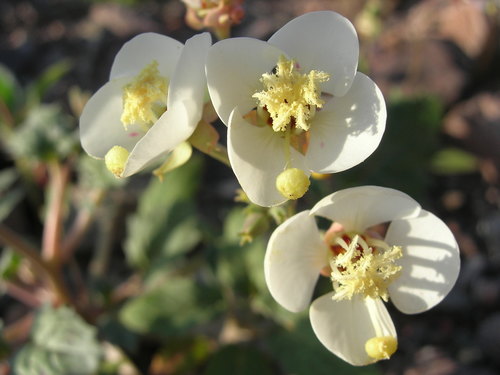
Browneyes (Chylismia claviformis) is a hardy desert wildflower belonging to the evening primrose family. Native to the arid regions of western North America, this winter annual emerges rapidly in response to seasonal rainfall, transforming dry desert washes into vibrant displays of life. The species is highly valued by ecologists for its role as an early-season food source for specialized native bees and other desert pollinators. Its common name, 'Browneyes', comes from the distinctive dark, brownish-purple center of its delicate blossoms, which contrasts beautifully with its white or pale yellow petals.
Habitat: Found in sandy desert washes, gravelly flats, and rocky slopes of the Mojave, Sonoran, and Great Basin deserts.
Browneyes is a low-growing annual herb that typically reaches heights of 10 to 60 centimeters. It features a basal rosette of pinnately lobed, purplish-green leaves that hug the ground. From this rosette, one or more reddish, upright stems arise, capped by nodding clusters of small, four-petaled flowers. The blossoms, which measure about 1.5 centimeters across, are usually creamy white or bright yellow, each highlighted by a deep, dark brown or maroon center and a prominent, club-shaped green stigma.
Category
PlantsRarity
Common
Danger
1/5 · Very low
Snaps
1
Browneyes can carpet desert landscapes in yellow and white during a 'superbloom' event following unusually wet winters.
Despite being in the evening primrose family, Browneyes flowers often open in the late afternoon and remain open into the night.
The plant's scientific species name, claviformis, means 'club-shaped', referring to the distinct shape of its seed pods and pistil.
Exhibits a rapid life cycle, germinating, flowering, and setting seed within a few weeks of winter rainfall to avoid the extreme heat of summer.
The dark brown floral centers contrast sharply with the petals under ultraviolet light, acting as a beacon to guide twilight-active pollinators.
The flat, basal rosette of leaves acts as a funnel, capturing scarce condensation and directing it straight down to the deep taproot.
As a photosynthetic plant, Browneyes produces its own food by converting sunlight, carbon dioxide, and water into energy-rich sugars.
Andrena rozeni
Provides critical nectar and pollen to specialized, twilight-active miner bees.

Gopherus agassizii
The foliage is consumed by foraging desert tortoises looking for moisture and nutrients in early spring.
Hyles lineata
Caterpillars feed heavily on the leaves of various evening primrose species, including Browneyes.
No trait badges are assigned for this object yet.
No aliases listed yet.
Collections for this object will appear here as more themes are added.
Danger
1/5 · Very low
No special safety notes yet.
Start with the whole plant, then compare leaf arrangement, leaf edges, stems and any flowers or fruit. Opposite leaves grow in pairs; alternate leaves come one at a time along the stem. These details tell you far more together than a single green leaf does. Plant Identifier: upload a photo and compare the visible details.
10-60 cm
1 years
As a photosynthetic plant, Browneyes produces its own food by converting sunlight, carbon dioxide, and water into energy-rich sugars.
Found in sandy desert washes, gravelly flats, and rocky slopes of the Mojave, Sonoran, and Great Basin deserts.
Zoom in to split clusters and explore where this object has been snapped.
Take the discovery with you
Snap it with Snappit to identify it, learn what makes it special, and add the discovery to your collection.