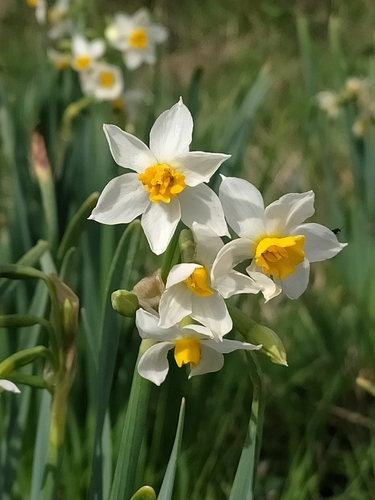


Bunch-Flowered Daffodil
narcissus tazetta
The Bunch-Flowered Daffodil, Narcissus tazetta, is a charming and highly regarded bulbous perennial, celebrated for its clusters of fragrant flowers that herald the arrival of spring. Native to the Mediterranean region, this species has been cultivated for centuries, prized for its ornamental value and intoxicating scent. Unlike many other daffodils that produce a single flower per stem, N. tazetta stands out with multiple blooms per stalk, creating a more abundant and visually striking display. Its robust nature and adaptability have made it a popular choice in gardens worldwide, symbolizing rebirth and hope.
Habitat: The Bunch-Flowered Daffodil is naturally found in rocky hillsides, scrublands, and open fields across the Mediterranean basin, thriving in well-drained soils and full sun to partial shade.
This daffodil typically grows 20-45 cm tall, featuring slender, strap-like, grayish-green leaves. The most distinguishing characteristic is its flower display: 3 to 20 small, fragrant flowers are borne in a cluster atop a single sturdy stem. Each flower typically has six white, sometimes yellow, perianth segments (petals) that spread outwards, surrounding a short, cup-shaped corona (central cup) that can range in color from yellow to deep orange. The overall effect is delicate yet impactful due to the profusion of blooms.
Category
PlantsRarity
Common
Danger
1/5 · Very low
Snaps
Be the first to snap!
Despite their beauty, all parts of the Narcissus tazetta plant are poisonous if ingested, containing alkaloids that can cause severe gastrointestinal distress.
In some cultures, Narcissus tazetta is associated with good fortune and prosperity, especially when it blooms around the Lunar New Year.
Its highly aromatic flowers have made it a valuable source in the perfumery industry, particularly in regions like Grasse, France.
The Bunch-Flowered Daffodil is one of the oldest cultivated daffodil species, with its presence noted in ancient Greek and Roman texts.
Produces multiple flowers on a single stem, maximizing visual impact and fragrance to attract a wider range of pollinators effectively.
Contains toxic alkaloids (lycorine) throughout the plant, deterring most herbivores from consuming its leaves or bulbs, ensuring its survival against grazing.
Emits a strong, sweet fragrance, particularly potent in the evening, which serves as a powerful attractant for nocturnal and diurnal pollinators.
As a plant, Narcissus tazetta produces its own food through photosynthesis, converting sunlight, carbon dioxide, and water into sugars for energy and growth. It absorbs essential nutrients from the soil via its root system.
Apis mellifera
Pollination
Polyommatus icarus
Pollination

Cornu aspersum
Herbivory/Defense
Fusarium oxysporum f. sp. narcissi
Pathogen
No trait badges are assigned for this object yet.
No aliases listed yet.
Collections for this object will appear here as more themes are added.
Danger
1/5 · Very low
No special safety notes yet.
Start with the whole plant, then compare leaf arrangement, leaf edges, stems and any flowers or fruit. Opposite leaves grow in pairs; alternate leaves come one at a time along the stem. These details tell you far more together than a single green leaf does. Plant Identifier: upload a photo and compare the visible details.
20-45 cm
0.01-0.05 kg
5-20 years
As a plant, Narcissus tazetta produces its own food through photosynthesis, converting sunlight, carbon dioxide, and water into sugars for energy and growth. It absorbs essential nutrients from the soil via its root system.
The Bunch-Flowered Daffodil is naturally found in rocky hillsides, scrublands, and open fields across the Mediterranean basin, thriving in well-drained soils and full sun to partial shade.
Nutrient Absorption
Zoom in to split clusters and explore where this object has been snapped.
Recent snaps will appear here as new observations are added.
Take the discovery with you
Snap it with Snappit to identify it, learn what makes it special, and add the discovery to your collection.