





orange honeysuckle
Lonicera ciliosa
The orange honeysuckle is a beautiful shrub with bright orange flowers that attract hummingbirds and butterflies. It grows in the wild and can add color to gardens too!
Habitat: Forests
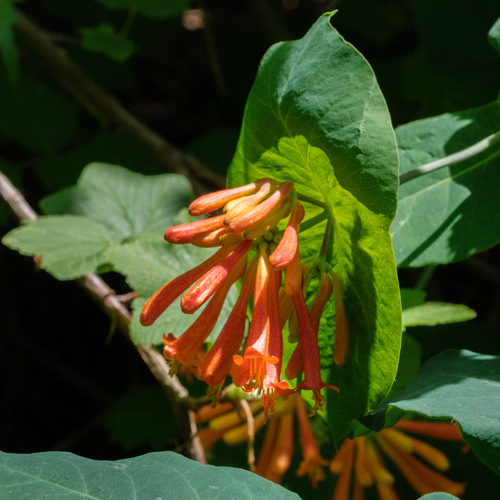
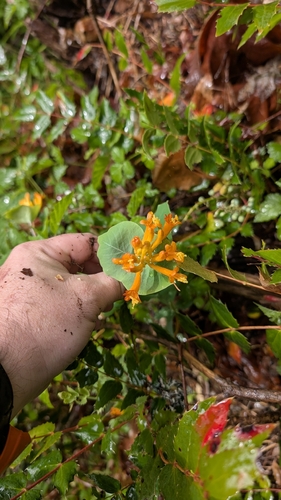
The orange honeysuckle is a climbing vine with vibrant, trumpet-shaped orange to reddish-orange flowers. Its blossoms often grow in clusters, contrasting with its green, oval leaves that sometimes fuse together below the flowers. The slender stems twine around supports, creating a lush, colorful display.
Category
PlantsRarity
Common
Danger
1/5 · Very low
Snaps
6
Early settlers sometimes used honeysuckle stems for weaving baskets!
Its vibrant orange flowers glow like tiny trumpets, announcing spring's arrival!
Some honeysuckle vines can grow over 8 meters long, reaching high into trees!
Some leaves hug the stem so tightly, they appear as one single leaf!
Orange honeysuckle has bright, tubular flowers that perfectly fit hummingbird beaks, ensuring pollination.
Orange honeysuckle can twine its flexible stems around trees and shrubs, reaching sunlight in dense forests.
Orange honeysuckle has perfoliate leaves that fuse, creating cups that collect rainwater for thirsty visitors.
Orange honeysuckle produces red berries that offer a food source for many bird species in late summer.
.jpg&width=800)
Selasphorus rufus
Sips nectar, carrying pollen between flowers.
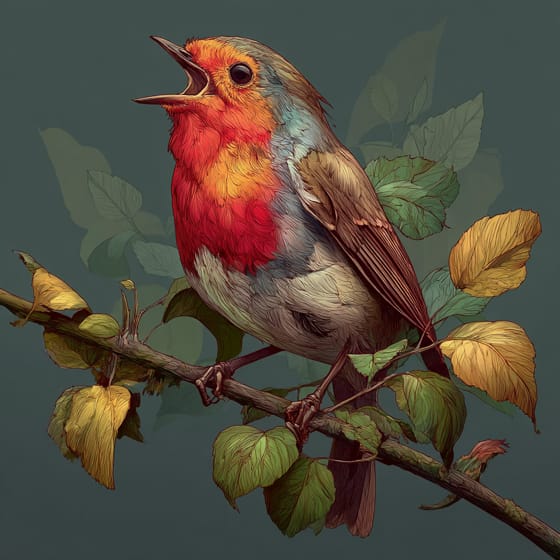
Turdus migratorius
Eats the bright red berries, spreading seeds.
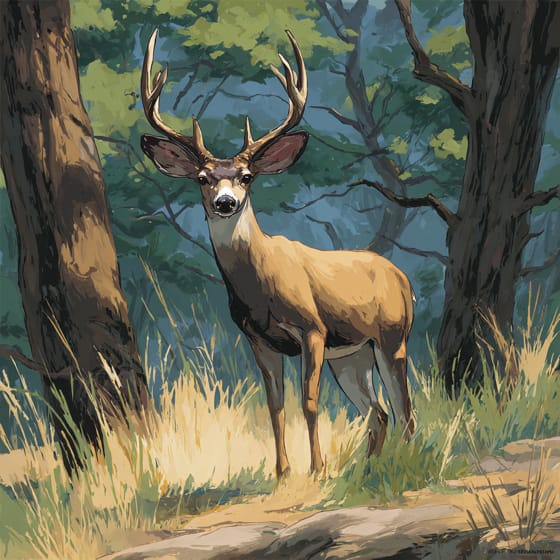
Odocoileus hemionus
Browses on the leaves and young stems.
Bombus bifarius
Visits flowers for nectar and pollen.
Aromatic plants produce and emit fragrant volatile organic compounds, often for defense or to attract pollinators.
Deciduous plants periodically shed all their leaves, typically during autumn or dry seasons.
Flowering plants are any plants that produce flowers as part of their reproductive cycle.
A shrub is a woody plant smaller than a tree, typically with multiple stems branching from or near the ground.

Spring blooming plants produce their flowers during the spring season, often signifying the end of winter and the start of new growth.

Summer blooming plants produce their flowers during the summer season, often providing vibrant color when many other plants have finished.

Fragrant flowers emit a pleasant aroma, often to attract pollinators or for defense.

Colorful describes organisms or objects displaying a wide range of bright and distinct colors.

Describes plants that are particularly attractive and beneficial to a wide range of pollinating organisms.

Forest habitats are terrestrial environments dominated by dense tree cover, supporting a high diversity of plant and animal life.
No aliases listed yet.
Danger
1/5 · Very low
Always check with an adult before touching or tasting any plants.
The easiest way to identify orange honeysuckle is to use the Snappit nature identifier app.
300-800 cm
100-300 cm
2-4 cm
Spring to early summer
No
Mild
Perennial
Zoom in to split clusters and explore where this object has been snapped.
May 28, 2026
Hoyt ArboretumPhoto attribution
no rights reserved
License: CC0 1.0 ↗
Image may be shown cropped inside the card frame.
May 13, 2026
Wind River ArboretumPhoto attribution
(c) Christopher Burton, some rights reserved (CC BY)
License: CC BY 4.0 ↗
Image may be shown cropped inside the card frame.

Washington, US
You might spot Wood Duck, Rough-Skinned Newt, and Pacific Trillium.
View guide →

Washington, US
You might spot Broad-Leaved Stonecrop and Western Sword Fern.
View guide →

Oregon, US
You might spot Western Redcedar, Salal, and Pacific Trillium.
View guide →

Oregon, US
You might spot Northern Phlox, Marbled Wild-Ginger, and Pacific Trillium.
View guide →
Washington, US
You might spot Cascade Oregon-Grape, Oregon Anemone, and Bride's Bonnet.
View guide →
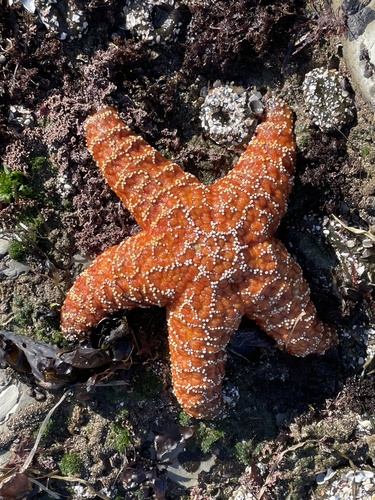
British Columbia, CA
You might spot Ochre Sea Star, Fringe Cups, and Moonglow Anemone.
View guide →
Take the discovery with you
Snap it with Snappit to identify it, learn what makes it special, and add the discovery to your collection.






.jpg&width=800)


_001.jpg&width=800)




