


Bushy St. John'S Wort
hypericum densiflorum
The Bushy St. John's Wort (Hypericum densiflorum) is a delightful, deciduous woody shrub native to the damp soils of the eastern United States. Celebrated for its lush, rounded habit and remarkably dense clusters of star-like yellow flowers, this plant lights up wet meadows and bogs from mid-summer into early autumn. It serves as a vital resource for local pollinators, who are drawn to the sheer abundance of its pollen-rich stamens. Gardeners and restoration ecologists value this resilient shrub for its ability to thrive in poor, waterlogged, and highly acidic soils where other plants struggle. Its tolerance to flooding and attractive form make it an excellent choice for rain gardens, bioswales, and wetland restoration projects, helping to stabilize banks and filter runoff while adding a vibrant splash of color to the landscape.
Habitat: Found in damp, acidic soils of wet meadows, bogs, pine flatwoods, and along riparian borders.
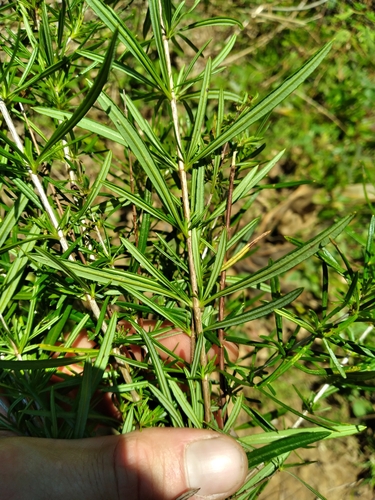
This densely branched, rounded shrub typically grows between 50 to 200 centimeters in height. It features narrow, linear to oblong green leaves arranged oppositely along the stems, which turn a warm yellow-brown in the autumn. Older branches exhibit a characteristic peeling, papery bark with a reddish-brown to grayish hue. During its peak bloom, the shrub is covered in tight, flat-topped clusters of small, bright yellow flowers, each measuring about 1 to 1.5 centimeters across. These flowers are distinguished by five distinct petals and an exceptionally bushy center of numerous protruding stamens, giving the entire inflorescence a fuzzy, golden appearance.
Category
PlantsRarity
Common
Danger
1/5 · Very low
Snaps
Be the first to snap!
Like other St. John's Worts, its leaves contain tiny, translucent glands that resemble pinpricks when held up to a light source.
The bushy, fuzzy appearance of the flowers is due to the dozens of long stamens that erupt from the center of each tiny blossom.
The species name 'densiflorum' literally translates to 'densely flowered' in Latin, perfectly describing its packed clusters of golden blossoms.
Produces hypericin, a chemical compound that acts as a natural deterrent against generalist herbivores by causing photosensitivity when ingested.
Possesses specialized root adaptations that allow it to survive prolonged periods of soil saturation and oxygen deprivation in wetland environments.
Develops exceptionally dense arrays of stamens to maximize pollen production, ensuring high rates of pollination by attracting a wide array of insect species.
As a photoautotrophic plant, it synthesizes its own food using sunlight, water, and carbon dioxide through the process of photosynthesis.
Bombus pensylvanicus
Collects pollen from the abundant blooms during the summer months.

Strymon melinus
Caterpillars feed on the leaves and flowers of the shrub as a host plant.

Glomus intraradices
Forms symbiotic associations in the root zone to enhance water and nutrient uptake.
No trait badges are assigned for this object yet.
No aliases listed yet.
Collections for this object will appear here as more themes are added.
Danger
1/5 · Very low
No special safety notes yet.
Start with the whole plant, then compare leaf arrangement, leaf edges, stems and any flowers or fruit. Opposite leaves grow in pairs; alternate leaves come one at a time along the stem. These details tell you far more together than a single green leaf does. Plant Identifier: upload a photo and compare the visible details.
50-200 cm
10-30 years
As a photoautotrophic plant, it synthesizes its own food using sunlight, water, and carbon dioxide through the process of photosynthesis.
Found in damp, acidic soils of wet meadows, bogs, pine flatwoods, and along riparian borders.
Zoom in to split clusters and explore where this object has been snapped.
Recent snaps will appear here as new observations are added.
Take the discovery with you
Snap it with Snappit to identify it, learn what makes it special, and add the discovery to your collection.


















