
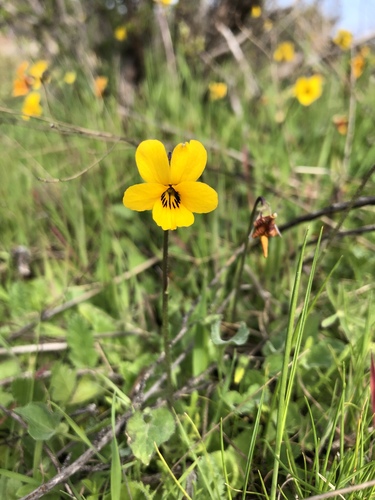


California Golden Violet
viola pedunculata
The California Golden Violet (Viola pedunculata), also known as the yellow pansy, is a delightful perennial herb native to the coastal ranges and foothills of California and Baja California. Blooming in early spring, this plant paints grassy hillsides and oak woodland floors with vibrant patches of golden yellow. It serves as an essential component of its native ecosystem, signaling the end of winter and providing critical sustenance for early-emerging pollinators. Beyond its ecological value, it is widely appreciated for its resilience to dry summer conditions, entering a dormant state to survive the Mediterranean climate. Gardeners and native plant enthusiasts cherish this wildflower for its charming face-like blooms and its ability to attract local wildlife, making it a star of California's spring wildflower displays.
Habitat: Typically found in open grasslands, chaparral, and the shady understory of oak woodlands throughout California coastal regions.
This low-growing perennial features bright golden-yellow flowers that stand atop long, slender reddish-brown stalks reaching up to 15 to 30 cm high. The flowers consist of five petals, with the lower three adorned with dark purple or brown nectar guides, and the backs of the upper two petals showcasing a rich, rusty brown or bronze hue. Its leaves are heart-shaped to deltoid, with prominent scalloped margins, and are a soft, deep green, forming a low carpet beneath the elevated blooms.
Category
PlantsRarity
Common
Danger
1/5 · Very low
Snaps
Be the first to snap!
It is highly adapted to fire, often blooming in massive numbers in the seasons immediately following a chaparral wildfire.
Its scientific name, 'pedunculata', refers to the exceptionally long stems (peduncles) that hold the flowers high above the leaves.
The edible petals have a mild, sweet, grassy flavor and are traditionally used as a colorful garnish in salads.
Produces seeds containing nutrient-rich structures called elaiosomes that attract ants, which safely transport and plant the seeds underground.
Survives harsh, dry Mediterranean summers by dying back to its rootstock and entering a dormant state until winter rains return.
Features dark ultraviolet-reflecting veins on its petals that act as visual runways, guiding pollinating insects directly to its nectar source.
As a photosynthetic plant, it generates its own energy from sunlight, carbon dioxide, water, and soil nutrients.
Speyeria callippe
The leaves serve as the primary larval food source for this endangered butterfly species.
Bombus vosnesenskii
Provides nectar and pollen to native bees in exchange for pollination.
Pogonomyrmex rugosus
Disperses the seeds of the violet by carrying them to underground nests to eat the oily appendages.
No trait badges are assigned for this object yet.
No aliases listed yet.
Collections for this object will appear here as more themes are added.
Danger
1/5 · Very low
No special safety notes yet.
Start with the whole plant, then compare leaf arrangement, leaf edges, stems and any flowers or fruit. Opposite leaves grow in pairs; alternate leaves come one at a time along the stem. These details tell you far more together than a single green leaf does. Plant Identifier: upload a photo and compare the visible details.
5-30 cm
0.01-0.05 kg
2-10 years
As a photosynthetic plant, it generates its own energy from sunlight, carbon dioxide, water, and soil nutrients.
Typically found in open grasslands, chaparral, and the shady understory of oak woodlands throughout California coastal regions.
Photosynthesis
Zoom in to split clusters and explore where this object has been snapped.
Recent snaps will appear here as new observations are added.
Take the discovery with you
Snap it with Snappit to identify it, learn what makes it special, and add the discovery to your collection.

















