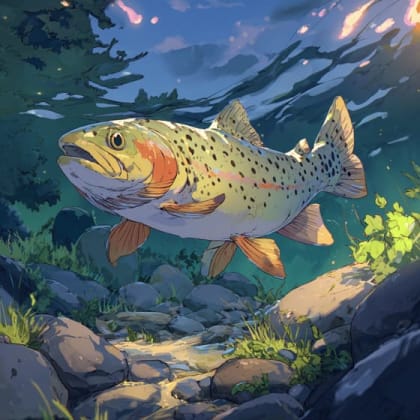
California moray
Gymnothorax mordax
The California moray is a long, snake-like fish that lives in the ocean. It has a smooth, slimy body and hides in rocks and coral, making it a sneaky swimmer!
Habitat: Coastal areas
The California moray has a long, snake-like body, typically brown to olive-green, often with mottled or spotted patterns that help it camouflage. It lacks pectoral and pelvic fins, making it look smoother than most fish, and has a large mouth filled with sharp, needle-like teeth.
Category
FishRarity
Common
Danger
3/5 · Moderate
Snaps
Be the first to snap!
A moray can go months without eating a single meal if food is scarce!
Morays often share their reef homes with tiny cleaner shrimp!
They have super-flexible spines that let them tie themselves in knots!
Unlike most fish, morays don't have scales; their skin is smooth!
California moray has a second set of pharyngeal jaws that extends forward to grab and pull prey deep into its throat.
California moray can use its excellent sense of smell to find prey in dark crevices or murky water.
California moray has a thick, protective mucus layer that helps it slide into tight spots and keeps parasites away.
They are sneaky hunters who feast on other fish, crabs, and shrimp hiding in the reefs.
Paralabrax clathratus
Preys on these fish in kelp beds.
Cancer antennarius
Hunts crabs hiding in reef crevices.
Lysmata californica
Shrimp clean parasites from moray's skin.
Solitary animals live alone for most of their lives, only interacting with others for mating or parental care.
Camouflaged describes organisms that possess coloring or patterns that allow them to blend into their environment.
Piscivorous organisms are animals that primarily subsist on a diet of fish.
An ambush predator hunts by patiently waiting and concealing itself, then launching a sudden attack when unsuspecting prey comes within range.

Coastal habitats are dynamic environments located along the interface between land and sea, influenced by tides, waves, and saltwater.

This trait identifies organisms whose diet consists entirely or primarily of animal tissue.

Marine habitats encompass all saltwater environments of the Earth's oceans, supporting an immense diversity of aquatic life.
No aliases listed yet.
Danger
3/5 · Moderate
Never touch or disturb morays if you see them while swimming; they can be shy and may bite if scared.
The easiest way to identify California moray is to use the Snappit nature identifier app.
50-150 cm
2-6 kg
10-20 years
They are sneaky hunters who feast on other fish, crabs, and shrimp hiding in the reefs.
8 km/h
Coastal areas
Ambush
Zoom in to split clusters and explore where this object has been snapped.
Recent snaps will appear here as new observations are added.
Take the discovery with you
Snap it with Snappit to identify it, learn what makes it special, and add the discovery to your collection.