

California Seahare
aplysia californica
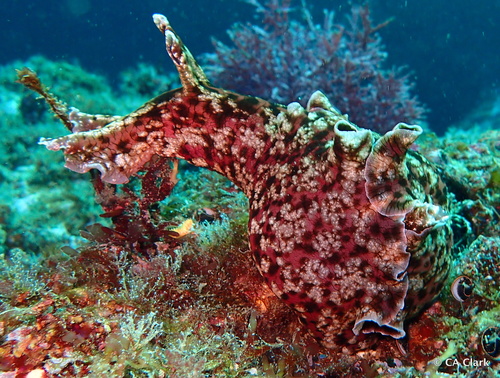
The California Seahare (Aplysia californica) is a fascinating marine gastropod mollusk native to the shallow coastal waters of the eastern Pacific Ocean. Resembling a large, shell-less snail, this soft-bodied giant is famous for its peaceful grazing habits and its remarkable role in scientific history. It is highly valued by researchers because it possesses an exceptionally simple nervous system with large, easily identifiable neurons, which provided the key insights that led to a Nobel Prize in medicine for understanding learning and memory. In their natural tide pool habitats, these gentle creatures slowly glide over rocks, playing a crucial ecological role by consuming massive quantities of algae and recycling nutrients back into coastal marine ecosystems.
Habitat: Found in shallow coastal waters, rocky tide pools, estuaries, and kelp forests along the eastern Pacific coastline.
This large, slug-like mollusk typically ranges from reddish-brown to greenish-amber or deep purple, often covered in dark lines and mottled spots that match the seaweeds they consume. They have a plump, heavy body with a pair of large, wing-like parapodia on their back used for covering their gills, and two prominent, ear-like tentacles called rhinophores on their head that resemble the ears of a hare.
Category
InvertebrateRarity
Common
Danger
1/5 · Very low
Snaps
1
Their ink contains a chemical called aplysioviolin, which sensory-disrupts predators like lobsters, temporarily blinding and confusing them.
They are simultaneous hermaphrodites, possessing both male and female reproductive systems, and can form mating chains of multiple individuals.
They helped win a Nobel Prize in Physiology or Medicine in 2000, as Eric Kandel used their giant neurons to study how memories are stored.
Releases a dark purple or reddish ink cloud when threatened to block the scent and sight of predators.
Absorbs pigments from the specific marine algae it eats to closely match its body coloration to its food source.
Possesses exceptionally large nerve cells that can be seen with the naked eye, facilitating unique cellular communication adaptations.
A dedicated grazer that feeds almost exclusively on marine seaweeds and algae, especially red algae which provides its unique coloration.
Age differences: Juveniles feed exclusively on delicate red algae like Plocamium, while larger adults can consume tougher kelp and brown seaweeds.
Plocamium pacificum
Primary juvenile food source and camouflage provider
Navanax inermis
Predator of juvenile seahares in shallow waters
Loxorhynchus grandis
Large crustacean predator that feeds on adult seahares
No trait badges are assigned for this object yet.
No aliases listed yet.
Collections for this object will appear here as more themes are added.
Danger
1/5 · Very low
No special safety notes yet.
The easiest way to identify California Seahare is to use the Snappit nature identifier app.
20-75 cm
0.5-7 kg
1 years
A dedicated grazer that feeds almost exclusively on marine seaweeds and algae, especially red algae which provides its unique coloration.
Found in shallow coastal waters, rocky tide pools, estuaries, and kelp forests along the eastern Pacific coastline.
Grazing
1000000-80000000
Zoom in to split clusters and explore where this object has been snapped.

California, US
You might spot Sunburst Anemone, Western Gull, and Giant Coreopsis.
View guide →

California, US
You might spot Sunburst Anemone and Striped Shore Crab.
View guide →

California, US
You might spot Sunburst Anemone and Striped Shore Crab.
View guide →
Take the discovery with you
Snap it with Snappit to identify it, learn what makes it special, and add the discovery to your collection.