

Canary Islands Polypody
polypodium macaronesicum
The Canary Islands Polypody is an enchanting evergreen fern native to the misty Macaronesian archipelagos, including the Canary Islands, Madeira, and the Azores. It often thrives as an epiphyte, draping itself gracefully over the moss-covered branches of ancient laurel forest trees, or as a lithophyte, anchoring into damp, rocky volcanic crevices. This resilient fern plays a crucial role in its humid, cloud-kissed ecosystem, capturing atmospheric moisture and providing shelter for small invertebrates. Highly admired for its lush, feather-like fronds, it is a quintessential representative of the ancient Laurisilva forests, bringing a prehistoric, vibrant green charm to the damp woodlands it calls home.
Habitat: Typically found in highly humid, shaded environments such as Macaronesian laurel forests, often growing on mossy tree trunks, rock faces, and steep ravines.
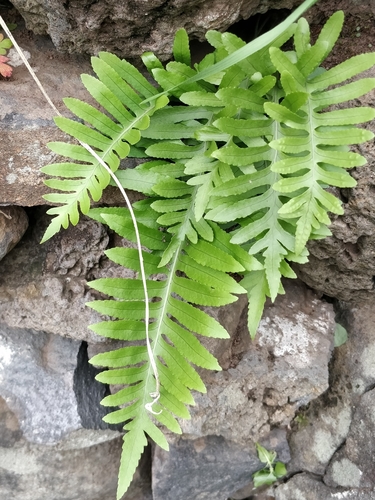
This fern features deeply pinnatisect, lance-shaped fronds that range from 10 to 50 centimeters in length, showcasing a vibrant, bright green coloration. The individual segments or pinnae are alternating, narrow, and have slightly wavy margins. On the undersides of fertile fronds, one can find two neat rows of conspicuous, circular, bright orange-to-golden spore-producing sori that lack a protective membrane. The fronds emerge from a creeping, fleshy rhizome that is heavily covered with reddish-brown, paper-like scales.
Category
PlantsRarity
Common
Danger
1/5 · Very low
Snaps
Be the first to snap!
In times of severe dry spells, this resilient fern can dry out significantly and curl its fronds, only to quickly revive and uncurl once rain or heavy mist returns.
The species name 'macaronesicum' is a nod to Macaronesia, the group of volcanic North Atlantic archipelagos where this fern primarily thrives.
Unlike many other fern species, its sori (spore clusters) completely lack an indusium, a protective membrane, leaving the golden spores exposed to the wind.
Utilizes a creeping, scaly rhizome to securely clasp tree trunks and damp rocks, allowing it to grow high above the forest floor.
Adapted to humid cloud forests, it is capable of absorbing moisture directly from the heavy mist and fog that regularly blankets its habitat.
During dry spells, the fronds curl upward to reduce surface area and limit water loss, rapidly reviving once moisture returns.
As a photosynthetic plant, it generates its own energy from sunlight, water, and carbon dioxide, while absorbing essential minerals through its root-like rhizoids.
Laurus novocanariensis
The fern frequently grows epiphytically on the mossy bark of this dominant canopy tree in Macaronesian cloud forests.
Davallia canariensis
Competes with the Canary Islands Polypody for epiphytic space and moisture on mossy tree branches.
No trait badges are assigned for this object yet.
No aliases listed yet.
Collections for this object will appear here as more themes are added.
Danger
1/5 · Very low
No special safety notes yet.
Compare frond shape, how the leaflets are arranged, the stalk, and any spore clusters you can see. A single detached leaflet often hides the plant's overall growth pattern. Fern Identifier: upload a photo and compare the visible details.
10-50 cm
5-20 years
As a photosynthetic plant, it generates its own energy from sunlight, water, and carbon dioxide, while absorbing essential minerals through its root-like rhizoids.
Typically found in highly humid, shaded environments such as Macaronesian laurel forests, often growing on mossy tree trunks, rock faces, and steep ravines.
Zoom in to split clusters and explore where this object has been snapped.
Recent snaps will appear here as new observations are added.
Take the discovery with you
Snap it with Snappit to identify it, learn what makes it special, and add the discovery to your collection.