

Cannonball Jelly
stomolophus meleagris
The Cannonball Jelly, scientifically known as Stomolophus meleagris, is a remarkably abundant and distinctive jellyfish found primarily along the coasts of the western Atlantic Ocean and the Gulf of Mexico. True to its common name, this fascinating marine invertebrate boasts a firm, dome-shaped bell that closely resembles a cannonball. Unlike many of its infamous relatives, the cannonball jelly lacks the long, trailing, venomous tentacles that typical beachgoers fear. Instead, it relies on a dense cluster of short oral arms to filter feed on microscopic plankton and small pelagic eggs. Extremely common in coastal estuaries and nearshore waters, these jellies often travel in massive aggregations, sometimes washing ashore in impressive numbers during the fall. Beyond their ecological role as a vital food source for endangered sea turtles, cannonball jellies have gained significant economic importance. They are frequently harvested in the wild and exported for human consumption, considered a crunchy, nutrient-dense delicacy in various Asian cuisines.
Habitat: Found in warm coastal waters and estuaries, often drifting near the surface in large swarms.
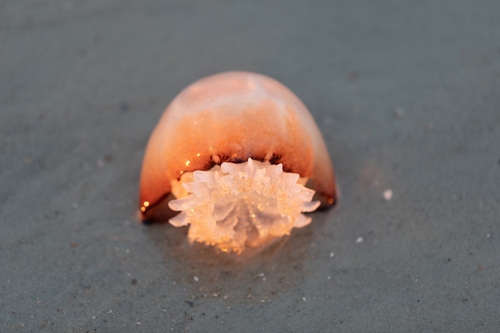
The Cannonball Jelly is easily recognizable by its firm, highly convex bell, which typically measures between 12 and 25 centimeters in diameter. The bell is mostly translucent to milky-white and is distinctly marked by a dark brown or purplish-red band running along its lower margin. Rather than possessing long, thread-like tentacles, it features a chunky, gristle-like cluster of oral arms directly underneath its dome. Because of its unusually sturdy, rigid structure, it holds its spherical shape much better than most jellyfish when washed ashore on beaches.
Category
AnimalRarity
Common
Danger
1/5 · Very low
Snaps
Be the first to snap!
Because they are relatively dense and heavy for jellyfish, they must pulse continuously; if they stop swimming, they will sink to the ocean floor.
Cannonball jellies are commercially harvested and exported to Asia, where they are dried, salted, and eaten as a crunchy, protein-rich delicacy.
Unlike most jellyfish, their sting is incredibly mild to humans, typically causing no more than a minor, brief itch if it is felt at all.
When threatened, they secrete a sticky, toxic mucus into the water that can cause severe respiratory distress in fish that swim too close.
Instead of stinging with long tentacles, they secrete a toxin-laced mucus when disturbed, which deters predators and stuns small prey.
They are remarkably strong and active swimmers compared to other scyphozoans, using powerful, rhythmic muscular contractions of their bell to propel themselves continuously.
Their bells often serve as living, floating sanctuaries for juvenile longnose spider crabs, which safely ride inside the jelly for protection and food scraps.
The Cannonball Jelly filter-feeds on tiny pelagic organisms suspended in the water column using secondary mouth openings on its oral arms.
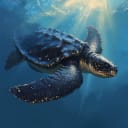
Dermochelys coriacea
Primary prey providing crucial sustenance for endangered marine reptiles.
Libinia dubia
Provides a floating sanctuary and food source for juvenile crabs.
Sciaenops ocellatus
Frequently preys on the drifting, pelagic eggs of coastal fish.
No trait badges are assigned for this object yet.
No aliases listed yet.
Collections for this object will appear here as more themes are added.
Danger
1/5 · Very low
No special safety notes yet.
Look for fins, arms, tentacles, shells and body symmetry. Underwater light shifts colors, so structure and markings usually matter more than shade. Sea Creature Identifier: upload a photo and compare the visible details.
12-25 cm
0.2-2 kg
0-1 years
The Cannonball Jelly filter-feeds on tiny pelagic organisms suspended in the water column using secondary mouth openings on its oral arms.
Found in warm coastal waters and estuaries, often drifting near the surface in large swarms.
Filtering
Zoom in to split clusters and explore where this object has been snapped.
Recent snaps will appear here as new observations are added.

North Carolina, US
You might spot Firewheel, Domestic Horse, and Atlantic Horseshoe Crab.
View guide →

Georgia, US
You might spot American Alligator, Laughing Gull, and Cannonball Jelly.
View guide →

Florida, US
You might spot Laughing Gull, Royal Tern, and Brown Pelican.
View guide →

US
You might spot Brown Pelican, Laughing Gull, and Cannonball Jelly.
View guide →

South Carolina, US
You might spot Blood Ark, Anole, and Willet.
View guide →

US
You might spot Brown Pelican, Cannonball Jelly, and Laughing Gull.
View guide →
Take the discovery with you
Snap it with Snappit to identify it, learn what makes it special, and add the discovery to your collection.