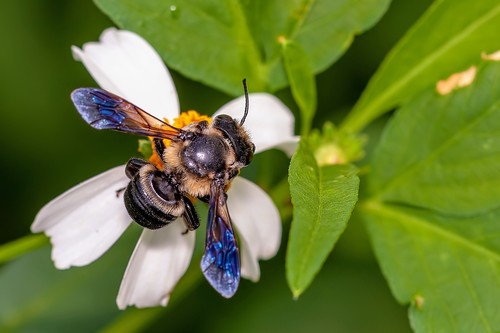


Carpenter-Mimic Leafcutter Bee
megachile xylocopoides
The Carpenter-Mimic Leafcutter Bee (Megachile xylocopoides) is a fascinating native pollinator primarily found in the southeastern United States. True to its name, this robust bee is a master of mimicry, closely resembling the larger and more intimidating eastern carpenter bee. Despite its formidable appearance, it is a non-aggressive, highly industrious insect. Female bees are famous for their unique nesting habits, using their sharp mandibles like scissors to cut precise, neat circles from leaves and flower petals. They use these leaf fragments to construct protective, thimble-shaped cells for their offspring in pre-existing cavities in wood or hollow stems. As crucial pollinators of wildflowers and agricultural crops, these bees play a vital role in maintaining the health and diversity of their native ecosystems.
Habitat: Typically found in coastal dunes, pine savannas, deciduous woodlands, gardens, and meadows where nesting sites and flowering plants are abundant.
This species is large and robust, measuring about 1 to 2 centimeters in length. It features a strikingly dark, near-entirely black body covered with coarse black hairs, mimicking the appearance of large carpenter bees. The wings are a distinct smokey-dark or dark violet-blue color, which shimmers slightly in direct sunlight. Females possess specialized pollen-carrying hairs (scopa) on the underside of their abdomen rather than on their hind legs, which is a key identifying feature. Males can be distinguished by lighter, pale yellow hair on their face and front legs.
Category
InsectsRarity
Common
Danger
1/5 · Very low
Snaps
Be the first to snap!
The perfect circular cuts they make in leaves do not harm the plants, as the bees only take small portions to line their nursery cells.
These bees do not live in hives; they are solitary insects where every female is a queen who builds her own nest.
Unlike honeybees, which carry pollen on their legs, leafcutter bees carry pollen on the underside of their abdomen, making them incredibly messy and highly effective pollinators.
Uses sharp, specialized mandibles to clip precise circular or oval portions from leaves and petals to construct nests.
Mimics the size and dark coloration of aggressive carpenter bees to deter potential predators.
Collects pollen on specialized abdominal hairs instead of hind legs, making pollen transport highly efficient.
Adults feed on nectar for energy and gather both nectar and pollen to feed their developing larvae.
Baptisia tinctoria
Provides essential pollination services while gathering nectar and pollen.

Xylocopa virginica
Competes for nectar resources and serves as the visual model for this bee's mimicry defense.
Coelioxys octodentata
Lays its eggs in the nests of the leafcutter bee, where its larvae consume the host's food provisions.
No trait badges are assigned for this object yet.
No aliases listed yet.
Collections for this object will appear here as more themes are added.
Danger
1/5 · Very low
No special safety notes yet.
Compare the antennae, wings, waist, body hair and legs. Yellow and black stripes show up on bees, wasps and harmless mimics alike. Bee & Wasp Identifier: upload a photo and compare the visible details.
1+ cm
2+ cm
0.0001+ kg
1+ years
15 km/h
Adults feed on nectar for energy and gather both nectar and pollen to feed their developing larvae.
Typically found in coastal dunes, pine savannas, deciduous woodlands, gardens, and meadows where nesting sites and flowering plants are abundant.
Zoom in to split clusters and explore where this object has been snapped.
Recent snaps will appear here as new observations are added.
Take the discovery with you
Snap it with Snappit to identify it, learn what makes it special, and add the discovery to your collection.