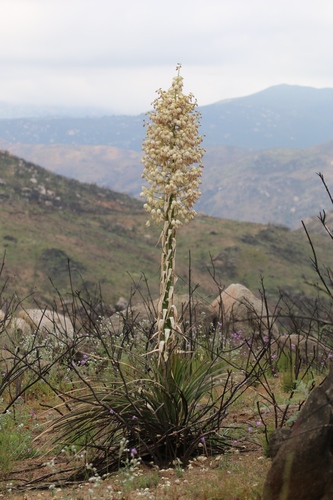


Chaparral Yucca
hesperoyucca whipplei
The Chaparral Yucca, also known as Our Lord's Candle, is a striking and iconic plant native to the chaparral and coastal sage scrub of Southern California and Baja California. Spending most of its life as an unassuming rosette of dagger-like leaves, it transforms dramatically when it is ready to reproduce. After gathering energy for several years, it shoots up a massive, towering flower stalk adorned with hundreds of creamy-white blooms. This spectacular display is a singular event, as the plant is monocarpic, meaning it dies completely after this single reproductive effort. Beyond its visual splendor, the Chaparral Yucca is an ecological linchpin, famous for its obligate mutualism with a specific species of yucca moth that is solely responsible for its pollination.
Habitat: Found on dry, rocky slopes, typically among the dense shrubs of chaparral and coastal sage scrub.
This plant typically forms a dense basal rosette composed of rigid, sword-shaped, gray-green leaves measuring 20 to 90 centimeters in length, each ending in a needle-sharp point. When blooming, it produces a thick, fleshy central stalk that can rocket to heights of up to 4 meters. The top half of this stalk develops into a massive, densely packed panicle of nodding, bell-shaped flowers. These blossoms are primarily creamy-white, often tinged with striking purplish or reddish tips, and give way to dark, woody seed capsules that split open once mature.
Category
PlantsRarity
Common
Danger
1/5 · Very low
Snaps
2
Also known as 'Our Lord's Candle', its massive flower stalk grows incredibly fast, sometimes rocketing up to 14 inches in a single day.
Indigenous peoples of California traditionally roasted the young flower stalks in earth ovens, yielding a sweet food similar in taste to molasses or sweet asparagus.
It is a monocarpic plant, meaning it spends years gathering energy to produce one spectacular bloom, after which the main plant dies completely.
The plant has an obligate mutualistic relationship with the California yucca moth, which is the only insect on Earth capable of pollinating its flowers.
Relies entirely on the California yucca moth for pollination, while providing the moth larvae with a safe place to develop.
Stores energy for years to produce a single massive inflorescence, dying immediately after its seeds mature.
Features tough, fibrous leaves with thick waxy coatings that drastically reduce water loss in its arid chaparral environment.
As a photosynthetic plant, it produces its own energy using sunlight, water, and atmospheric carbon dioxide.
Tegeticula maculata
The only insect capable of pollinating the plant's flowers, laying its eggs inside the ovary.
Neotoma macrotis
Eats the seeds and sometimes uses the sharp leaves for nest protection.
_(40059471280).jpg&width=800)
Callipepla californica
Forages for fallen seeds beneath the mature plant.
No trait badges are assigned for this object yet.
No aliases listed yet.
Collections for this object will appear here as more themes are added.
Danger
1/5 · Very low
No special safety notes yet.
The easiest way to identify Chaparral Yucca is to use the Snappit nature identifier app.
100-400 cm
5-15 years
As a photosynthetic plant, it produces its own energy using sunlight, water, and atmospheric carbon dioxide.
Found on dry, rocky slopes, typically among the dense shrubs of chaparral and coastal sage scrub.
Zoom in to split clusters and explore where this object has been snapped.

California, US
You might spot Sequoia, California Newt, and Pacific Dogwood.
View guide →

California, US
You might spot Western Fence Lizard and California Brittlebush.
View guide →

California, US
You might spot Western Fence Lizard, Duck, and California Brittlebush.
View guide →

California, US
You might spot Chaparral Yucca and Grinnell's Beardtongue.
View guide →

California, US
You might spot Western Fence Lizard and California Buckwheat.
View guide →

California, US
You might spot California Buckwheat, Chaparral Yucca, and White Sage.
View guide →
Take the discovery with you
Snap it with Snappit to identify it, learn what makes it special, and add the discovery to your collection.












.jpg&width=800)



_001.jpg&width=800)




