





common columbine
Aquilegia vulgaris
The common columbine is a beautiful flower with unique, spiky petals that look like little bells. It often blooms in gardens and can attract butterflies and hummingbirds with its bright colors.
Habitat: Gardens
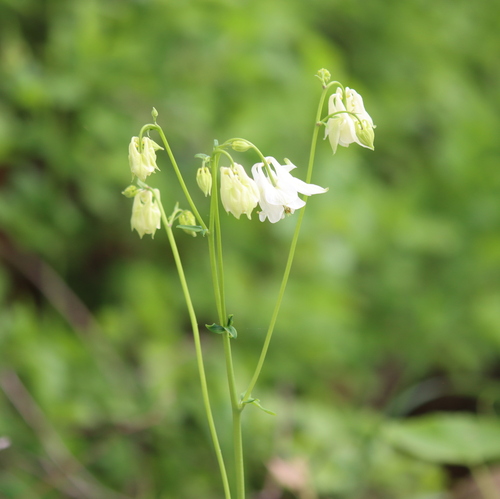
The common columbine has striking, intricate bell-shaped flowers with five distinctive backward-pointing spurs. Its blossoms, often purple, blue, pink, or white, hang elegantly, contrasting with its lobed, blue-green foliage.
Category
PlantsRarity
Common
Danger
1/5 · Very low
Snaps
14
Ancient people believed smelling columbine flowers could make you courageous.
Columbine seeds can stay alive in the soil for decades, waiting to sprout!
Its intricate flower shape makes it look like a tiny crown or jester's hat!
Some wild columbines can grow in cracks of rocks on steep mountain cliffs!
Common columbine has long spurs holding nectar, guiding long-tongued insects and hummingbirds to pollinate effectively.
Its unique bell-shaped petals funnel pollinators deep inside, ensuring efficient pollen transfer for successful reproduction.
Dry seed pods split open at the top, allowing seeds to be shaken out and dispersed by wind or passing animals.
Bombus terrestris
Collects nectar and pollen

Archilochus colubris
Feeds on nectar from spurs
Pristiphora aquilegiae
Larvae feed on leaves
Phytomyza aquilegiae
Larvae tunnel within leaves
Bell-shaped flowers possess petals fused or arranged to form a cup-like or campanulate structure resembling a bell.
Flowering plants are any plants that produce flowers as part of their reproductive cycle.
Biennial plants complete their life cycle over two growing seasons, typically forming foliage in the first year and flowering/seeding in the second.
Spring blooming plants produce their flowers during the spring season, often signifying the end of winter and the start of new growth.

Fragrant flowers emit a pleasant aroma, often to attract pollinators or for defense.

Colorful describes organisms or objects displaying a wide range of bright and distinct colors.

Describes plants that are particularly attractive and beneficial to a wide range of pollinating organisms.

Possessing sharp, pointed projections or spines on the body or surface.

This habitat trait indicates species that can coexist with humans in urban and suburban environments, utilizing man-made structures and green spaces.
No aliases listed yet.
Danger
1/5 · Very low
Always look but don't touch flowers without asking an adult, as some can be delicate.
The easiest way to identify common columbine is to use the Snappit nature identifier app.
60-90 cm
30-45 cm
3-5 cm
Late spring to early summer
No
Mild
Perennial
Zoom in to split clusters and explore where this object has been snapped.
May 27, 2026
Pittsfield Center Historic DistrictPhoto attribution
(c) Steven Lamonde, some rights reserved (CC BY)
License: CC BY 4.0 ↗
Image may be shown cropped inside the card frame.

Pennsylvania, US
You might spot Mountain Laurel, Ghost Pipe, and Sweetfern.
View guide →

Pennsylvania, US
You might spot Pinesap, Great Rhododendron, and Mountain Laurel.
View guide →

Vermont, US
You might spot Eastern White Pine, Staghorn Sumac, and Box Elder.
View guide →

New York, US
You might spot Common Mugwort, Lesser Celandine, and White Snakeroot.
View guide →
Pennsylvania, US
You might spot American Alligator, Black Bear, and Canada Lynx.
View guide →

Massachusetts, US
You might spot African Lion, Panthera Pardus Orientalis, and Sloth Bear.
View guide →
Take the discovery with you
Snap it with Snappit to identify it, learn what makes it special, and add the discovery to your collection.








.jpg&width=800)


_001.jpg&width=800)




