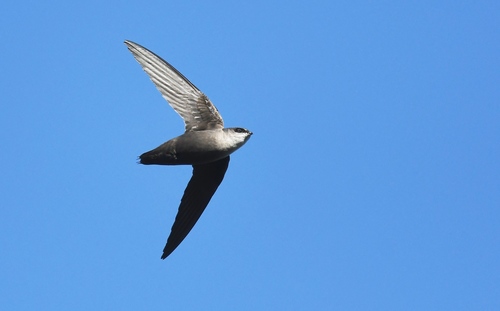


Chimney Swift
chaetura pelagica
The Chimney Swift is a remarkable aerial acrobat, easily identified by its distinctive cigar-shaped body and rapid, twinkling wingbeats. Often referred to as a "flying cigar," this small, soot-colored bird spends almost its entire active life on the wing, landing only to nest or roost. They are famous for their unique affinity for human-made structures, especially brick chimneys, which they have adopted as substitutes for hollow trees. During the breeding season, they form monogamous pairs that build half-saucer nests made of twigs glued together with their own sticky saliva. In late summer, before embarking on their long migration to South America, Chimney Swifts gather in spectacular communal roosts. Watching thousands of swifts swirl in a massive funnel cloud before diving in unison down a single chimney at dusk is one of urban nature's most breathtaking spectacles.
Habitat: Historically nesting in hollow trees, they are now found predominantly in urban and suburban areas, nesting inside brick chimneys, air shafts, and abandoned buildings.
The Chimney Swift is characterized by a compact, cylindrical, cigar-shaped body with no visible neck, a short, squared-off tail, and extremely long, narrow, curved wings. It has a uniform, dark soot-brown to grayish plumage, which is slightly paler on the throat. Adults range from 12 to 15 cm in length with a wingspan of 27 to 30 cm. In flight, their silhouettes are unmistakable as they perform jerky, rapid wingbeats interspersed with short glides, making them look like a cross between a swallow and a tiny, dark boomerang.
Category
BirdsRarity
Common
Danger
1/5 · Very low
Snaps
3
A single Chimney Swift can consume up to 12,000 insects, including pest mosquitoes, every single day.
Because of their unique leg structure, Chimney Swifts are physically unable to perch on branches or walk on flat ground; they can only cling to vertical surfaces.
During the breeding season, 'helpers'—often unmated young from previous years—frequently assist the breeding pair with incubating eggs and feeding the nestlings.
To collect nesting materials, they fly at small, dead tree branches, grabbing a twig with their feet and snapping it off mid-flight.
Chimney Swifts are highly adapted for life in the air, feeding, drinking, and even bathing on the wing, rarely touching the ground.
They possess specialized salivary glands that produce a sticky, cement-like saliva used to glue twigs together and attach their nests to vertical brick walls.
Due to unique skeletal adaptations and pamprodactyl feet, they cannot perch on branches but can cling effortlessly to vertical, rough surfaces.
They are strict aerial insectivores that feed continuously while flying, scooping up a wide variety of flying insects from the air column.

Accipiter cooperii
Common predator of adult swifts, capturing them in mid-air flights.
Culex pipiens
A primary food source captured on the wing during summer.

Procyon lotor
An opportunistic nest predator that climbs chimneys to eat eggs and nestlings.
No trait badges are assigned for this object yet.
No aliases listed yet.
Collections for this object will appear here as more themes are added.
Danger
1/5 · Very low
No special safety notes yet.
Compare the silhouette, bill shape, tail length, wing bars and markings around the eyes. The same small brown bird at your feeder can look quite different in breeding plumage, winter plumage or its first year. Bird Identifier: upload a photo and compare the visible details.
They are strict aerial insectivores that feed continuously while flying, scooping up a wide variety of flying insects from the air column.
Historically nesting in hollow trees, they are now found predominantly in urban and suburban areas, nesting inside brick chimneys, air shafts, and abandoned buildings.
Pursuit201c1097e370a597a7e8e52eef9e7ebcf0438cf56fbfbd9f783226dbb4a8e2cb9ad8c3a1b3be05322894595861b5895781a54b39b5b9e59d995968595cb68a73a62886c52a9
3+
Zoom in to split clusters and explore where this object has been snapped.

New York, US
You might spot Monarch and Common Eastern Bumble Bee.
View guide →

New Jersey, US
You might spot White-Tailed Deer, American Robin, and Spotted Lanternfly.
View guide →

Illinois, US
You might spot Polar Bear, Grizzly Bear, and African Lion.
View guide →

Illinois, US
You might spot Henbit Deadnettle, Metric Paper Wasp, and Dryad's Saddle.
View guide →
Take the discovery with you
Snap it with Snappit to identify it, learn what makes it special, and add the discovery to your collection.