

Choughs
pyrrhocorax
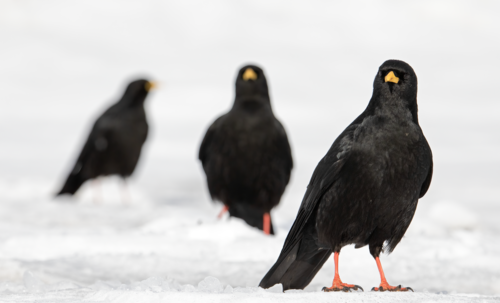
Choughs are highly charismatic, acrobatic corvids belonging to the genus Pyrrhocorax. Comprising two distinct species—the Red-billed Chough and the Alpine Chough—these birds are celebrated for their incredible aerial displays, frequently seen swooping, diving, and performing effortless barrel rolls along windy mountain cliffs and rugged coastal shores. With their glossy black plumage, vibrant bills, and bright red legs, choughs stand out beautifully against their rugged rocky environments. Unlike many of their more opportunistic crow cousins, choughs have highly specialized feeding habits, relying on short-grazed pastures and alpine meadows to find soil-dwelling insects. They are deeply social birds, often seen in pairs or noisy flocks, communicating with clear, ringing calls that echo through deep valleys.
Habitat: Typically found on rugged coastal cliffs, high-altitude alpine meadows, and steep mountain crags where short-cropped turf is available for foraging.
Choughs are medium-sized crows, immediately recognizable by their glossy, jet-black feathers which shimmer with a faint green or blue sheen under direct sunlight. Their most defining features are their strikingly colorful, slender, and curved bills—vibrant red in the Red-billed Chough and bright yellow in the Alpine Chough. They possess matching red legs and feet, which contrast sharply against their dark bodies. When in flight, they display broad, deeply fingered wings stretching around 70 to 90 centimeters, and a square-tipped tail, allowing them to execute high-speed, acrobatic aerial maneuvers.
Category
BirdsRarity
Common
Danger
1/5 · Very low
Snaps
Be the first to snap!
Alpine choughs have been recorded nesting at altitudes over 6,500 meters on Mount Everest, making them one of the highest-altitude nesting birds on Earth.
Choughs are highly playful; they have been observed sliding down snowbanks on their backs, playing catch with small stones, and performing aerial tag with each other.
The Cornish chough is a prominent cultural symbol in Cornwall, England, appearing on the county's coat of arms and associated with the legend of King Arthur.
Choughs utilize high mountain winds and coastal updrafts to perform complex aerial maneuvers, including spectacular dives, loops, and barrel rolls.
Their slender, downward-curved bills are perfectly adapted to probe deep into loose soil and rock crevices to pluck out hidden insects.
They possess broad, slotted wings that allow them to effortlessly catch thermal updrafts, enabling them to soar to extreme altitudes with minimal effort.
Choughs primarily feed on soil invertebrates and insect larvae, supplemented by berries, seeds, and occasional scraps in winter.
Age differences: Chicks are fed exclusively on high-protein invertebrates, whereas adults consume more plant matter, fruits, and seeds during cold winter months.

Falco peregrinus
A primary aerial predator that hunts adult and juvenile choughs along coastal and mountain cliffs.
Ovis aries
Sheep keep the grass short, which is essential for choughs to forage for subterranean invertebrates, and choughs occasionally remove ticks from the sheep.

Corvus corax
Competes with choughs for nesting sites on cliffs and food resources in overlapping territories.
No trait badges are assigned for this object yet.
Collections for this object will appear here as more themes are added.
Danger
1/5 · Very low
No special safety notes yet.
Compare the silhouette, bill shape, tail length, wing bars and markings around the eyes. The same small brown bird at your feeder can look quite different in breeding plumage, winter plumage or its first year. Bird Identifier: upload a photo and compare the visible details.
0.192+ kg
80 km/h
Choughs primarily feed on soil invertebrates and insect larvae, supplemented by berries, seeds, and occasional scraps in winter.
Typically found on rugged coastal cliffs, high-altitude alpine meadows, and steep mountain crags where short-cropped turf is available for foraging.
Foraging
Zoom in to split clusters and explore where this object has been snapped.
Recent snaps will appear here as new observations are added.
Take the discovery with you
Snap it with Snappit to identify it, learn what makes it special, and add the discovery to your collection.