

Christmas Wrasse
thalassoma trilobatum
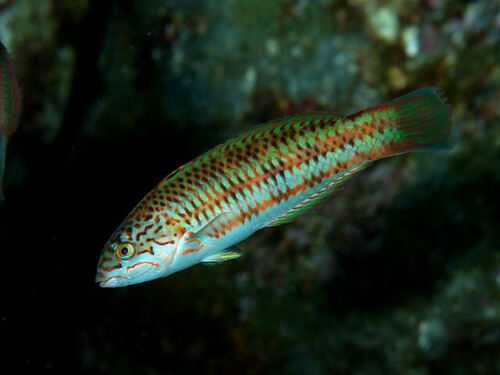
The Christmas Wrasse is a vibrant and highly active reef fish known for its stunning, festive coloration. Swimming with a distinctive rowing motion using only its pectoral fins, this energetic wrasse is a staple of Indo-Pacific shallow reefs. They are protogynous hermaphrodites, meaning they can change sex from female to male depending on social dynamics. This species plays a crucial role in maintaining reef health by feeding on a variety of small, hard-shelled invertebrates, making them fascinating to watch for snorkelers and divers alike.
Habitat: Found in shallow, surge-swept coral reefs, rocky shores, and reef flats exposed to wave action.
Terminal-phase males display a breathtaking array of colors, with reddish-orange bodies marked by two rows of green rectangular spots, a green-blue head with pink or orange facial stripes, and a bright yellow tail fin. Females and juveniles are more modestly colored, usually brownish-green with checkered patterns. They have a sleek, elongated, cigar-shaped body that typically reaches lengths between 15 to 30 centimeters.
Category
FishRarity
Common
Danger
1/5 · Very low
Snaps
Be the first to snap!
A single dominant male maintains a harem of females; if he dies, the largest female will transition to male within a few weeks.
Like many wrasses, this species burrows into the sand at night or when threatened to hide from predators.
The Christmas Wrasse gets its name from its festive red and green coloration, which resembles traditional holiday colors.
Females can transition into colorful dominant males when the social structure requires it, ensuring reproductive continuity.
Uses its pectoral fins in a unique rowing motion to maneuver swiftly through turbulent, wave-swept reef zones.
Can dive quickly into sandy patches to bury itself to escape predators or sleep safely at night.
Feeds primarily on small, hard-shelled benthic invertebrates such as crabs, mollusks, and sea urchins by crushing them with specialized pharyngeal teeth.
Age differences: Juveniles feed on smaller crustaceans and occasionally clean ectoparasites off larger fish, whereas adults target larger, hard-shelled invertebrates.
Gymnothorax javanicus
Eaten by larger reef predators when seeking shelter in reef crevices at night.
Echinometra mathaei
The Christmas Wrasse hunts and feeds on these small sea urchins, helping control their populations.
Calcinus laevimanus
The wrasse uses its strong jaws to crack open the shells of these crabs.
No trait badges are assigned for this object yet.
No aliases listed yet.
Collections for this object will appear here as more themes are added.
Danger
1/5 · Very low
No special safety notes yet.
Look at body shape, where the fins sit and their outline, mouth position, stripes and spots. Young fish and breeding adults can wear different patterns, and aquarium color varieties can look nothing like wild fish. Fish Identifier: upload a photo and compare the visible details.
15-30 cm
0.1-0.5 kg
5-10 years
15 km/h
Feeds primarily on small, hard-shelled benthic invertebrates such as crabs, mollusks, and sea urchins by crushing them with specialized pharyngeal teeth.
Found in shallow, surge-swept coral reefs, rocky shores, and reef flats exposed to wave action.
Foraging
Zoom in to split clusters and explore where this object has been snapped.
Recent snaps will appear here as new observations are added.
Take the discovery with you
Snap it with Snappit to identify it, learn what makes it special, and add the discovery to your collection.