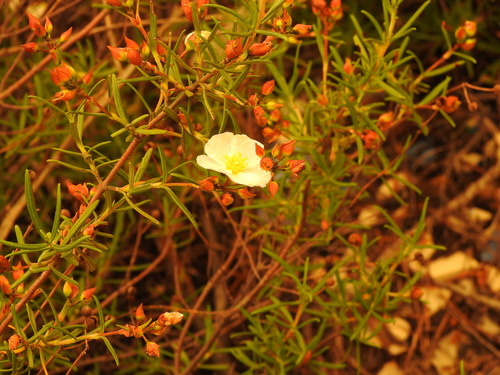


Cistus Libanotis
cistus libanotis
Cistus libanotis, commonly known as the rosemary-leaved rockrose, is a charming evergreen shrub native to the coastal sand dunes and open pine forests of the southwestern Iberian Peninsula. Belonging to the rockrose family, Cistaceae, this resilient plant is perfectly adapted to the dry, sun-drenched Mediterranean climate. During late spring, it transforms its sandy habitats into beautiful displays, bursting with delicate white blossoms that contrast wonderfully against its dark green foliage. This plant plays a vital ecological role in preventing soil erosion in fragile dune systems and providing essential nectar for local pollinator species. It is a true survivor of the Mediterranean coast, thriving where other plants struggle in nutrient-poor soils.
Habitat: Found in coastal sand dunes and sandy pine woodlands of southern Spain and Portugal.
This erect, woody shrub typically grows up to 1.5 meters tall. It is characterized by narrow, linear leaves that resemble rosemary needles, with edges that roll inward and a sticky, resinous texture. In spring, it produces small clusters of flowers measuring about 2 to 3 centimeters across. Each flower features five snowy-white petals with a dense, bright yellow cluster of stamens at the center, creating a striking contrast against the dark, needle-like foliage.
Category
PlantsRarity
Common
Danger
1/5 · Very low
Snaps
Be the first to snap!
Despite having delicate flowers, the plant is extremely tough and can survive in poor, acidic soils where other Mediterranean plants fail.
Its beautiful white petals are incredibly delicate and typically last for only a single day, dropping off by the late afternoon.
Like many rockroses, this species produces a aromatic sticky resin that was historically collected using goats, whose beards would get coated in it while grazing.
The seeds have a tough protective outer coat that is broken down by the high temperatures of wildfires, enabling them to sprout rapidly in post-fire landscapes.
Its leaves secrete a sticky, aromatic resin that creates a protective barrier, preventing water loss through transpiration during hot summer months.
The narrow leaves are curled downward at the edges, which shelters the stomata from drying winds and reduces evaporation.
As a photoautotroph, this plant generates its own energy from sunlight, water, and carbon dioxide through the process of photosynthesis.
Apis mellifera
Provides nectar and pollen, receiving pollination services in return.

Oryctolagus cuniculus
Uses the dense shrubbery for protective shelter and occasionally feeds on young green shoots.
No trait badges are assigned for this object yet.
No aliases listed yet.
Collections for this object will appear here as more themes are added.
Danger
1/5 · Very low
No special safety notes yet.
Start with the whole plant, then compare leaf arrangement, leaf edges, stems and any flowers or fruit. Opposite leaves grow in pairs; alternate leaves come one at a time along the stem. These details tell you far more together than a single green leaf does. Plant Identifier: upload a photo and compare the visible details.
50-150 cm
10-25 years
As a photoautotroph, this plant generates its own energy from sunlight, water, and carbon dioxide through the process of photosynthesis.
Found in coastal sand dunes and sandy pine woodlands of southern Spain and Portugal.
Zoom in to split clusters and explore where this object has been snapped.
Recent snaps will appear here as new observations are added.
Take the discovery with you
Snap it with Snappit to identify it, learn what makes it special, and add the discovery to your collection.